







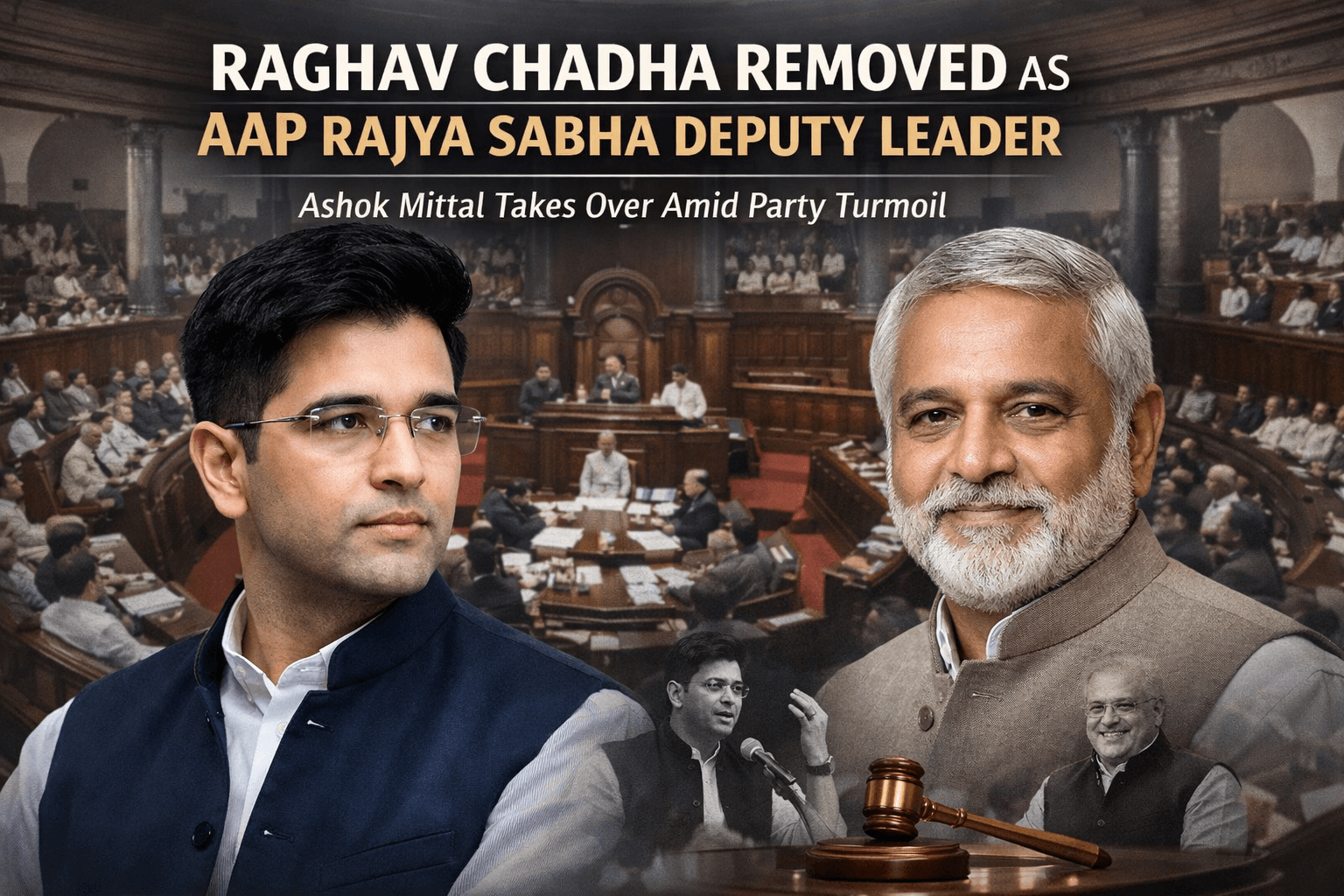
Raghav Chadha Removed as AAP Rajya Sabha Deputy Leader as Ashok Mittal Takes Over Amid Fresh Political Speculation
In a major political development, the Aam Aadmi Party (AAP) has removed Raghav Chadha from the post of deputy leader in the Rajya Sabha and proposed Ashok Mittal as his replacement. Multiple reports said AAP formally wrote to the Rajya Sabha Secretariat on April 2, 2026, and the change was then reflected in parliamentary records and widely reported by Indian media.
The same round of reports also said the party asked that Chadha should not be allotted speaking time from AAP’s quota in the House. That distinction matters. It is more accurate to say AAP sought to stop him from being assigned floor time through the party’s internal allocation, not that Chadha was permanently barred from speaking in Parliament under all circumstances.
This story gained even more traction because it unfolded alongside strong social-media chatter. The Instagram post linked in your prompt appears to be one of the viral posts amplifying the news of Chadha’s removal, while Chadha’s own more substantive public reaction came later through a video message posted on X, where he said he had been “silenced, not defeated.”
What Is Confirmed So Far
The core confirmed facts are straightforward. AAP moved to replace Raghav Chadha as its deputy leader in the Rajya Sabha. Ashok Mittal, a Rajya Sabha MP from Punjab and founder of Lovely Professional University, was named as the new deputy leader. Sanjay Singh remained the party’s leader in the Rajya Sabha, according to reporting on the reshuffle.
It is also confirmed that this was not a small technical correction. The move affected Chadha’s formal parliamentary role and became significant because he had been one of AAP’s most visible national faces in Parliament and in television debates over the last several years. Reports also noted that AAP currently has a 10-member presence in the Rajya Sabha, making internal role allocation politically meaningful.
What Is Not Confirmed
What remains unconfirmed is the exact reason why AAP removed him. Several reports mention speculation about internal differences, Chadha’s relative absence from certain recent party moments, and his silence on some high-profile issues involving Arvind Kejriwal and Manish Sisodia. But these are still reported as sources-based interpretations, not as an official explanation issued by AAP.
That means any article claiming with certainty that Chadha was removed because of a direct rebellion, a fixed internal split, or a final break with the leadership would go beyond what is publicly verified right now. The more accurate phrasing is that the reshuffle has triggered speculation about internal equations within AAP, but the party has not publicly laid out a formal reason.
Ashok Mittal’s Appointment and the Party Line
Ashok Mittal’s appointment is politically notable because he is not as media-visible as Chadha, yet he now occupies a key coordination role in the Upper House. Some coverage described the move as a possible shift in AAP’s parliamentary strategy, with Mittal taking over a more controlled organizational role.
At the same time, Mittal was also quoted in follow-up reporting as downplaying the controversy. According to reports, he described the change as a “routine party process” and said there were “no specific reasons” behind it. He also reportedly pushed back against the interpretation that Chadha would never get speaking opportunities again, saying party members get opportunities in a democratic process. That does not erase the significance of the party’s letter, but it does show that AAP’s public line is more measured than the rumor cycle around the story.
Raghav Chadha’s Response: From Silence to Public Challenge
After the reshuffle, Chadha’s first strong public response came through a video message on X, not through the Instagram post linked in your message. In that video, he asked whether raising public-interest issues in Parliament had become a crime and said he had been “silenced, not defeated.” NDTV’s report quotes him asking whether he had “done something wrong” by repeatedly bringing ordinary people’s issues before Parliament.
This response matters politically because it framed the episode not as a procedural change but as a democratic issue. Chadha positioned himself as someone being punished for speaking on behalf of the “aam aadmi.” Whether that framing is fully accepted or not, it instantly turned a parliamentary reshuffle into a public narrative battle.
Why Chadha’s Public Image Makes This Bigger
This reshuffle would have been important in any case, but it became bigger because of who Raghav Chadha is inside AAP’s political story. He has long been seen as one of the party’s youthful, articulate, urban-facing leaders. He rose quickly within AAP, handled spokesperson duties, won the Rajendra Nagar Assembly seat in Delhi, and later entered the Rajya Sabha from Punjab.
Recent reporting also highlighted that even before this change, Chadha had been active on several public-interest themes, including menstrual hygiene, gig workers’ rights, paternity leave, consumer concerns, and the issue of “sarpanch pati” in local governance. That gave his response extra resonance: he was able to argue that he had been consistently raising citizen-focused issues rather than retreating from political engagement.
Parliamentary Procedure vs Political Messaging
One of the biggest points needing correction from earlier draft-style reports is the difference between formal House rights and party-controlled speaking allocation. Reports suggest the immediate procedural issue was that Chadha was not being allotted time from AAP’s quota, and one report said the Rajya Sabha Secretariat did not allow him to speak in a debate because the party had not allocated him time. That is a narrower and more precise claim than saying he was totally banned from speaking in Parliament.
This distinction is essential for a fact-checked article because it keeps the report grounded in procedure, not exaggeration. The political implications are serious, but the legal or parliamentary framing must still be accurate.
Read more on Kash Patel Firing.
What This Could Mean for AAP
Politically, the reshuffle raises three possibilities, though none can yet be stated as proven fact. First, it may simply be a parliamentary reorganization. Second, it may reflect discomfort within AAP over Chadha’s recent positioning and visibility. Third, it may indicate a broader rebalancing of authority inside the party as it navigates a difficult national phase. At the moment, media reports support the existence of speculation, not a settled conclusion.
For AAP, the bigger challenge may now be narrative management. If the party intended this to be a quiet internal change, Chadha’s public response and the social-media traction around the story have made that impossible. The issue is no longer just who holds the deputy leader title in the Rajya Sabha; it is now also about whether one of AAP’s known national faces is being sidelined, disciplined, or merely reassigned.
Conclusion
AAP has removed Raghav Chadha as its deputy leader in the Rajya Sabha and named Ashok Mittal as his replacement. Reports also say the party asked that Chadha not be allotted speaking time from AAP’s quota in the House. Chadha later responded publicly by saying he had been “silenced, not defeated.” What is not yet confirmed is the exact internal reason for his removal. That remains the subject of political speculation, not official disclosure.