







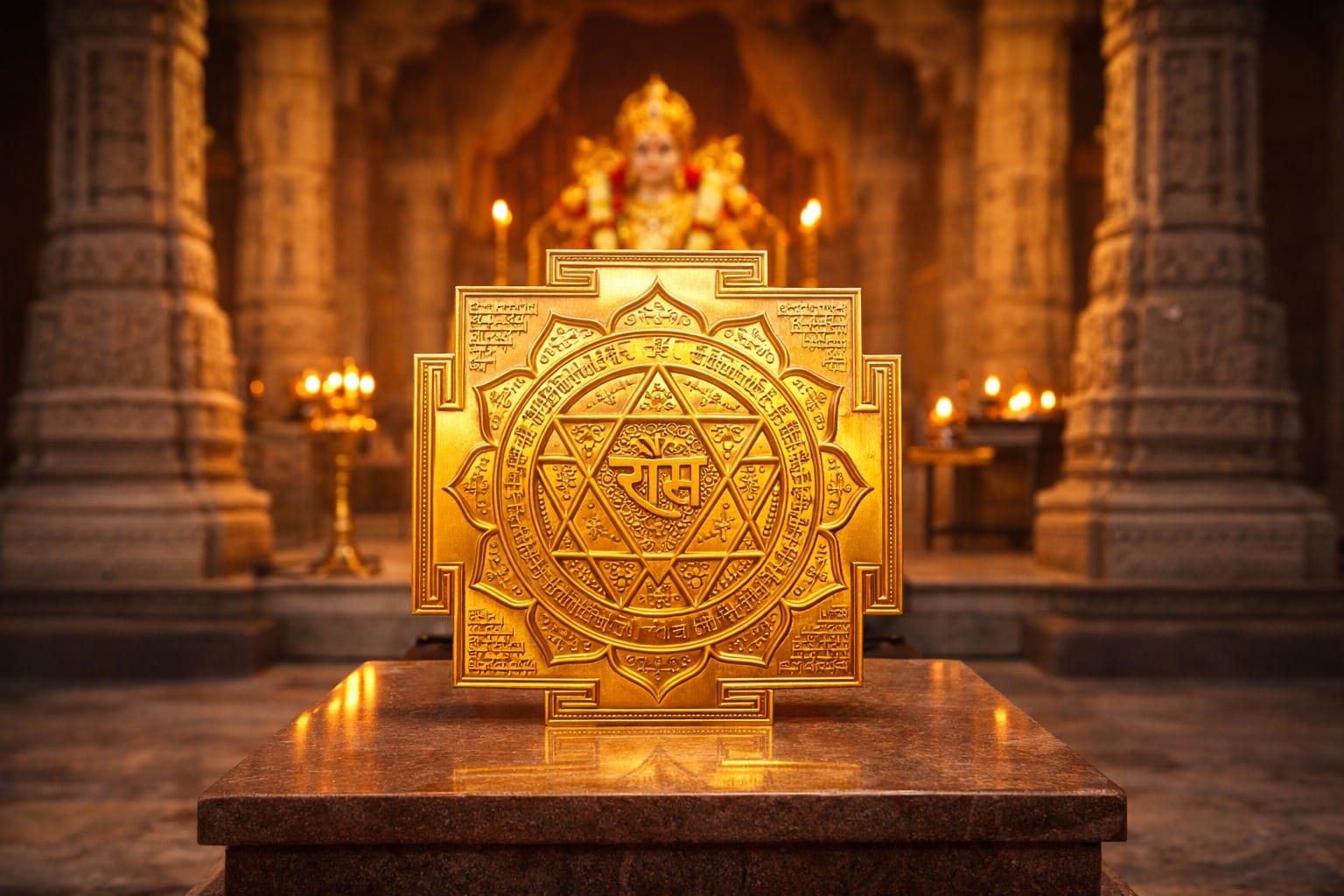
Ram Yantra Installed at Ram Mandir
The installation of the Shri Ram Yantra at the Ram Mandir in Ayodhya marks yet another profound spiritual milestone in the evolution of one of India’s most sacred religious sites. Following the consecration of Ram Lalla in 2024 and the completion of the grand temple structure in 2025, the addition of the Ram Yantra represents a deeper layer of spiritual symbolism, Vedic science, and metaphysical belief embedded within the temple complex.
While idols and rituals form the visible dimension of worship, the placement of a yantra introduces an invisible, energetic dimension—one that aligns the temple not just as a place of devotion, but as a cosmic center of spiritual energy.
What is Ram Yantra?
To understand the importance of the Ram Yantra, one must first understand the concept of a yantra in Hindu tradition.
A yantra is not merely a decorative or symbolic object. It is considered a geometric representation of divine energy, constructed using precise mathematical patterns and sacred inscriptions. Unlike idols, which are anthropomorphic representations of deities, yantras function as cosmic diagrams—maps of spiritual forces that channel energy into a defined space.
The Shri Ram Yantra, specifically, is designed to invoke the presence and blessings of Lord Ram. According to traditional beliefs, such yantras act as spiritual conduits, allowing divine energy to flow into the environment and stabilize it.
In essence, while the idol of Ram Lalla represents the form of divinity, the Ram Yantra represents its energy and principle.
Structure and Composition of Ram Yantra
The Ram Yantra installed at Ayodhya is not a random artifact—it is the result of carefully calculated Vedic design and spiritual engineering.
The yantra consists of:
- Sacred geometric patterns, often based on Vedic mathematics
- Intricate inscriptions in Devanagari script
- Embedded Sanskrit mantras invoking Lord Ram
- Symbolic structures that align with cosmic principles
These geometric forms are believed to function as energy channels, creating a spiritually charged and harmonious environment within the temple.
One of the most significant aspects of the Ram Yantra is the presence of a Sanskrit prayer embedded within its design. This prayer symbolically invites Lord Ram to reside eternally in the temple, just as he is believed to dwell in Vaikuntha, while also invoking Lord Hanuman as a protective force guarding the sacred space.
This dual invocation—of presence and protection—highlights the yantra’s purpose as both a spiritual anchor and a guardian mechanism.
Also read – 10 Oldest Religions of the World
Spiritual Meaning: Why Ram Yantra Was Installed
The installation of the Ram Yantra is not merely ritualistic—it is deeply philosophical.
In Hindu temple architecture and Vedic traditions, a temple is not just a place of worship. It is considered a living organism, where:
- The idol represents the body of the deity
- The rituals represent the breath and life force
- The yantra represents the energy core or consciousness
By installing the Ram Yantra, the Ram Mandir in Ayodhya is being transformed into a complete spiritual ecosystem.
The yantra is believed to:
- Enhance the spiritual vibrations within the temple
- Create a protective field against negative energies
- Establish a constant flow of divine presence
Spiritual leaders have also described the yantra as a symbol of deeper knowledge, suggesting that it represents not just devotion, but an understanding of the cosmic principles behind divinity.
Where is the Ram Yantra Installed in the Temple?
The Ram Yantra has been placed on the second floor of the Ram Mandir complex in Ayodhya, a location chosen after careful ritual and architectural consideration.
Before its installation, the yantra was:
- Brought to Ayodhya nearly two years earlier
- Worshipped continuously in front of the deity
- Prepared through elaborate Vedic rituals
The final installation was carried out during Chaitra Navratri, marking the beginning of the Hindu New Year—an auspicious period symbolizing renewal and divine alignment.
The ceremony itself involved:
- Priests from across India
- Sacred chants and Vedic rituals
- Participation of spiritual leaders and dignitaries
This indicates that the installation was not just symbolic but was performed with full ritualistic sanctity and precision.
The Role of Kanchipuram and Vedic Consecration
One of the most important aspects of the Ram Yantra is its origin.
The yantra was consecrated in Kanchipuram, a historic center of Vedic learning and spirituality, under the guidance of the Kanchi Kamakoti Peetham.
Before reaching Ayodhya, it underwent:
- Purification rituals
- Vedic chanting
- Spiritual energization ceremonies
This process, known as “prana-pratishtha” for yantras, ensures that the object is not just symbolic but is believed to be spiritually activated.
This also reflects the pan-India nature of the Ram Mandir project—bringing together traditions and expertise from different regions.
Ram Yantra and Vedic Science: The Energy Perspective
From a philosophical standpoint, the installation of a yantra is rooted in what many describe as Vedic science.
The idea is that:
- Geometry influences energy
- Sound (mantras) influences vibration
- Space can be “activated” through alignment
The Ram Yantra combines all three:
- Geometry (design)
- Mantra (inscriptions)
- Ritual (installation process)
This creates what believers consider a high-energy spiritual zone.
While modern science may interpret this symbolically, within the framework of Hindu philosophy, this is seen as a scientific approach to spirituality—one that integrates mathematics, sound, and consciousness.
Cultural and National Significance
The installation of the Ram Yantra is not just a religious event—it also carries cultural and national symbolism.
The Ram Mandir itself has become:
- A symbol of faith for millions
- A major spiritual destination in India
- A representation of cultural resurgence
The addition of the Ram Yantra reinforces this identity by:
- Connecting ancient traditions with modern India
- Showcasing the depth of Vedic knowledge systems
- Strengthening the temple’s role as a spiritual center
Leaders and spiritual figures have described the installation as a moment of collective joy and cultural affirmation, reflecting India’s deep-rooted connection to its spiritual heritage.
Ram Yantra vs Idol Worship: A Deeper Understanding
One of the most important distinctions to understand is the difference between:
- Murti (idol)
- Yantra (energy diagram)
The idol is:
- Visual
- Emotional
- Devotional
The yantra is:
- Abstract
- Energetic
- Conceptual
Together, they create a complete spiritual experience.
In the context of the Ram Mandir:
- The idol allows devotees to see and connect with Lord Ram
- The yantra ensures that the energy of that connection is sustained and amplified
The Bigger Picture: A Living Temple System
With the installation of the Ram Yantra, the Ram Mandir evolves from a structure into what can be described as a living spiritual system.
It now includes:
- Deity (Ram Lalla)
- Rituals (daily worship)
- Architecture (Vastu-aligned design)
- Energy core (Ram Yantra)
This aligns with ancient temple traditions where temples were designed not just as places of worship, but as centers of energy, learning, and consciousness.
Conclusion
The installation of the Ram Yantra at Ram Mandir Ayodhya is far more than a ceremonial addition. It represents the integration of faith, philosophy, and Vedic science into a single spiritual framework.
At a time when the Ram Mandir has already become a symbol of devotion and national identity, the presence of the Ram Yantra adds a deeper dimension—one that transforms the temple into a space where form meets energy, and devotion meets knowledge.
For millions of devotees, this is not just about tradition.
It is about creating a sacred space where divinity is not only worshipped—but experienced.
Subscribe to our YouTube Channel, The Logic Stick, for more video insights