






Iran’s Strait of Hormuz Crypto Toll Plan: Why Tehran’s $1-Per-Barrel Proposal Is Shaking Global Oil Markets
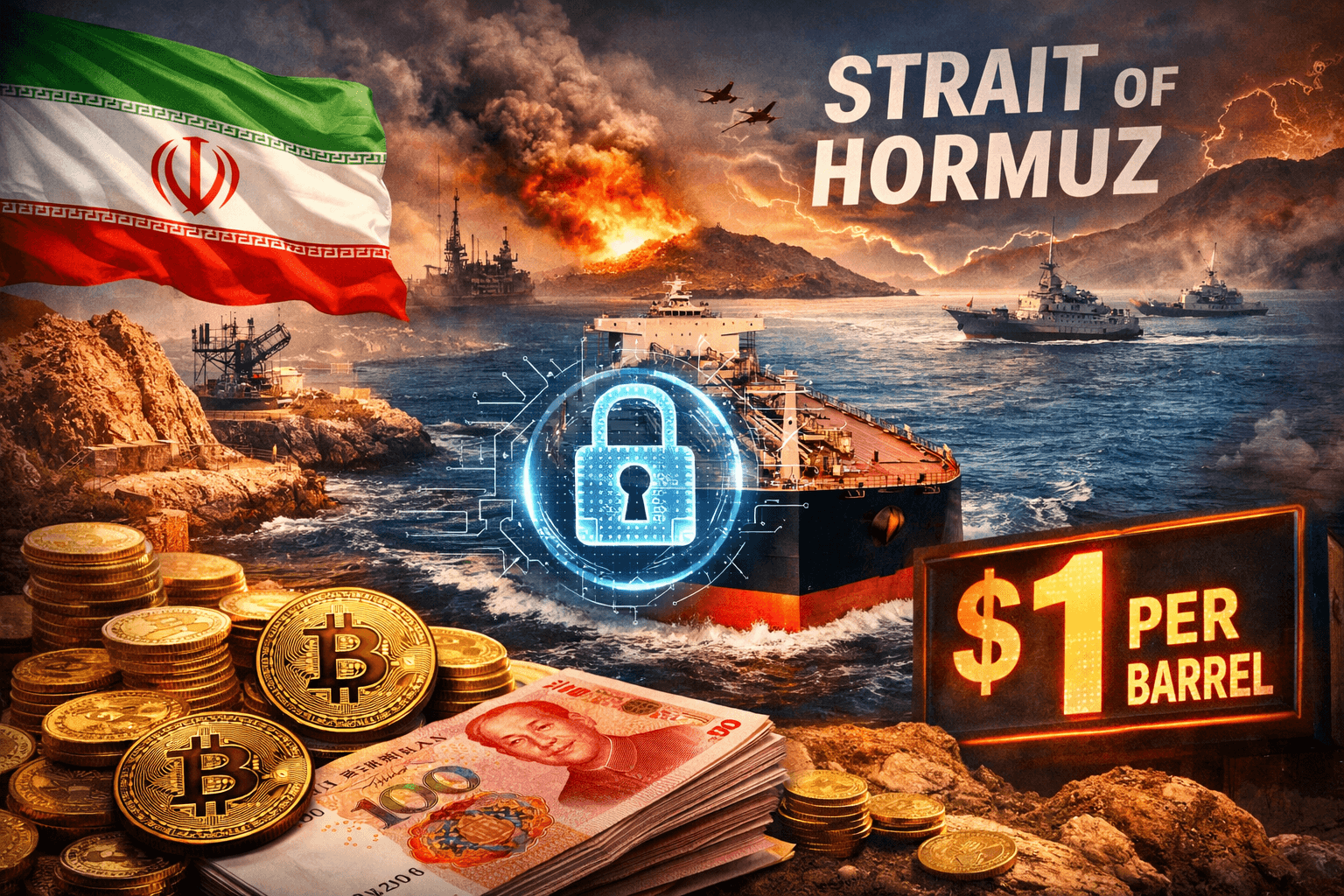
Iran’s reported plan to charge oil tankers a $1-per-barrel transit toll, potentially payable in cryptocurrency or Chinese yuan, has added a new layer of uncertainty to one of the world’s most important energy chokepoints: the Strait of Hormuz. The proposal comes at a moment of extraordinary fragility in the Gulf, with a two-week U.S.-Iran ceasefire still shaky and shipping through the strait far from normal.
The Strait of Hormuz is not just another maritime route. Before the war and resulting disruption, it carried roughly a fifth of the world’s oil and gas flows, making it one of the most critical arteries in the global energy system. When traffic through Hormuz is restricted, the effects are felt everywhere: in crude prices, freight costs, fuel inflation, refinery margins, and the broader mood of financial markets.
What makes the present moment especially important is that Iran’s approach appears to go beyond a simple military blockade or political threat. According to reporting from AP, Reuters, and Bloomberg, Tehran has either proposed or begun enforcing a system under which vessels must seek Iranian clearance, provide cargo and crew details, and in some cases pay for safe passage. Some reports say the fee could amount to around $1 per barrel, while others describe payments of up to $2 million per ship, especially for very large crude carriers.
That distinction matters. The headline figure of $1 per barrel is useful because it explains how the toll would scale with cargo size, but the more important fact is that the system remains opaque. There is no publicly available, fully detailed legal framework showing exactly how Iran would apply the charges, who would collect them, what role Oman would or would not play, or how shippers would challenge the process. Reuters has explicitly noted that the rules of passage remain “deeply unclear,” and AP has described the system as a murky “tollbooth” arrangement rather than a settled international mechanism.
Still, the market reaction shows that traders are taking the risk seriously. Reuters reported that after weeks of conflict, oil prices dropped sharply on ceasefire hopes, but the possibility of an Iranian “toll booth” in Hormuz could keep energy prices structurally higher for years. In other words, even if the war cools, the fear premium may not disappear quickly if shipping companies believe Tehran can decide who moves, when, and at what cost.
Another correction worth making is about the crypto angle. It would be inaccurate to say that Iran has publicly rolled out a neat, official, universally verified “Bitcoin-only” payment system. What the reporting actually shows is narrower and more nuanced: major outlets have reported that some fees are being demanded in cryptocurrency or yuan, partly because both options can help bypass Western sanctions and reduce exposure to the dollar-centered financial system. Bloomberg reported that some vessels have paid fees in Chinese currency or crypto, while Reuters noted market concerns that ships may have to pay in yuan or crypto under Iranian approval procedures.
That makes the story bigger than a shipping fee. It touches a deeper geopolitical trend: the gradual push by sanctioned or U.S.-aligned adversarial states to settle strategic transactions outside the dollar system. If even a small portion of the Gulf’s oil transit starts being priced, cleared, or approved through yuan- or crypto-linked mechanisms, that would not end the petrodollar overnight, but it would deepen concerns about fragmentation in the global payments architecture. Reuters and market commentary have already flagged exactly that concern.
At the same time, this is not just a currency story. It is fundamentally a freedom of navigation story. AP and Reuters both point out that Iran’s toll demand collides with a core principle of maritime law: peaceful ships should be able to transit strategic waterways without arbitrary obstruction or monetized coercion. AP cited Article 17 of the U.N. Convention on the Law of the Sea on innocent passage, while also noting that even though Iran and the United States have not ratified the treaty, maritime law experts still argue that Iran remains bound by customary international law norms on transit passage.
This is why the backlash has been sharp. Greek Prime Minister Kyriakos Mitsotakis called the idea of paying a fee for every ship crossing Hormuz “completely unacceptable” and warned it would set a dangerous precedent for freedom of navigation. The White House, meanwhile, said its priority is reopening the strait without limitations, even though Donald Trump also floated the idea of a joint U.S.-Iran toll venture in comments that further muddied the diplomatic picture.
Read more about France pulling out it’s gold reserves from US.
The legal argument is not abstract. If Iran succeeds in normalizing a toll regime in Hormuz, other strategic maritime powers could cite the precedent. Analysts quoted by AP warned that the implications could extend well beyond the Gulf. The fear is that if Hormuz can become a fee-based geopolitical checkpoint, then future disputes could invite similar behavior in places such as the Taiwan Strait, the Bab el-Mandeb, the Strait of Gibraltar, or other narrow passages critical to world trade.
For oil-importing countries, especially in Asia, that is a serious concern. Reuters noted that China, Japan, South Korea, and India remain heavily exposed to Gulf energy flows. Even modest transit delays, erratic approvals, or elevated war-risk insurance could ripple quickly through refining costs and domestic inflation. India, in particular, has reason to watch the situation closely because Gulf crude remains central to its energy security and fuel-price stability.
The numbers help explain why the issue matters so much. Reuters reported that before the war, the strait handled around a fifth of the world’s oil and gas, while AP noted that a $2 million toll on a 2 million-barrel tanker works out to about $1 per barrel. That may not sound catastrophic in isolation, but in energy markets, even seemingly small transport cost changes can become magnified once insurance, financing, schedule uncertainty, port congestion, and geopolitical risk are layered on top.
And shipping is not yet anywhere close to normal. Reuters reported that although U.S. officials projected confidence about reopening, vessel-tracking reality looked much more constrained: prewar average transit was around 138 vessels a day, whereas current movement was described as 10 or fewer in one Reuters market dispatch. That gap between diplomatic rhetoric and commercial reality is exactly why markets remain uneasy.
There is also the question of whether Gulf producers can simply bypass Hormuz. The answer is: only partly. Reuters reported that Saudi Arabia and the UAE have relied more heavily on alternative export routes, including pipelines to Red Sea and Fujairah terminals, but those routes do not fully replace the capacity and convenience of Hormuz. Some infrastructure has also been exposed to attack, reinforcing the idea that alternatives are useful hedges, not complete substitutes.
So what should readers take away from the current reporting?
First, the core story is real: Iran is using its leverage over Hormuz to seek tighter control over shipping, and toll-like payments are no longer just hypothetical in press commentary. AP reported that some vessels were diverted, vetted by intermediaries, and at least two reportedly paid the equivalent of $2 million in yuan. Bloomberg separately reported that some ships have paid fees in yuan or crypto before being escorted through the strait.
Second, the details are still fluid. It is more accurate to say Iran has proposed and in some cases reportedly enforced toll-style payments, rather than to describe the system as a settled, formal, transparent global policy already accepted by the international community. Reuters and AP both make clear that the arrangement remains contested, legally controversial, and operationally murky.
Third, the economic implications are significant even if the policy never fully crystallizes. Reuters argues that the mere prospect of Iranian oversight, selective permissions, higher insurance costs, and structurally elevated political risk could keep energy markets more volatile long after the ceasefire headlines fade.
In that sense, Tehran’s reported $1-per-barrel crypto toll proposal is not just a story about one shipping charge. It is a test of who controls a strategic chokepoint, who gets to rewrite rules of maritime access after war, and whether energy trade will become even more politicized in the years ahead. If the Strait of Hormuz turns from an open passage into a discretionary gate, the impact will reach far beyond the Gulf. It will shape oil markets, legal norms, diplomatic alignments, and perhaps even the future of how global trade is paid for.
For now, the most accurate conclusion is this: Iran’s toll push is credible enough to shake markets, controversial enough to alarm governments, and unclear enough that every new report still needs careful fact-checking. That is exactly why this story matters.