






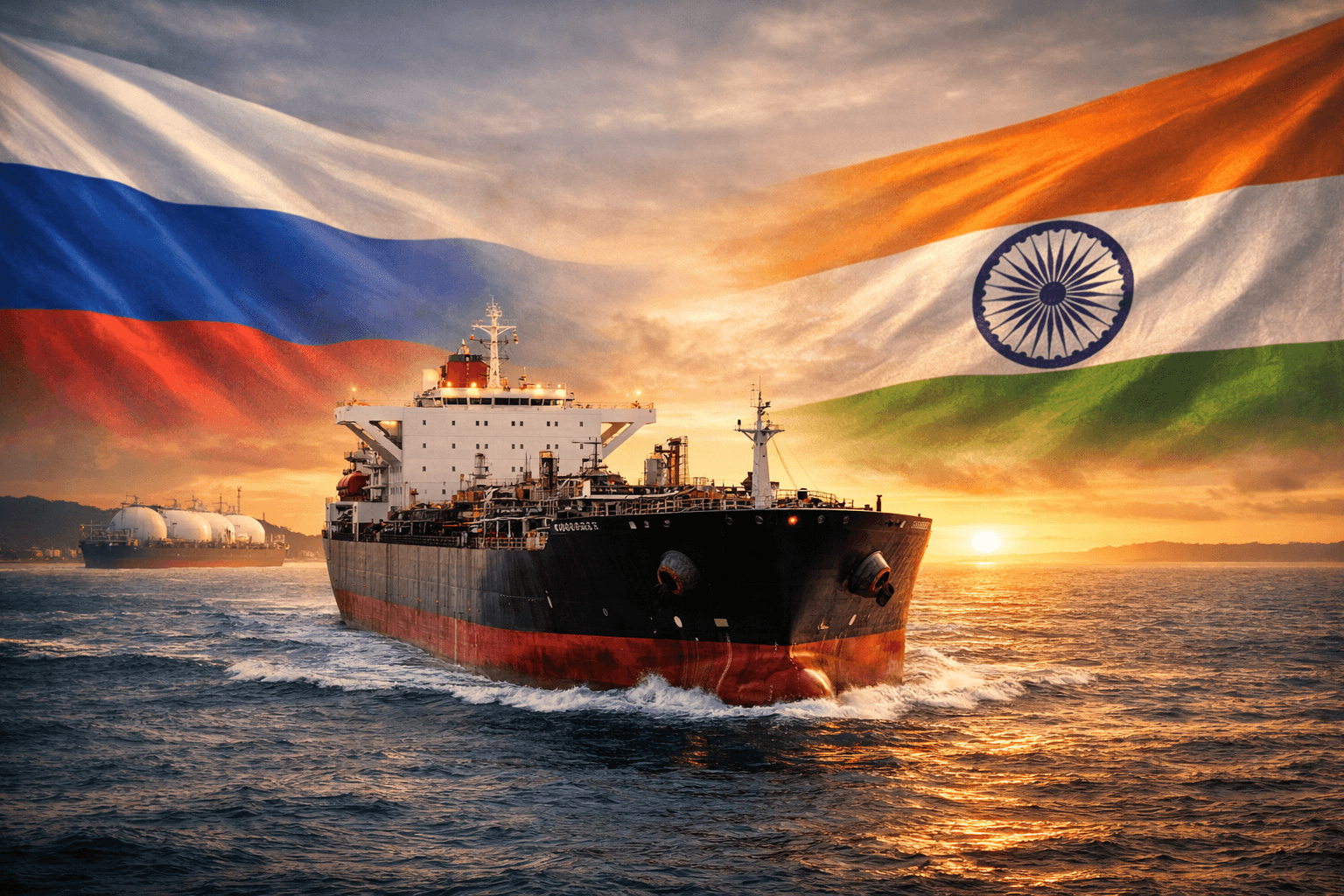
Russia Offers More Oil and LNG to India During Bilateral Talks Amid West Asia Supply Risks.
Russia has offered to increase supplies of oil and liquefied natural gas to India during high-level bilateral talks in New Delhi, in a move that underscores how energy security has again moved to the centre of India-Russia ties. The development came during the April 2–3, 2026 visit of Russian First Deputy Prime Minister Denis Manturov, who held meetings with Prime Minister Narendra Modi, External Affairs Minister S. Jaishankar, Finance Minister Nirmala Sitharaman and National Security Adviser Ajit Doval.
What has been publicly confirmed so far is narrower than many headlines suggest. India’s Ministry of External Affairs said the two sides held wide-ranging discussions on trade, industry, energy, fertilisers, connectivity, mobility, technology, innovation and critical minerals, and also reviewed outcomes from the 23rd India-Russia Annual Summit held in December 2025. The Russian side, as cited in Indian media reports based on the Russian Embassy’s statement, said Russian companies have the capacity to steadily increase supplies of oil and LNG to the Indian market.
That distinction matters. There is, at the time of writing, no official announcement of a fresh long-term contract, no public disclosure of additional supply volumes, and no published pricing framework. What has happened is an important political and commercial signal: Moscow is telling New Delhi that if India needs more fuel, Russian suppliers are prepared to step up.
What actually happened in the India-Russia talks
According to the MEA, Manturov visited India on April 2–3 and co-chaired bilateral discussions with Jaishankar in his role as co-chair of the India-Russia Inter-Governmental Commission on Trade, Economic, Scientific, Technological and Cultural Cooperation, or IRIGC-TEC. The Indian readout does not mention a signed energy agreement, but it clearly lists energy among the main pillars discussed during the visit.
The Russian position, reported by Hindustan Times and elaborated in Economic Times coverage citing the Russian Embassy statement, was more specific on fuels. Manturov said Russian companies can steadily increase supplies of oil and LNG to India. The same reporting also said Moscow highlighted a 40% rise in supplies of certain mineral fertilisers to India by the end of 2025 and pointed to continued cooperation on the Kudankulam Nuclear Power Plant project.
This means the energy message from Moscow was part of a wider package. Russia was not only speaking about crude oil. It was also tying together oil, LNG, fertilisers and nuclear cooperation to reinforce the idea that it remains a major long-term strategic supplier for India across multiple sectors.
Why the timing matters
The offer comes at a time when India is watching the West Asia situation closely. The MEA said the two sides exchanged views on regional and global developments, including the conflict in West Asia. That is highly relevant because India remains exposed to disruptions around the Strait of Hormuz, a route that Reuters reported carries around 40% of India’s crude imports.
Reuters reported in March that Russia was prepared to divert oil to India as Middle East supply disruptions worsened and that an industry source said Moscow was ready to help India meet up to 40% of its crude needs if required. Reuters also reported that Russia was ready to sell LNG to India after supply strains intensified in the wider regional crisis. Those Reuters reports provide the broader market context for Manturov’s latest remarks in New Delhi.
So this is not an isolated diplomatic talking point. It fits a larger pattern that has emerged over recent weeks: India has been reassessing supply risks from West Asia, while Russia has been signalling that it can serve as a buffer supplier in both crude and LNG if disruptions persist.
Read more on the latest Iran Israel war updates affecting India.
Why India is likely to take the offer seriously
India is the world’s third-largest energy-consuming country, according to the International Energy Agency and U.S. Energy Information Administration material. That scale alone makes reliable supply a strategic necessity, not just a commercial issue.
Over the past few years, Russian crude has become a major part of India’s import basket, especially after Western sanctions redirected Russian flows toward Asian buyers. Reuters reported that India’s imports of Russian crude had fallen to about 1.1 million barrels per day in January 2026, pushing Russia’s share down to 21.2%, but that the share climbed back to around 30% in February amid renewed market pressure. Another Reuters report said Russian oil was set to regain the top spot in India in March, with shipments expected at roughly 2 million to 2.2 million barrels per day.
That trend shows two things. First, India has not abandoned diversification. Second, Russian crude remains one of the fastest levers available when international supply conditions tighten. In that context, Moscow’s latest offer is commercially credible and strategically useful for New Delhi.
Oil and LNG, not just “more gas”
One important correction for accuracy: the most specific public formulation attached to Manturov’s visit is that Russian companies can increase supplies of oil and liquefied natural gas, or LNG, to India. Some headlines have used the broader phrase “natural gas,” but the clearest cited reporting refers specifically to LNG.
That matters because LNG and pipeline gas are not the same thing in commercial terms or infrastructure requirements. India imports LNG through terminals, while pipeline gas from Russia to India is not a practical near-term route. So, for publication purposes, the most accurate phrasing is that Russia has offered to raise supplies of oil and LNG to India.
What was not announced
There is a temptation in fast-moving energy stories to overstate what bilateral talks mean. Based on the official Indian readout and currently available reporting, several claims cannot yet be stated as fact.
There is no public evidence yet of a newly signed mega oil contract. There are no officially disclosed figures for how many additional barrels or LNG cargoes Russia would send. There is also no public confirmation of a new rupee-ruble payment structure or any fresh logistics arrangement arising directly from this visit.
That does not make the story small. It just means the correct interpretation is that the visit advanced the political and commercial groundwork for more energy trade, rather than producing a fully detailed new fuel deal on the spot.
The wider India-Russia strategic picture
Manturov’s visit also shows that India-Russia ties remain broader than oil alone. Alongside energy, both sides discussed fertilisers, industry, connectivity, mobility, technology, innovation and critical minerals. Russia also underlined continued cooperation in nuclear energy, with the Kudankulam project progressing according to schedule.
That broader agenda is significant because it suggests neither side wants the relationship reduced to transactional oil buying. India is balancing multiple strategic relationships, including with the United States and Europe, while Russia is looking to deepen long-term economic partnerships in Asia. Energy remains central, but it is being packaged within a larger framework of strategic cooperation.
What this means for India’s energy security
For India, the practical takeaway is simple: keeping multiple supply options open remains essential. Reuters has reported that India is vulnerable to supply shocks and that the country’s crude stocks cover only about 25 days of demand in the context of recent wartime disruptions. That makes quick access to alternative suppliers critically important when traditional shipping routes come under pressure.
Russia’s message, therefore, is not just diplomatic reassurance. It is an offer to remain a flexible backup and, potentially, a larger primary supplier if market conditions worsen. For Indian refiners, that could mean greater room to manoeuvre if West Asian cargoes are delayed, insurance costs rise, or benchmark prices remain volatile.
At the same time, India is unlikely to frame this as dependence on a single source. New Delhi has consistently preferred diversification, and recent Reuters reporting shows refiners adjusting their baskets based on geopolitics, pricing and availability rather than ideology alone.
The bottom line
The corrected reading of this development is clear. Russia did not unveil a fully structured new oil-and-gas pact with India this week. What happened is that during Denis Manturov’s April 2–3 visit to New Delhi, the two sides formally discussed energy among a broad set of strategic sectors, and the Russian side publicly said its companies can increase supplies of oil and LNG to India.
That is still a major signal. It comes at a time of regional conflict, shipping uncertainty and heightened concern over energy security. It reinforces Russia’s intent to stay deeply embedded in India’s energy mix. And it gives India another lever as it navigates a volatile global fuel market.
In short, the headline is real, but the precise fact-checked version is this: Russia has offered to raise oil and LNG supplies to India during bilateral talks, while both countries reviewed broader cooperation in energy and related sectors; no new public supply volumes or contract details have yet been announced.