







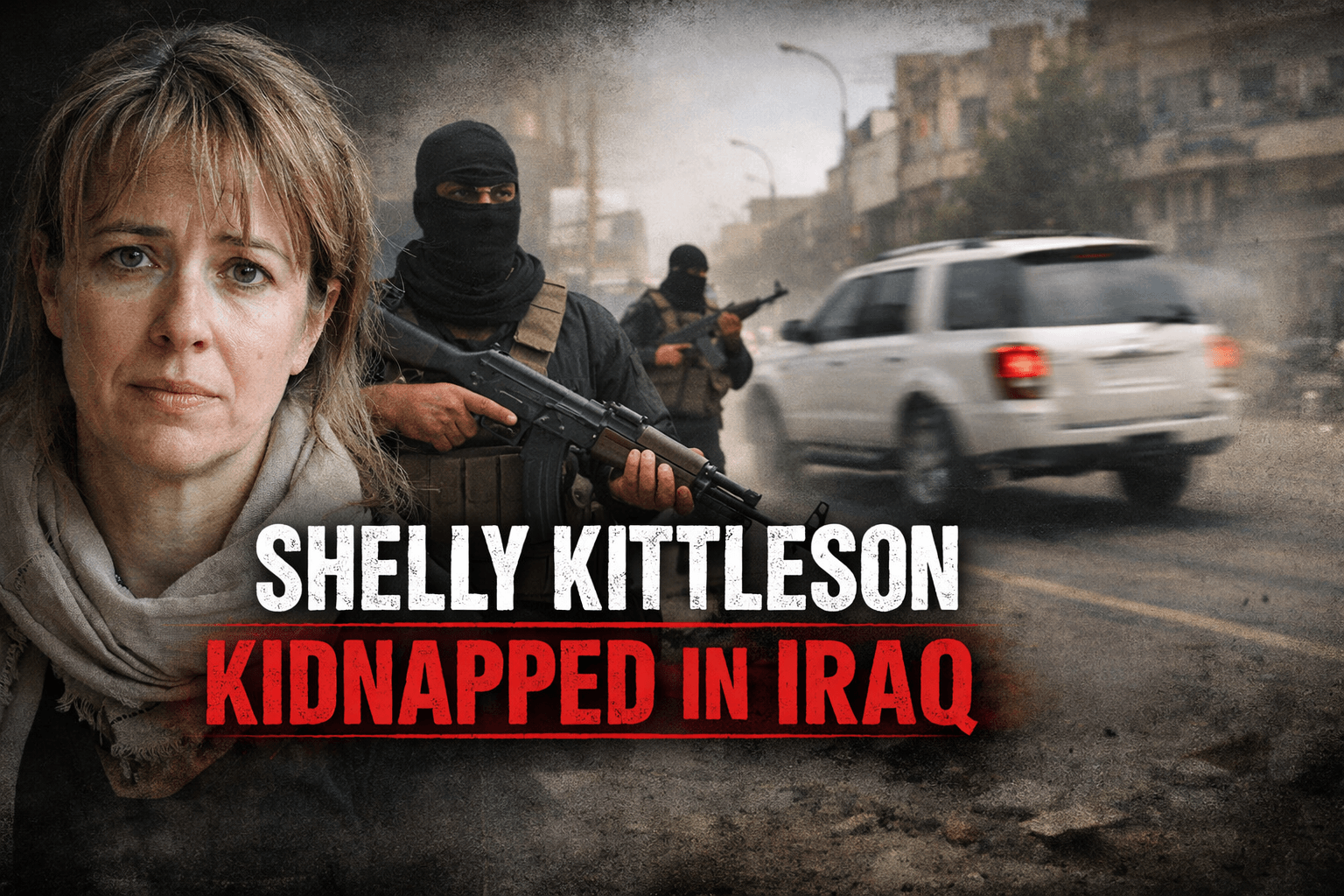
Shocking Shelly Kittleson Kidnapped in Iraq: Baghdad Abduction Raises Fresh Fears for Journalist Safety
The reported kidnapping of American freelance journalist Shelly Kittleson in Iraq has triggered urgent international concern, not only because of who she is, but because of what the case says about the risks facing reporters in volatile conflict zones. Iraqi officials say a foreign journalist was abducted in Baghdad on March 31, 2026, and multiple U.S. and international media organizations later identified that journalist as Shelly Kittleson. Iraqi authorities say one suspect has been arrested and that efforts to locate her are ongoing.
This case has quickly drawn global attention because it comes at a time of heightened regional instability, with Iraq once again caught in the crosscurrents of U.S.-Iran tensions, militia activity, and a fragile internal security environment. While some reports have pointed toward the Iran-aligned militia Kataib Hezbollah, officials have so far stopped short of announcing a final, formal attribution. That distinction matters. At this stage, the kidnapping is confirmed, the search is active, and suspicion has fallen on an Iran-backed armed group, but some details still remain under investigation.
Who is Shelly Kittleson?
Shelly Kittleson is an American freelance journalist who has reported extensively from the Middle East. Outlets and advocacy groups describing her background say she has contributed to publications including Al-Monitor, BBC, Politico, and Foreign Policy, and that she is based in Rome while frequently traveling in the region for reporting work. Her journalism has focused on conflict, politics, and security, making her part of a small group of foreign correspondents who continue reporting from areas many others avoid because of security concerns.
That professional background is part of why the case has resonated so strongly. Kittleson is not an occasional traveler or tourist caught up in a random incident. She is known as a legitimate field reporter with substantial regional experience, according to press freedom groups and media outlets following the case.
Shelly Kittleson Kidnapped in Iraq: What Happened in Baghdad?
The basic facts are now relatively consistent across major reports. Iraqi authorities said a foreign female journalist was kidnapped in Baghdad on Tuesday, March 31, 2026. Reuters reported that the Iraqi Interior Ministry confirmed the kidnapping and said one suspect had been arrested. The ministry did not initially disclose the victim’s nationality, but later reporting from AP and The Washington Post identified the journalist as Shelly Kittleson.
According to police and Iraqi official accounts cited by AP and Reuters-based coverage, the abductors used at least one vehicle, and Iraqi security forces launched a pursuit. One vehicle connected to the incident reportedly overturned during the chase, and one suspect was detained. However, Kittleson was not found in the intercepted vehicle, which means the rescue operation remains incomplete and her whereabouts were still not publicly known at the time of reporting.
Some reports add that she was taken by four men in civilian clothes, and that the search was focused on the eastern part of Baghdad where the kidnappers’ vehicle was believed to be headed. Those details appeared in Reuters-based reporting carried elsewhere and in follow-up coverage, but officials have not publicly released a full official narrative of the incident beyond confirming the abduction and search.
What Was Corrected From the Earlier Version
A few details often repeated in early coverage needed tightening or correcting.
First, it is confirmed that a foreign journalist was kidnapped in Baghdad and that she was later identified as Shelly Kittleson, but some exact location details circulating in early reports were inconsistent. Central Baghdad is well supported; highly specific descriptions tied to one hotel or one exact street should be treated cautiously unless directly confirmed by officials.
Second, while many reports strongly point to Kataib Hezbollah, the most careful wording is that the group is suspected or that a suspect with ties to the militia has been detained. That is more accurate than stating as settled fact that the group officially claimed or conclusively carried out the kidnapping. No public claim of responsibility was cited in the major reports reviewed.
Third, some sensational retellings added speculative elements, including detailed motives, bargaining scenarios, or negotiations. Those claims were not firmly established in the strongest available reporting and should not be presented as fact. What is supported is that U.S. officials and Iraqi authorities suspect Iran-aligned militia involvement and are actively working the case.
Read more on the new tax laws here.
Who Is Suspected in the Kidnapping?
The name that appears most often in credible reporting is Kataib Hezbollah, an Iran-backed Iraqi militia. AP reported that Iraqi and U.S. officials suspect the group. The Washington Post likewise reported that a suspect with links to the militia was arrested, and that U.S. officials had become involved in response efforts. The Guardian, citing a U.S. official, also reported that an individual with ties to Kataib Hezbollah believed to be involved in the kidnapping had been taken into Iraqi custody.
Still, this is an important distinction for accuracy: the evidence in public reporting supports strong suspicion, not a fully concluded public case announced by Iraqi authorities. For an SEO article, that nuance is critical, because overstating attribution can undermine the article’s credibility. Based on the strongest available reports, the safest formulation is this: Kataib Hezbollah is the main suspected group in the abduction of Shelly Kittleson, but the investigation is still ongoing.
Did U.S. Officials Warn Her Before the Kidnapping?
Yes, this appears to be one of the most striking confirmed elements in the story. AP and The Washington Post both reported that the U.S. State Department had warned Kittleson about potential threats before the kidnapping. AP reported that she had been advised to leave Iraq due to threats. That detail adds a sobering layer to the story, suggesting authorities had reason to believe she faced elevated danger before the abduction took place.
This does not mean the kidnapping was inevitable, nor does it shift responsibility away from the perpetrators. But it does underline the seriousness of the risk environment foreign journalists face in Iraq today, especially those whose work touches militias, armed factions, and regional politics.
Why the Shelly Kittleson Kidnapped in Iraq Case Matters
This story is significant beyond the immediate tragedy because it touches on three larger issues at once: press freedom, regional security, and militia power inside Iraq. Iraq has seen periods of improved security compared with the most violent years after the U.S. invasion, but kidnappings, militia intimidation, and politically motivated violence have never fully disappeared. The abduction of a foreign journalist in Baghdad is a reminder that the capital can still become a dangerous operating environment very quickly.
The timing also matters. Major reports note that the kidnapping happened amid wider regional tensions linked to the conflict involving the U.S., Israel, and Iran. In such environments, hostages and foreign nationals can take on symbolic and geopolitical value far beyond the individual case. That does not prove a motive here, but it explains why officials and press freedom organizations reacted so rapidly.
Echoes of the Elizabeth Tsurkov Case
The Kittleson case has been repeatedly compared with the abduction of Elizabeth Tsurkov, an Israeli-Russian academic kidnapped in Baghdad in 2023. Reuters reporting from 2023 and 2025 said Tsurkov had been kidnapped by Kataib Hezbollah and later released in 2025. That precedent matters because it shows that kidnappings involving foreign nationals in Iraq are not hypothetical risks; they are part of a documented pattern.
That comparison does not prove the exact same operational structure in Kittleson’s case, but it does explain why so many reports immediately viewed the suspected militia angle as highly plausible. Iraq has a recent history of cases in which armed factions, particularly Iran-aligned groups, have been accused of abducting foreign researchers or journalists for leverage.
Reaction From Media and Press Freedom Groups
The response from journalism and press freedom organizations was immediate. The Washington Post reported that media freedom organizations including the Committee to Protect Journalists, the International Women’s Media Foundation, and the National Press Club voiced serious concern and called for urgent action. AP also reported that Al-Monitor, one of the publications Kittleson has written for, expressed deep concern and urged her release.
That response matters because attacks on journalists are not treated merely as ordinary criminal acts. They are also seen as threats to the public’s right to know. When a reporter is kidnapped, especially one covering politically sensitive issues, it raises concerns not just about one life but about whether armed actors are trying to silence scrutiny and limit independent reporting.
What Iraqi Authorities Have Said
The Iraqi Interior Ministry has publicly confirmed that a foreign journalist was kidnapped and that security operations are ongoing. Reuters reported that the ministry said one suspect had been arrested. AP added that Iraqi security forces were pursuing leads and attempting to recover the journalist. These official statements are the most reliable baseline in a story that is still developing.
At the same time, Iraqi authorities have not yet publicly released a complete, definitive explanation of who ordered the kidnapping, where the journalist is being held, or what the kidnappers’ demands might be. That means any article written on the subject has to be careful not to move beyond what the evidence actually supports.
What Happens Next?
At the moment, the biggest unanswered question is the simplest one: Where is Shelly Kittleson? As of the latest major reports, Iraqi authorities had detained one suspect and seized a vehicle connected to the abduction, but Kittleson had not been recovered. U.S. agencies are also reported to be involved in trying to secure her release.
The next phase of the story will likely depend on three developments: whether Iraqi authorities identify additional suspects, whether a group publicly claims responsibility, and whether any negotiations or rescue efforts begin to surface publicly. Until then, caution is essential. In fast-moving international stories, early claims often change.
Conclusion
The Shelly Kittleson kidnapped in Iraq case is a serious and developing international story, but the facts need to be handled carefully. What is clearly confirmed is that an American freelance journalist identified as Shelly Kittleson was kidnapped in Baghdad on March 31, 2026; Iraqi authorities arrested one suspect; the search for her is ongoing; and U.S. as well as Iraqi officials suspect ties to the Iran-backed militia Kataib Hezbollah.
What is not firmly established in the strongest reporting is a final official attribution, a confirmed motive, or any public resolution to the case. That is the corrected reality of the story so far. For readers, journalists, and policymakers alike, the case is a stark reminder that reporting from conflict-prone regions still carries extraordinary risk, and that even in capital cities, the line between reporting and danger can disappear in an instant.