







Stock market crashes are scary.
Headlines turn red, portfolios fall sharply, social media is filled with panic, and investors start questioning every decision they’ve ever made.
Yet, history shows us something very important:
Stock Market crashes destroy wealth only for those who panic.
They create wealth for those who stay disciplined.
From Warren Buffett to Rakesh Jhunjhunwala, from the 1929 Great Depression to the 2008 financial crisis and the 2020 COVID crash, one pattern repeats again and again — smart investors behave very differently during market crashes.
This article explains exactly what smart investors do when stock markets crash, why these strategies work, and how ordinary investors can apply the same principles today — without hype, fear, or guesswork.
WATCH VIDEO
Understanding a Stock Market Crash (Before Reacting to It)
A stock market crash is a sharp and sudden fall in stock prices, usually triggered by fear, uncertainty, or economic shocks such as:
- Global financial crises
- Wars or geopolitical tensions
- Pandemics
- Interest rate shocks
- Banking or liquidity crises
What is important to understand is this:
A market crash does not mean businesses stop existing.
It means investors temporarily lose confidence.
Markets fall faster than fundamentals change. This gap between price and reality is exactly where smart investors operate.
Also read – Everything You Need To Know About the BRICS Currency “UNIT”
The Biggest Mistake Investors Make During Market Crashes
Before discussing what smart investors do, it is crucial to understand what most investors do wrong.
Common Panic Reactions:
- Selling everything to “save what’s left”
- Stopping SIPs or long-term investments
- Trying to time the exact bottom
- Following social media tips or viral advice
- Moving all money into one “safe” asset
These decisions are driven by emotion, not logic.
Legendary investor Peter Lynch once said:
“Far more money has been lost by investors preparing for corrections, or trying to anticipate corrections, than has been lost in corrections themselves.”
Smart investors are not smarter because they predict crashes —
they are smarter because they prepare for them.
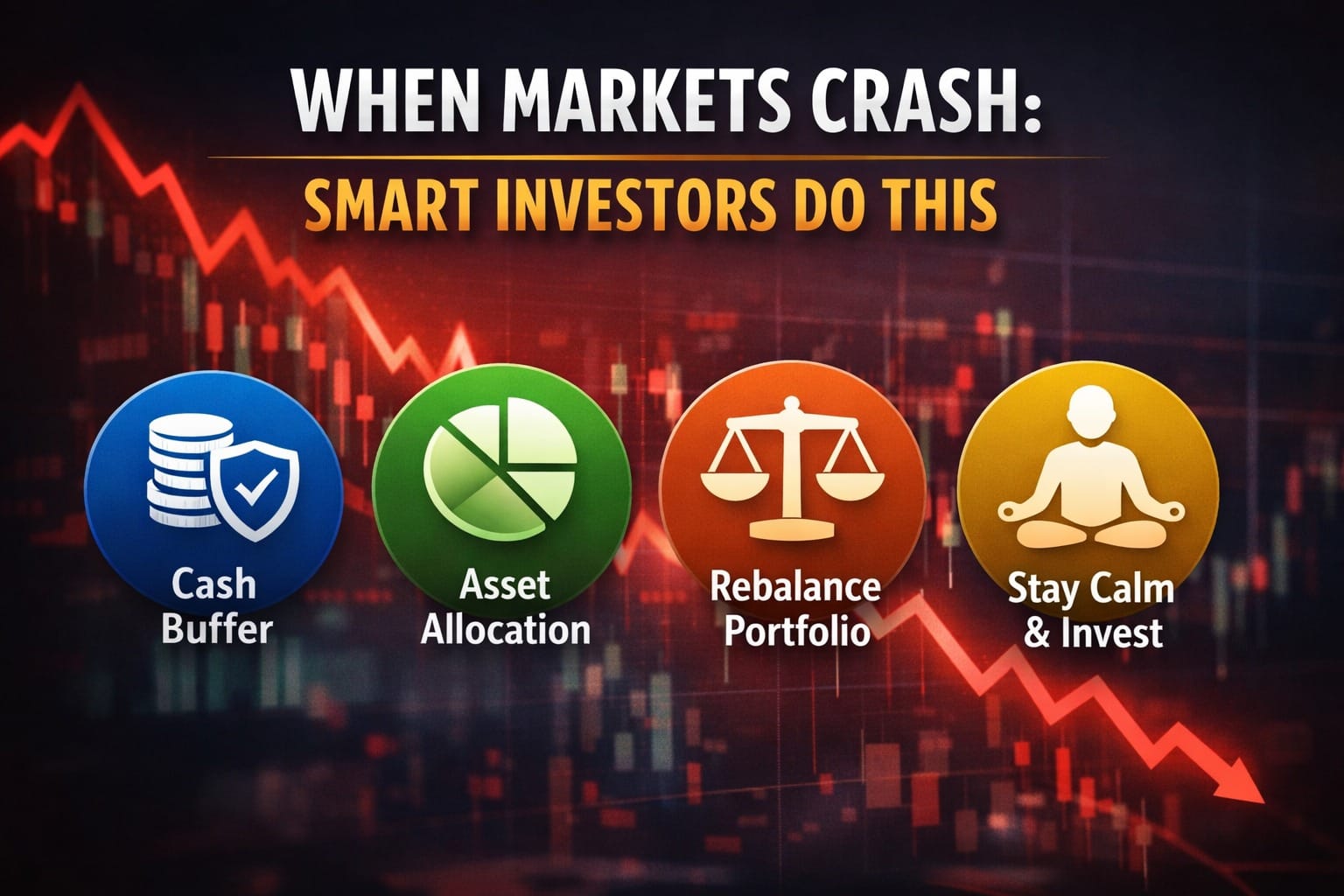
1. Smart Investors Maintain a Strong Cash Buffer
The first thing smart investors focus on during a market crash is liquidity, not profits.
What Is a Cash Buffer?
A cash buffer (or emergency fund) is money set aside to cover 3 to 6 months of essential expenses, kept in safe and easily accessible instruments.
Why Cash Buffer Matters During Crashes
- Prevents forced selling of investments at low prices
- Reduces emotional stress during income uncertainty
- Allows investors to take advantage of opportunities
- Keeps long-term plans intact
Most investors sell stocks during crashes not because they want to, but because they need cash.
Smart investors never let the market decide their personal finances.
2. Smart Investors Follow Asset Allocation, Not Asset Worship
One of the most important principles smart investors follow is asset allocation.
What Is Asset Allocation?
Asset allocation means dividing your money across different asset classes such as:
- Equity (stocks) – for long-term growth
- Debt (bonds, fixed income) – for stability
- Gold or alternatives – for risk protection
No single asset performs best all the time.
Why Asset Allocation Protects You in a Crash
When markets fall:
- Equity may decline sharply
- Debt provides stability
- Gold often acts as a hedge
Smart investors decide their allocation before the crash, not during it.
This prevents emotional decisions and keeps the portfolio balanced even in turbulent times.
Also watch
3. Smart Investors Rebalance Their Portfolio
Rebalancing is one of the most powerful yet misunderstood strategies in investing.
What Is Rebalancing?
Rebalancing means adjusting your portfolio back to its original asset allocation when market movements distort it.
Example:
- Original allocation: 60% equity, 40% debt
- After a crash: 50% equity, 50% debt
A smart investor shifts some money from debt to equity to restore the 60:40 ratio.
This automatically ensures:
- Buying equity when prices are low
- Selling assets that have relatively outperformed
This is disciplined investing, not market timing.
4. Smart Investors Do Not Panic Sell
Selling during a market crash is one of the biggest wealth destroyers.
Legendary investor John Bogle, founder of Vanguard, summed it up perfectly:
“Stay the course.”
Why Panic Selling Is Dangerous
- Locks in losses permanently
- Makes re-entry psychologically difficult
- Misses the strongest recovery phases
- Turns temporary losses into permanent damage
Markets historically recover — often faster than expected.
Investors who exit during fear usually re-enter at higher prices.
5. Smart Investors Understand Market History
Every generation believes, “This time is different.”
History repeatedly proves otherwise.
Major Global Market Crashes:
- 1929 – Great Depression
- 1987 – Black Monday
- 2000 – Dot-com bubble
- 2008 – Global Financial Crisis
- 2020 – COVID-19 crash
India-Specific Example:
During the 2008 crisis, the Sensex fell from around 21,000 to near 8,000.
Many believed Indian markets would never recover.
Yet, over time, Indian equity markets not only recovered but reached new highs.
The lesson is simple:
Crashes are temporary. Compounding is permanent.
6. Smart Investors Avoid Leverage and “Quick Recovery” Tricks
Market crashes expose risky behavior quickly.
Warren Buffett famously said:
“Only when the tide goes out do you discover who’s been swimming naked.”
What Smart Investors Avoid:
- Margin trading
- Excessive leverage
- Speculative bets
- “Doubling down” emotionally
Instead, they focus on:
- Quality businesses
- Strong balance sheets
- Long-term earnings power
Crashes punish speculation but reward discipline.
7. Smart Investors Continue SIPs and Long-Term Investing
Systematic Investment Plans (SIPs) are designed specifically to handle market volatility.
Why SIPs Work During Crashes:
- Automatically invest more units at lower prices
- Reduce emotional decision-making
- Smoothen market volatility over time
Stopping SIPs during a crash defeats their entire purpose.
Smart investors understand that volatility is the friend of disciplined investors.
8. Smart Investors Control Their Emotions
Perhaps the most underrated skill in investing is emotional discipline.
Charlie Munger once said:
“The big money is not in the buying or selling, but in the waiting.”
Smart investors:
- Limit news consumption during crashes
- Avoid constant portfolio checking
- Stick to pre-decided rules
- Focus on long-term goals
They know markets reward patience more than intelligence.
9. Do These Strategies Always Work?
There are no guarantees in investing.
However, what history clearly shows is this:
Investors who follow cash discipline, asset allocation, rebalancing, and emotional control consistently outperform those who react emotionally during crashes.
The strategy does not eliminate volatility —
it uses volatility to your advantage.
10. A Simple Crash-Proof Framework for Investors
Here is a simple checklist smart investors follow during market crashes:
- Maintain a 3–6 month emergency fund
- Review asset allocation, not daily prices
- Continue SIPs and long-term investments
- Rebalance portfolio periodically
- Avoid leverage and speculation
- Stay invested and stay patient
This framework has worked across:
- Countries
- Market cycles
- Economic systems
- Political changes
Final Thoughts: Market Crashes Are Not the Enemy
Market crashes feel dangerous, but they are not unusual.
What truly destroys wealth is:
- Panic
- Greed
- Short-term thinking
- Emotional decision-making
Smart investors understand one timeless truth:
The stock market transfers money from the impatient to the patient.
If you treat market crashes as lessons instead of threats, you place yourself on the same side of history as the world’s most successful investors.
Frequently Searched Questions (SEO Boost)
Q: Should I invest during a market crash?
Yes, but only through disciplined allocation and long-term planning.
Q: Is it better to wait for the market bottom?
Most investors fail to identify bottoms accurately. Staying invested is usually more effective.
Q: Do stock markets always recover?
Historically, diversified equity markets have always recovered over long periods.
Susbcribe to our YouTube Channel The Logic Stick for more Video Insights