





Introduction
Few individuals in modern India represent the intersection of innovation, environmental activism, and social reform as powerfully as Sonam Wangchuk. Known globally as the real-life inspiration behind the character “Phunsukh Wangdu” in the film 3 Idiots, Wangchuk is much more than an engineer or educator. He is a visionary who has spent decades addressing Ladakh’s problems—education gaps, water scarcity, climate change, and political representation.
Born in a remote Himalayan village, Wangchuk transformed adversity into innovation. From founding an alternative education movement in Ladakh to inventing the world-famous Ice Stupa artificial glaciers, his work has earned him international recognition, including the prestigious Ramon Magsaysay Award in 2018.
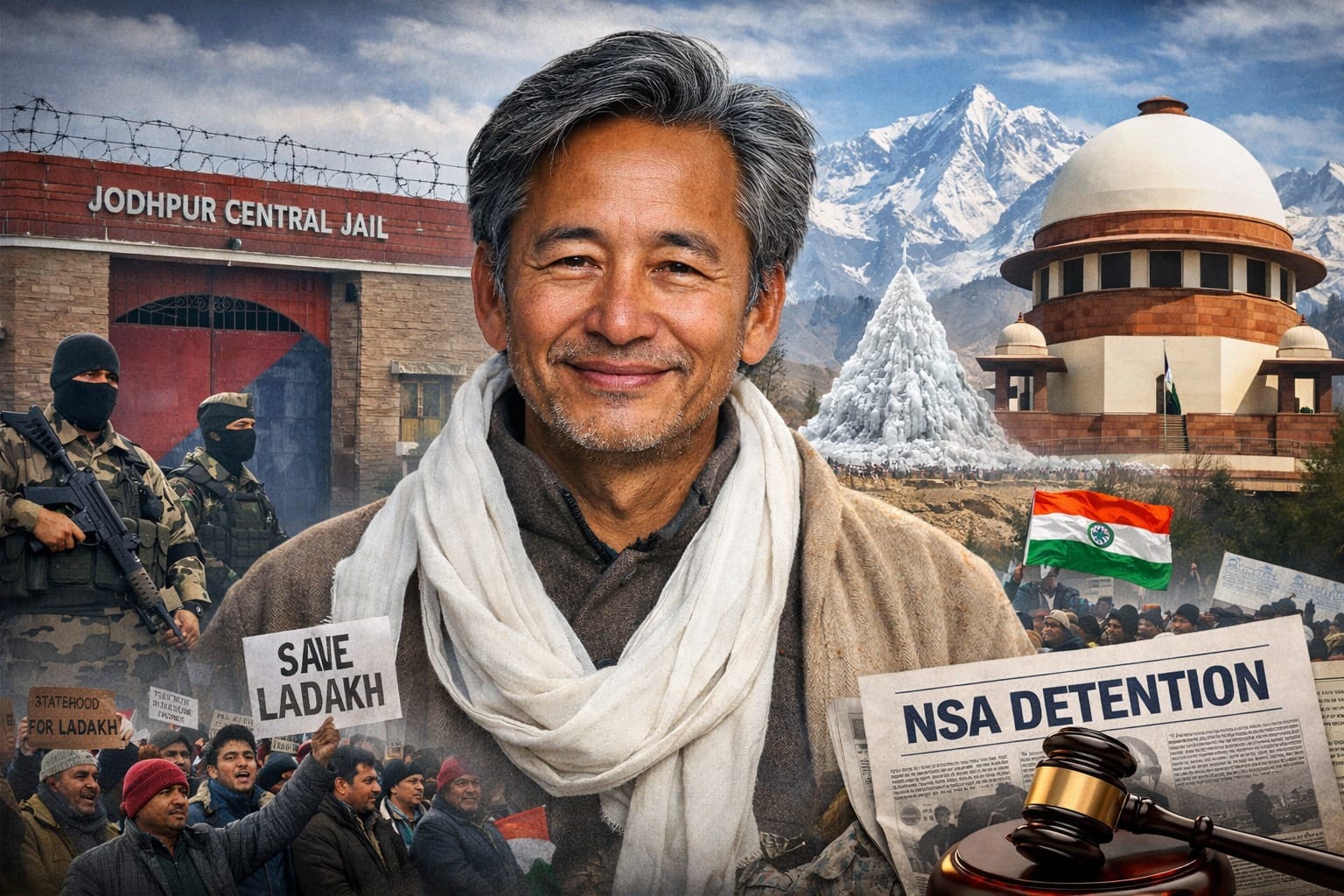
However, in recent years, his activism has brought him into conflict with authorities. His protests demanding constitutional safeguards for Ladakh led to his detention under the National Security Act (NSA) and a major political debate across India.
This article explores the complete timeline of Sonam Wangchuk’s life, achievements, activism, controversies, detention, and release—providing a full understanding of why he remains one of the most influential figures from the Himalayan region.
Also read – From Epstein files to Iran War: How Powerful People Strategically Distracted Us
Early Life of Sonam Wangchuk (1966–1987)
Sonam Wangchuk was born on 1 September 1966 in a small village near Alchi in Ladakh, which was then part of the Indian state of Jammu and Kashmir.
Growing up in the harsh Himalayan landscape shaped his worldview and later innovations.
Childhood without formal schooling
Wangchuk’s early childhood highlights the educational challenges in Ladakh.
- There were no schools in his village when he was growing up.
- Until the age of nine, his mother personally taught him basic reading and writing in the Ladakhi language.
When he was finally sent to school in Srinagar, he struggled due to language barriers.
The school system used Urdu and English, languages he did not understand. Teachers mistook his silence for stupidity, making this period one of the most difficult phases of his life.
This experience deeply influenced his later work in education reform.
Education and engineering career
Despite early difficulties, Wangchuk pursued engineering and eventually graduated from National Institute of Technology (NIT) Srinagar with a degree in engineering.
His technical background later helped him create innovative environmental solutions for Himalayan communities.
Founding the Education Movement in Ladakh (1988)
After completing his education, Wangchuk returned to Ladakh and began working on educational reforms.
In 1988, he co-founded the Students’ Educational and Cultural Movement of Ladakh (SECMOL) along with a group of students who had struggled in the conventional education system.
Purpose of SECMOL
SECMOL aimed to:
- Reform Ladakh’s education system
- Teach students in their native language
- Replace rote learning with practical knowledge
- Empower local communities
Wangchuk believed the existing education system was “alien to Ladakh’s culture and environment.”
Operation New Hope (1994)
One of Wangchuk’s biggest educational reforms came in 1994 with the launch of Operation New Hope.
This initiative was a collaboration between:
- Ladakh’s civil society
- Village communities
- The government education department
The program focused on improving government schools by:
- Training teachers
- Revising the curriculum
- Introducing local languages in classrooms
The project dramatically improved pass rates in Ladakh’s government schools and became a model for community-driven education reform.
SECMOL Alternative School
In 1998, Wangchuk helped establish the SECMOL Alternative School, which later became internationally famous.
This school introduced a revolutionary concept:
Students who failed in conventional schools could rebuild their confidence and skills through hands-on learning.
Unique features of the SECMOL campus
The campus itself became an engineering innovation.
Key features include:
- Solar-powered buildings
- Passive solar heating systems
- Mud-based architecture
- Zero fossil fuel energy consumption
Even in Ladakh’s winters, where temperatures fall below –30°C, the buildings remain warm through solar heating techniques.
The campus later won the International Terra Award for Earth Architecture in 2016.
Editor, Policy Advisor and Social Reformer (1993–2005)
Beyond education, Wangchuk also worked in media and policy.
Ladags Melong
Between 1993 and 2005, he served as editor of Ladags Melong, Ladakh’s only print magazine.
The publication focused on:
- regional culture
- governance issues
- social development
Government policy roles
He also worked with the Ladakh Autonomous Hill Development Council and helped draft policies on:
- education
- tourism
- regional development
His work influenced Ladakh’s Vision 2025 development strategy.
The Ice Stupa Innovation (2014)
One of Sonam Wangchuk’s most famous contributions to environmental innovation is the Ice Stupa project.
Why the Ice Stupa was created
Ladakh faces a serious water crisis.
During winters, rivers freeze and water flows go unused. But during spring planting season, farmers suffer from severe water shortages.
To solve this problem, Wangchuk developed the Ice Stupa artificial glacier technology in 2014.
How it works
The system stores winter water in cone-shaped ice towers, called Ice Stupas.
These structures:
- freeze water during winter
- melt slowly in spring
- supply irrigation water when farmers need it most
The first prototype stored about 150,000 litres of water, demonstrating its effectiveness.
Today, Ice Stupas have been replicated in several countries to combat water scarcity caused by climate change.
Global Recognition and Awards
Over the years, Sonam Wangchuk has received numerous international awards.
Major awards
Some of his most notable recognitions include:
- Ramon Magsaysay Award (2018)
- Rolex Awards for Enterprise (2016)
- Global Award for Sustainable Architecture (2017)
- Ashoka Fellowship for Social Entrepreneurship (2002)
- Real Heroes Award (2008)
The Ramon Magsaysay Award is often referred to as Asia’s Nobel Prize, recognizing Wangchuk’s contributions to education and sustainable development.
Himalayan Institute of Alternatives, Ladakh (HIAL)
After decades of work with SECMOL, Wangchuk launched another ambitious project—the Himalayan Institute of Alternatives, Ladakh (HIAL).
Vision behind HIAL
The institute was created to:
- develop higher education suited to mountain regions
- train students in climate adaptation
- promote sustainable development
Wangchuk envisioned HIAL as a “Mountain University for the Himalayas.”
Inspiration for the Film 3 Idiots
Many people know Sonam Wangchuk as the real-life inspiration behind Phunsukh Wangdu, the brilliant scientist in the blockbuster Bollywood film 3 Idiots.
The character, portrayed by Aamir Khan, represents:
- creative learning
- innovation over rote memorization
- questioning the traditional education system
While the film’s story differs from Wangchuk’s real life, the philosophy behind the character was inspired by his work in Ladakh.
Activism and Political Engagement
As climate change and political issues intensified in Ladakh, Wangchuk became increasingly vocal about regional concerns.
In 2013, he helped launch the New Ladakh Movement, a campaign aimed at promoting sustainable development and better governance.
The movement focused on:
- environmental protection
- education reform
- economic sustainability
Over time, his activism expanded into larger political demands.
Activism After Ladakh Became a Union Territory (2019)
In 2019, the Indian government reorganized the state of Jammu and Kashmir, creating Ladakh as a separate Union Territory.
While many welcomed the decision, others—including Wangchuk—raised concerns.
Activists demanded:
- statehood for Ladakh
- constitutional protection under the Sixth Schedule
- safeguards against large-scale industrial and mining projects
These demands eventually triggered large protests and hunger strikes led by Wangchuk.
Rise of the Ladakh Constitutional Movement (2021–2024)
After Ladakh became a Union Territory in 2019, local leaders initially welcomed the decision because it separated Ladakh from the political complexities of Jammu and Kashmir. However, over time several concerns emerged.
Many Ladakhis began to worry about:
- Loss of legislative power
- Increased control by the central government
- Environmental risks from large-scale industrial projects
- Lack of constitutional protection for tribal land
These concerns gradually evolved into a political movement demanding constitutional safeguards.
The Four Key Demands
Civil society organizations such as the Leh Apex Body (LAB) and Kargil Democratic Alliance (KDA) raised four major demands:
- Full statehood for Ladakh
- Inclusion in the Sixth Schedule of the Constitution
- Creation of a Ladakh Public Service Commission
- Two parliamentary seats for Ladakh
The Sixth Schedule demand was particularly important because it would provide constitutional protection to tribal communities and control over land and natural resources.
Sonam Wangchuk emerged as one of the most influential voices supporting these demands.
Hunger Strikes and Climate Fasts
Wangchuk used non-violent Gandhian protest methods, particularly hunger strikes, to bring attention to Ladakh’s concerns.
March 2024: 21-Day Climate Fast
In March 2024, Wangchuk launched a 21-day fast in Leh demanding constitutional safeguards for Ladakh.
His protest highlighted:
- fragile Himalayan ecosystems
- threats from large infrastructure projects
- climate change in high-altitude regions
The protest attracted national attention and support from environmental activists across India.
The “Delhi Chalo” March (2024)
Later in September 2024, Wangchuk led a 1,000-kilometre march from Ladakh to Delhi.
The march was designed to:
- raise awareness about environmental threats
- highlight Ladakh’s political demands
- push for constitutional safeguards
However, the march was stopped at the Delhi border, where Wangchuk and several supporters were detained by Delhi Police under public order laws.
Although the detention was temporary, the incident increased tensions between Ladakh activists and the central government.
The 2025 Hunger Strike and Escalation of Protests
By 2025, talks between Ladakh leaders and the central government had stalled.
In response, the Leh Apex Body launched a 35-day hunger strike on 10 September 2025.
Wangchuk joined the protest.
The hunger strike demanded:
- Statehood for Ladakh
- Sixth Schedule protection
- environmental safeguards
- political autonomy
The protest was peaceful initially, but tensions escalated as negotiations with the government stalled.
September 24, 2025: Violence in Leh
The turning point came on 24 September 2025.
Protesters gathered in Leh to demand constitutional safeguards.
The situation quickly spiraled into violence:
- Protesters clashed with police
- Government buildings were attacked
- Vehicles were set on fire
- Security forces used tear gas and force to disperse crowds
The confrontation resulted in:
- 4 deaths
- dozens of injuries
- curfew across Leh
Authorities also shut down internet services and imposed restrictions on public gatherings.
This incident dramatically escalated the Ladakh political crisis.
September 26, 2025: Sonam Wangchuk Arrested
Two days after the violent protests, authorities arrested Sonam Wangchuk.
He was detained on 26 September 2025 under the National Security Act (NSA).
What is the National Security Act?
The National Security Act (NSA) is a preventive detention law in India.
It allows the government to detain a person without trial for up to 12 months if authorities believe the person threatens national security or public order.
The government justified Wangchuk’s detention by claiming that:
- his speeches allegedly incited unrest
- protests had turned violent
- preventive detention was necessary to restore order
Authorities accused him of making “provocative statements” that could trigger instability in a sensitive border region.
Wangchuk denied the allegations.
Transfer to Jodhpur Central Jail
After his arrest, Wangchuk was transferred from Ladakh to Jodhpur Central Jail in Rajasthan.
The move was controversial because:
- he was detained hundreds of kilometres away from his home
- supporters argued it made legal access and family visits difficult
By early 2026, Wangchuk had spent nearly five months in detention.
Legal Battle in the Supreme Court
Wangchuk’s wife, Gitanjali J Angmo, filed a petition in the Supreme Court challenging the detention.
The petition argued that:
- the NSA order was arbitrary
- authorities relied on misinterpreted speeches
- the detention violated fundamental rights
The Supreme Court issued notices to the government and repeatedly heard the case, although hearings were postponed several times.
During the proceedings, Wangchuk claimed that edited video clips had been used to portray him as anti-national.
Government’s Position
The government defended the detention by stating that it was necessary to maintain peace in Ladakh.
Officials argued that:
- protests had turned violent
- tensions were high in a sensitive border region
- preventive detention helped restore normalcy
The government even told the Supreme Court that normalcy returned to Ladakh after Wangchuk’s detention, suggesting the action had stabilized the situation.
Public Reaction and National Debate
Wangchuk’s detention sparked a nationwide debate.
Supporters argued that:
- he is a globally respected environmental activist
- his protests were peaceful and constitutional
- the NSA should not be used against activists
Several civil society groups organized protests demanding his release.
In Jodhpur, activists held demonstrations outside the jail, accusing the government of misusing preventive detention laws.
The issue also sparked discussions about:
- civil liberties in India
- environmental activism
- political representation in Ladakh
March 2026: Government Revokes NSA Detention
After months of detention and legal challenges, the central government made a major decision.
In March 2026, the Ministry of Home Affairs revoked Sonam Wangchuk’s detention under the NSA with immediate effect.
This decision ended his preventive detention.
The government did not publicly provide a detailed explanation for the revocation, but the move came amid:
- legal scrutiny in the Supreme Court
- continued public debate
- pressure from activists and civil society
His release marked a significant development in the Ladakh political situation.
Why Sonam Wangchuk Matters Globally
Despite the political controversy, Wangchuk remains internationally respected for his work.
His contributions include:
Environmental Innovation
- Ice Stupa artificial glaciers
- climate-resilient agriculture
- sustainable Himalayan architecture
Education Reform
- SECMOL alternative schools
- experiential learning models
- local-language education
Global Climate Advocacy
He has repeatedly warned that the Himalayas are one of the world’s most climate-vulnerable regions.
Melting glaciers threaten water supply for nearly two billion people across Asia.
Sonam Wangchuk Today
Today, Sonam Wangchuk represents several overlapping identities:
- engineer and innovator
- environmental activist
- education reformer
- political voice for Ladakh
His activism reflects a broader debate about development versus ecological protection in fragile mountain regions.
For many Ladakhis, Wangchuk symbolizes the fight for local autonomy and environmental justice.
For critics, however, his activism raises questions about political mobilization in sensitive border regions.
Conclusion
The story of Sonam Wangchuk is one of extraordinary transformation.
From a child who struggled to understand classroom languages to a global innovator and activist, his life reflects the power of education, creativity, and courage.
His innovations have helped communities tackle climate change and water scarcity.
At the same time, his activism has placed him at the centre of one of India’s most complex political debates.
The NSA detention and subsequent release of Sonam Wangchuk in 2026 illustrate the tension between environmental activism, democratic protest, and national security concerns.
As Ladakh continues to debate its political future, Wangchuk’s voice will likely remain one of the most influential in shaping the region’s path forward.
Subscribe to our YouTube Channel The Logic Stick for more video insights