





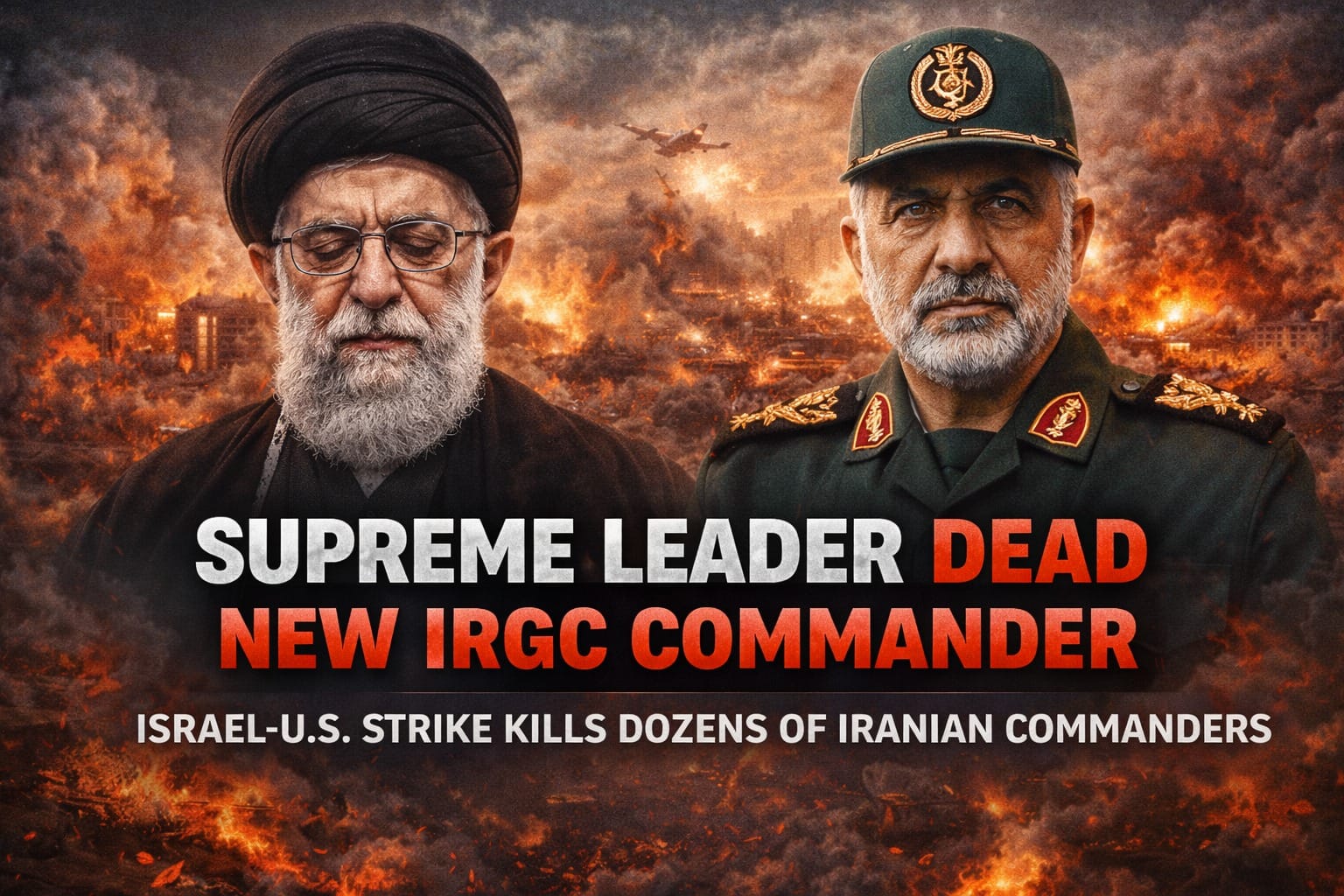
Supreme Leader Ayatollah Ali Khamenei Killed
In a dramatic escalation of Middle East hostilities on 28 February 2026, a coordinated military offensive by Israel and the United States struck multiple Iranian cities — including Tehran’s downtown, missile and nuclear facilities — resulting in the deaths of Iran’s Supreme Leader and senior military commanders. This unprecedented attack has triggered a fierce Iranian retaliation and extensive geopolitical repercussions.
This article provides the latest updates on casualties, the leadership changes within Iran’s elite military, the rise of the new IRGC commander, and the ongoing dynamics of the Israel-US-Iran conflict.
Explosions Rock Tehran and Key Iranian Cities
In the early hours of 28 February, explosions were heard across Tehran, with smoke rising over multiple districts including University Street and the Jomhouri area — suspected sites targeted during the joint operations by Israel and the U.S. military. Sirens blared as the capital came under sustained bombardment.
Iran’s airspace was shut down, and widespread destruction was visible near key strategic locations, including areas associated with the highest echelons of the regime.
Also Read
Supreme Leader Ayatollah Ali Khamenei Dead — A Leadership Shock
One of the most consequential developments of the attack was the death of Iran’s Supreme Leader, Ayatollah Sayyid Ali Khamenei, who had led the Islamic Republic since 1989. Iranian state media, international outlets, and multiple sources confirmed his death following the Israeli-U.S. strikes — marking an extraordinary turning point in Iran’s political and military history.
Who Was Ali Khamenei?
Ayatollah Khamenei, Iran’s supreme religious and political authority, wielded extensive control over the Islamic Republic’s security apparatus and foreign policy for nearly four decades. His tenure saw the expansion of Iran’s nuclear program, deep involvement in regional proxy networks, and prolonged tensions with both the United States and Israel.
His death has created a significant leadership vacuum, triggering both mourning and nationalistic calls for revenge, while raising profound uncertainties about Iran’s future governance and military strategy.
Other Key Iranian Commanders Killed
In addition to Khamenei, several high-ranked Iranian military figures were reported killed in the attack:
Major General Mohammad Pakpour
- Commander of the Islamic Revolutionary Guard Corps (IRGC) from 2025 until his death.
- Pakpour was killed in the 2026 strikes as part of the joint U.S.-Israeli offensive, which specifically targeted senior military leadership.
The loss of Pakpour has dealt a significant blow to Iran’s military hierarchy, considering his extensive role within the IRGC’s ground forces and strategic operations.
Other Senior Leaders
Iranian state and international reports indicate that additional senior security officials and top regime figures close to the leadership were killed or severely impacted in the strikes.
New IRGC Commander: Brigadier General Ahmad Vahidi
Following the deaths of top military officials and the Supreme Leader, Iran appointed Brigadier General Ahmad Vahidi as the new Commander-in-Chief of the IRGC (Islamic Revolutionary Guard Corps) — one of the most powerful institutions in the country.
Who Is Ahmad Vahidi?
- Vahidi is a founding figure of the IRGC, with deep experience in Iran’s military and intelligence apparatus.
- He previously led the Quds Force, Iran’s key external operations unit responsible for directing regional proxy wars and asymmetric warfare.
- Vahidi has also served as Iran’s Defence Minister and is widely seen as a staunch hardliner with strong ideological and operational ties to the IRGC’s strategic doctrine.
His appointment signals a shift toward more aggressive military posture and escalation, with Iranian authorities announcing preparations for the most powerful offensive operation in the country’s history in retaliation for the strikes.
Also read – UAE hit by missiles in the midst of Iran US – Israel War
Mass Mourning and Iranian Reaction
Following the attack and the death of Khamenei:
- Thousands of mourners gathered in central Tehran, chanting slogans and expressing grief and anger toward the U.S. and Israel.
- State media announced 40 days of national mourning, reflecting the gravity of the loss of the Supreme Leader.
These events have ignited patriotic sentiment and calls for retaliation across Iran and among allied groups in the region.
Retaliatory Offensive by Iran
In response to the U.S.-Israeli strikes, Iran has launched multiple waves of missile and drone attacks targeting:
- Israeli cities including Tel Aviv
- U.S. military bases across the Gulf, including in Qatar, Kuwait, Bahrain, and Iraq
- Strategic installations linked to Western forces in the region.
These counter-strikes underline Tehran’s intention not only to resist the offensive but to extend the conflict beyond its borders.
Regional and Global Impact
The killing of Iran’s Supreme Leader and top commanders has intensified fears of a full-scale regional war. Key ripple effects include:
1. Gulf Security Risks
Countries across the Gulf Cooperation Council (GCC) are on high alert amid sustained missile exchanges and threats of escalation, increasing instability in one of the world’s most strategically sensitive regions.
2. Global Oil Markets
The Middle East remains crucial for global energy supplies. Heightened hostilities risk disrupting oil exports, particularly with missiles targeting strategic infrastructure and transport corridors.
3. Diplomatic Pressure
World powers including the European Union and some Middle Eastern nations have called for restraint while cautioning against prolonged warfare, emphasizing the need for diplomatic avenues to prevent wider devastation.
4. U.S. and Israeli Strategic Positioning
Washington and Jerusalem have framed the offensive as necessary to eliminate existential threats from Iran’s missile and nuclear capabilities, though this rationale remains internationally controversial and has drawn divergent reactions from global capitals.
What Comes Next? Key Developments to Watch
Leadership Transition in Iran
With Khamenei’s death, the Assembly of Experts — a powerful clerical body — is now tasked with choosing a new Supreme Leader, while the IRGC under Vahidi consolidates military control.
Escalation or De-Escalation?
Iran’s vows of a massive retaliatory campaign could intensify warfare, yet growing international concern may push toward negotiations or ceasefire efforts, depending on the willingness of key actors.
Civilian Impact
As heavy bombardment continues, civilian casualties and displacement are expected to rise, increasing pressure on humanitarian agencies and further complicating peacemaking efforts.
Conclusion: A New Phase in Middle East Warfare
The 2026 Israel-US strikes on Iran have fundamentally altered the region’s geopolitical landscape:
- The death of Supreme Leader Ayatollah Ali Khamenei marks a historical turning point.
- The appointment of Brigadier General Ahmad Vahidi as the new IRGC commander signals a more militant phase of Iranian defence strategy.
- The deaths of senior military figures like Mohammad Pakpour reflect the intensity and precision of the offensive.
With tensions now extending across the broader Middle East and global powers watching closely, the future of the conflict remains highly uncertain — poised between escalation and the slim prospects of renewed diplomacy.
SUBSCRIBE TO OUR YOUTUBE CHANNEL THE LOGIC STICK FOR MORE VIDEO INSIGHTS