







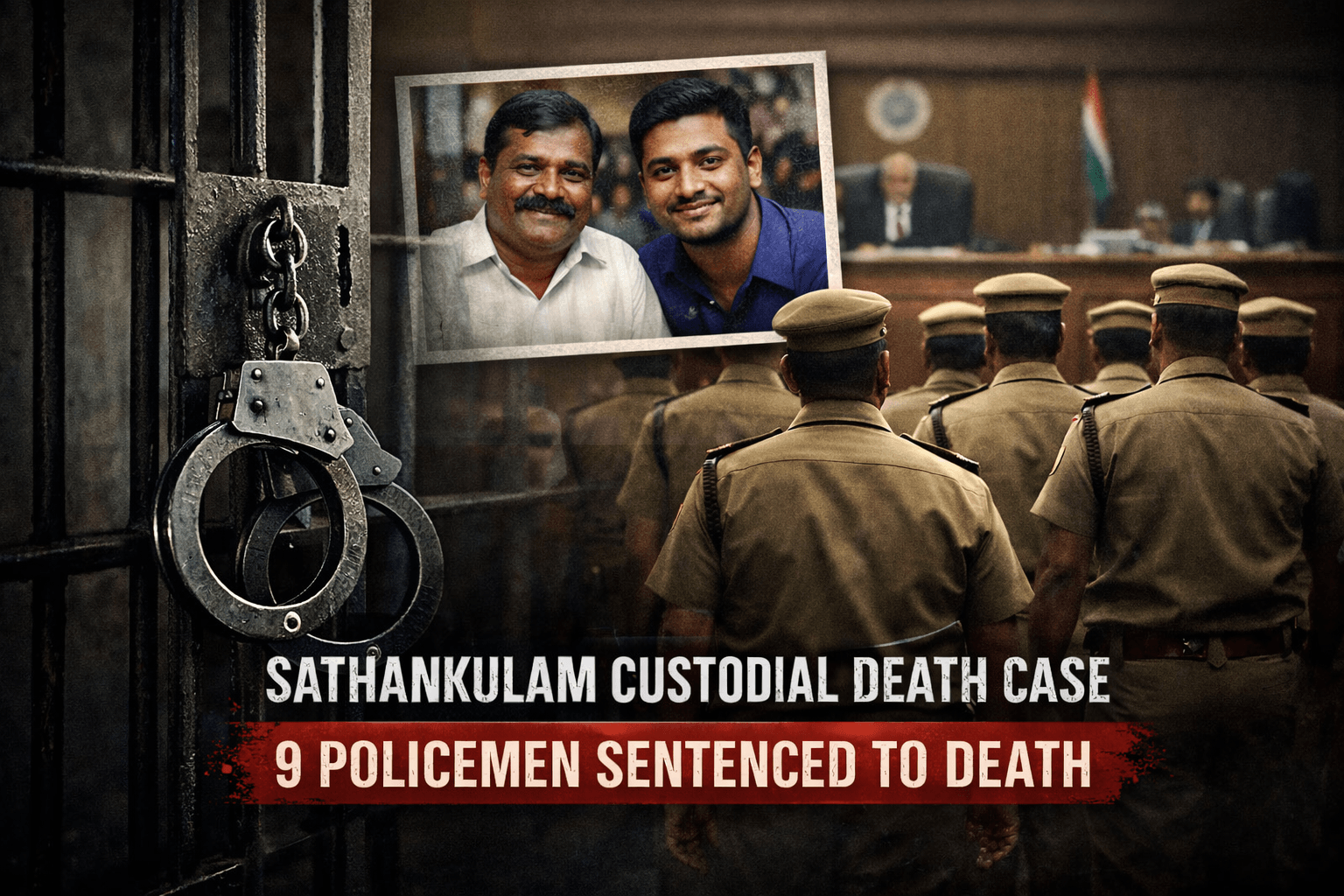
Tamil Nadu Custodial Death Case: Nine Policemen Sentenced to Death in Sathankulam Verdict
In one of the most consequential custodial violence judgments in recent Indian legal history, a court in Madurai has sentenced nine Tamil Nadu policemen to death for the 2020 custodial killings of a father and son in Sathankulam. The verdict, delivered on April 6, 2026, closes a major chapter in a case that had shaken the country during the Covid-19 lockdown and become a national symbol of police excess, weak accountability, and the urgency of justice in custodial death cases.
The case relates to the deaths of trader P. Jayaraj, 58, and his son J. Benicks, 31, who were taken into police custody in June 2020 in Sathankulam, in Tamil Nadu’s Thoothukudi district. Nearly six years later, the First Additional District and Sessions Court in Madurai sentenced the nine convicted policemen to capital punishment, with the court and prosecution describing the crime as an extraordinary abuse of police authority.
The judgment is significant not only because of the punishment awarded, but because of what the Sathankulam case came to represent. It was never seen merely as a local crime story. From the beginning, it became a test of whether a deeply disturbing allegation of custodial torture by police could be pursued to its legal conclusion despite institutional resistance, missing evidence, and delays in trial.
What happened in the Sathankulam custodial deaths case
According to current reports and the CBI’s case version cited in those reports, Jayaraj was taken from his shop near the Kamaraj statue at around 7.30 pm on June 19, 2020. Police initially claimed he had violated lockdown restrictions by keeping his shop open beyond permitted hours. But investigators later said that allegation did not hold up, and that he had, in fact, not violated the lockdown rules under which he was detained.
When his son Benicks came to the police station and objected to the treatment of his father, he too was wrongfully confined. The CBI version, as reported by Indian Express, says the two men were assaulted through the night to “teach them a lesson on how to behave with the police.” Investigators alleged that the father and son were forced to clean their own blood, and that evidence at the station was later cleaned up.
Reports on the case also described relatives seeing the two men the following morning in visibly terrible condition, with severe bleeding and soaked clothing. They were later remanded and sent onward into the system despite clear signs of physical abuse. Benicks died on June 22, 2020, and Jayaraj died the following day, on June 23, 2020.
Why the case shocked India
The Sathankulam case caused outrage across India because of the brutality alleged in custody and because of the institutional failures that appeared to follow. This was not simply a police violence story. It became a story about how multiple layers of the system appeared unable, or unwilling, to stop the abuse in time.
The case also triggered a wider public reckoning because it emerged at a time when lockdown enforcement was already under scrutiny. Two small traders being picked up over an alleged lockdown violation and then dying after severe custodial assault became, for many, a horrifying example of how unchecked police power could turn routine enforcement into a fatal abuse of the law.
High Court intervention and the role of the investigation
The Madurai Bench of the Madras High Court played a central role in keeping the case alive. According to Indian Express and NDTV, the High Court took suo motu cognisance of the matter in June 2020, ordered a judicial inquiry, and expressed distrust of the local police response. The court first directed the CB-CID to intervene until the CBI formally took over the investigation.
This judicial oversight proved crucial. NDTV’s report quotes the trial court as saying that, but for the continuous monitoring by the Madurai Bench of the Madras High Court, “the truth would have been buried.” That is an extraordinary observation, and it underlines how central court supervision was to the eventual prosecution.
Investigators also faced problems that have become familiar in custodial violence cases: allegations of missing or erased CCTV footage, delayed records, and non-cooperation from some police personnel. One woman constable’s statement reportedly became especially important, with investigators and the High Court relying on it as a key account of what happened inside the station.
Charges, trial and conviction
The CBI filed its chargesheet on September 25, 2020, and later filed a supplementary chargesheet on August 12, 2022, according to Indian Express. The trial then stretched on for years. In March 2021, the High Court had sought speedy completion, but the case continued amid repeated delays and procedural complications.
Eventually, on March 23, 2026, the Madurai court convicted all nine policemen in the double murder case. Current reports identify them as then inspector S. Sridhar; sub-inspectors K. Balakrishnan and P. Raghu Ganesh; head constables S. Murugan and A. Samadurai; and constables M. Muthuraja, S. Chelladurai, X. Thomas Francis, and S. Vailmuthu. A tenth accused, then special sub-inspector Paldurai, had died of Covid-19 in August 2020.
On April 6, 2026, Judge G. Muthukumaran sentenced the nine convicted policemen to death. That sentencing is what has brought the case back into national focus and turned it into a defining reference point in conversations about custodial death law in India.
Why the court awarded the death penalty
Current reports say the prosecution argued that the case fell within the “rarest of rare” standard, the legal threshold generally invoked when courts consider the death penalty in India. NDTV reported that the CBI pressed for the maximum penalty, describing the killings as a grave human rights violation and emphasizing the ghastly nature of the assaults.
The trial court’s remarks, as reported by NDTV, were severe. The court said the father and son were stripped and ruthlessly assaulted in front of each other as an act of vendetta. It also said this was a clear “case of abuse of authority” and stressed that public servants drawing salaries from the state cannot cite work stress as a justification for such conduct.
These observations matter because they frame the crime not as a spontaneous excess or an accidental death in custody, but as a deliberate and shocking misuse of state power. That distinction goes to the heart of why the punishment in this case is so significant.
A landmark in the debate on custodial violence in India
India has long struggled with allegations of torture, custodial assault, and suspicious deaths in police custody. What makes the Sathankulam case stand out is not only the brutality of the underlying facts, but the fact that the legal process actually moved from outrage to investigation, from investigation to conviction, and from conviction to the maximum sentence.
That does not mean the wider problem is solved. If anything, the case underlines the opposite. Without intense public pressure, media attention, and direct judicial monitoring, the outcome might have been very different. The case therefore stands as both a rare example of accountability and a reminder of how difficult accountability still is in custodial violence cases.
Read more on Nandigram Voter Controversy 2026
What this verdict means for policing and public trust
The verdict is likely to influence future debates on policing standards, custodial safeguards, station surveillance, judicial remand procedures, and witness protection in cases involving police personnel. It also sends a message that the uniform cannot be used as a shield against criminal liability when the evidence points to torture and murder.
At the same time, the court appears to have tried to separate accountability from institutional panic. NDTV reported that the court said the ruling should not instill fear among honest police officers. That line is important because it signals that the judgment is meant to punish criminal abuse of power, not weaken legitimate policing.
For the public, however, the case remains a wound. The image of a father and son picked up during lockdown and dying after a night in custody has stayed in India’s collective memory. The sentencing may offer a measure of justice, but it cannot undo the deeper loss or the damage done to trust in the system.
Conclusion
The Sathankulam custodial deaths case has now entered India’s legal history as one of the starkest examples of punishment for custodial killings by police. The sentencing of nine Tamil Nadu policemen to death by the First Additional District and Sessions Court in Madurai marks a major judicial milestone in the long fight for accountability in the deaths of P. Jayaraj and J. Benicks.
But the deeper lesson of the case lies beyond the punishment itself. The verdict is also an indictment of a system that required years of pressure, court monitoring, and national outrage before justice moved forward. The real test now is whether India treats this as an exceptional case to remember, or as a turning point to reform how custodial violence is investigated, prosecuted, and prevented.