




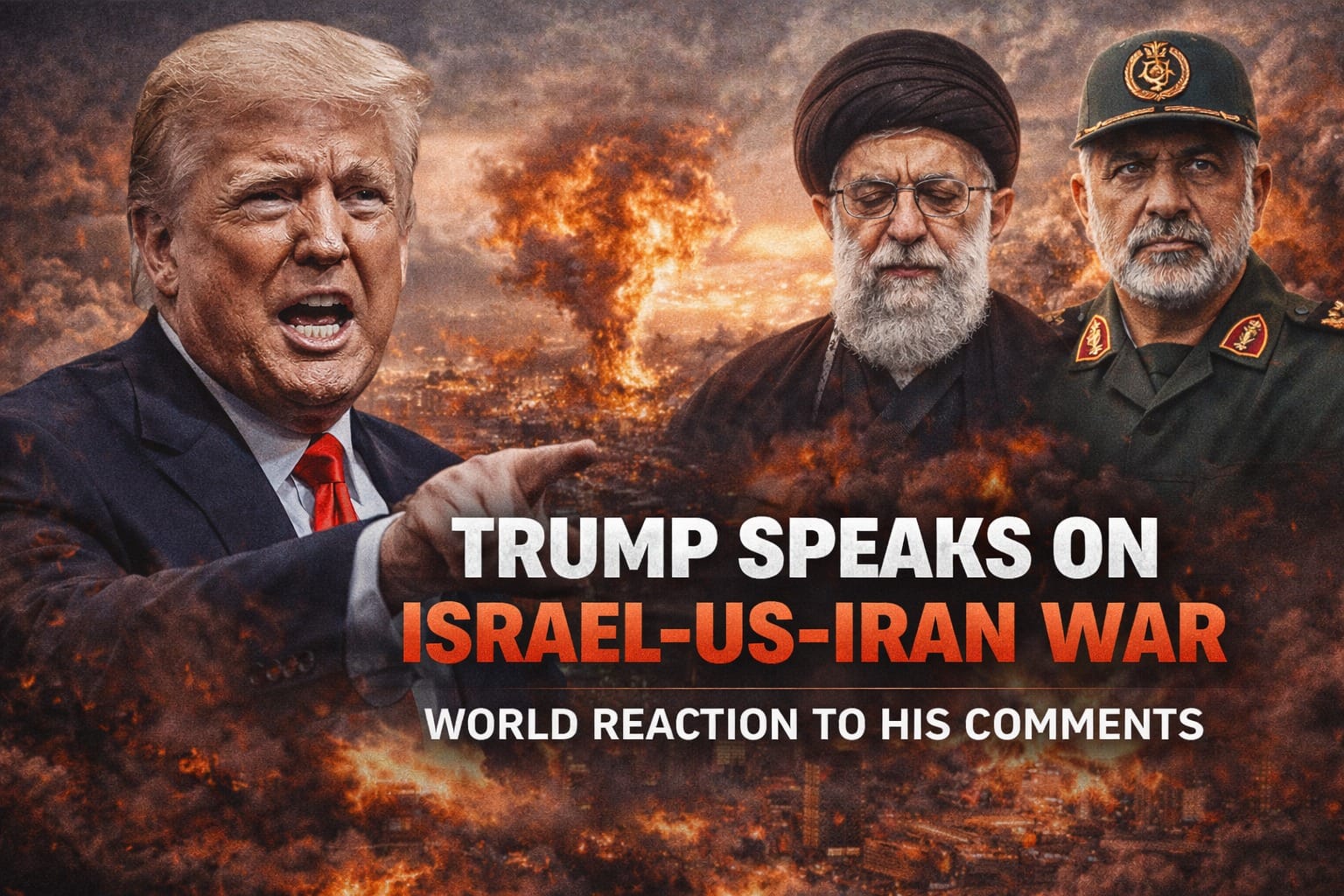
Trump on the Israel-US-Iran War 2026: Full Statements
In late February 2026, a major military confrontation erupted in the Middle East after Israel and the United States carried out coordinated strikes on Iran — a historic escalation that has profoundly impacted global geopolitics. Central to this conflict are the statements, strategy, and rhetoric of U.S. President Donald Trump, whose comments have shaped international responses and stirred intense debate both at home and abroad.
This article breaks down:
- All of Trump’s major statements on the conflict
- His justification for military action
- Calls for regime change
- Warnings, threats, and ideological framing
- How different world actors reacted
Trump’s Initial Statement on the Strikes: Major Combat Operations
Shortly after the attacks began, President Donald Trump released an official video statement, outlining the rationale and strategic objectives of the U.S. military’s involvement in Iran — which he described as “major combat operations”.
Key Points from Trump’s Statement
In his address, Trump said:
- The United States had commenced major combat operations in Iran.
- The goal was to defend American people and allies by dismantling “imminent threats from the Iranian regime.”
- Iran was described as “the world’s number one state sponsor of terror,” with longstanding hostility toward the U.S. and its partners.
- Trump warned that U.S. casualties were possible, acknowledging that war incurs losses but claiming the action was necessary for long-term security.
- He said Iran had repeatedly pursued nuclear and missile programs, which he framed as existential threats.
- Trump emphasized that Iran’s leadership had supported hostile activities for decades.
This speech marked the first formal White House explanation for why American forces were actively engaging targets in Iran alongside Israeli partners.
ALSO READ
Trump’s Call on Iranians to Rise Up
Beyond military justification, Trump shifted his rhetoric toward internal regime change in Iran — a dramatic escalation from prior U.S. policy approaches.
Direct Address to the Iranian People
In a separate video and social media posts, Trump called on the Iranian public to “take over your government,” portraying the conflict not only as military intervention but as an opportunity for Iranians to overthrow their leaders.
Quoting Trump’s words:
“When we are finished, take over your government. It will be yours to take. This will probably be your only chance for generations.*”
This marked a radical departure from traditional diplomatic messaging — inviting internal upheaval in another sovereign nation during an active conflict.
Trump’s Explosive Claims on Iran’s Regime and Nuclear Intentions
Trump repeatedly framed the conflict as part of a broader fight against what he described as a “evil” and dangerous regime.
Framing the Iranian Government
Trump accused the Iranian leadership of:
- Supporting militant proxies
- Endangering U.S. forces and allies
- Pursuing nuclear weapons despite years of negotiation attempts
- Repressing internal dissent and killing protestors
He emphasized that Iran “keeps pursuing nuclear work and missile development,” justifying continued American action.
Warnings and Threats: Escalation or De-escalation?
Trump’s rhetoric also included stern warnings directly to Tehran.
Forceful Warnings Against Retaliation
Trump issued a strong public message warning Iran not to escalate attacks on U.S. forces or interests, promising to respond “with a force that has never been seen before” if Iran carried out significant retaliation.
This aggressive stance signaled that the U.S. was prepared to expand its military engagement if deemed necessary, raising fears of wider conflict.
Also read – Arvind Kejriwal Discharged From the Liquor Scam Case
Trump’s Description of the Mission: Freedom and Regime Change
In part of his remarks, Trump framed the mission in moralistic terms.
Operation “Epic Fury” and Freedom
Referencing the military campaign (described by analysts as Operation Epic Fury), Trump said the objective was not just defense but securing freedom for the Iranian people and dismantling toxic governance structures.
He reportedly said that the operation sought to both eliminate immediate security threats and create conditions for a new political future inside Iran.
Domestic Reactions in the United States
Trump’s statements have produced divided reactions within the U.S. political landscape.
Support from Some Lawmakers
Certain Republican Senators and allies publicly supported the action as a necessary defense against threats, aligning with Trump’s national security priorities.
Criticism and Concerns in Congress
Opposition came from some members of Congress, who condemned the strikes as “unauthorized acts of war” and argued that Trump overstepped constitutional powers without explicit congressional approval.
This tension underscores the domestic debate over executive authority in war powers and military engagement abroad.
Global Reaction to Trump’s Statements and Actions
International responses to Trump’s rhetoric have been mixed and often critical.
Statements from Regional Neighbors
Some Middle Eastern countries expressed deep concerns:
- Oman’s Foreign Minister reportedly told the United States, “This is not your war,” indicating scepticism about external militaries deciding Middle East outcomes.
European Condemnation
European Union institutions issued statements expressing worry over the attack’s humanitarian and security consequences, calling for restraint and diplomacy to avoid further civilian suffering.
Russia’s Strong Condemnation
Russia sharply criticized the U.S. and Israel, accusing Trump of plunging the region into chaos and warning that the assault could have catastrophic consequences beyond immediate borders. Russian officials also questioned U.S. motives and strategic judgment.
Local Political Opposition
Even within U.S. cities, leaders voiced opposition — for instance, the mayor of New York City condemned the strikes as unlawful military aggression, highlighting public unease with the war’s trajectory.
The World Is Watching: Broader Implications
Trump’s comments have not just shaped military policy — they have influenced geopolitical discourse:
Shifts in U.S. Strategic Posture
Trump’s rhetoric signaled a doctrinal shift from deterrence to regime change strategy, making allies and adversaries reevaluate their security calculations.
Impact on Iranian Internal Dynamics
By calling for Iranians to “take over” their government, Trump’s statements have entered Tehran’s internal political narrative — potentially emboldening dissidents while also giving hardliners justification for repression.
Heightened Risk of Wider War
Warnings of greater force if Iran retaliates further have raised alarms about escalation, with experts cautioning that the conflict could expand into a broader regional war if responses spiral unchecked.
Conclusion: Trump’s Rhetoric and the Future of the War
President Trump’s statements on the Israel-US–Iran War of 2026 have defined this conflict’s narrative from the outset. His remarks:
- Justified the military strikes as necessary for U.S. and allied security
- Cast the conflict as a fight for freedom and regime change inside Iran
- Directly urged Iranians to overthrow their government
- Warned of unparalleled force in response to escalation
- Sparked intense domestic and international reactions
From ardent support within parts of the U.S. political class to global condemnation from world leaders, Trump’s comments have amplified both the stakes and the risks of this war. As the conflict continues, his statements will likely remain central to international debate and evolving strategies around diplomacy, containment, and regional security.