





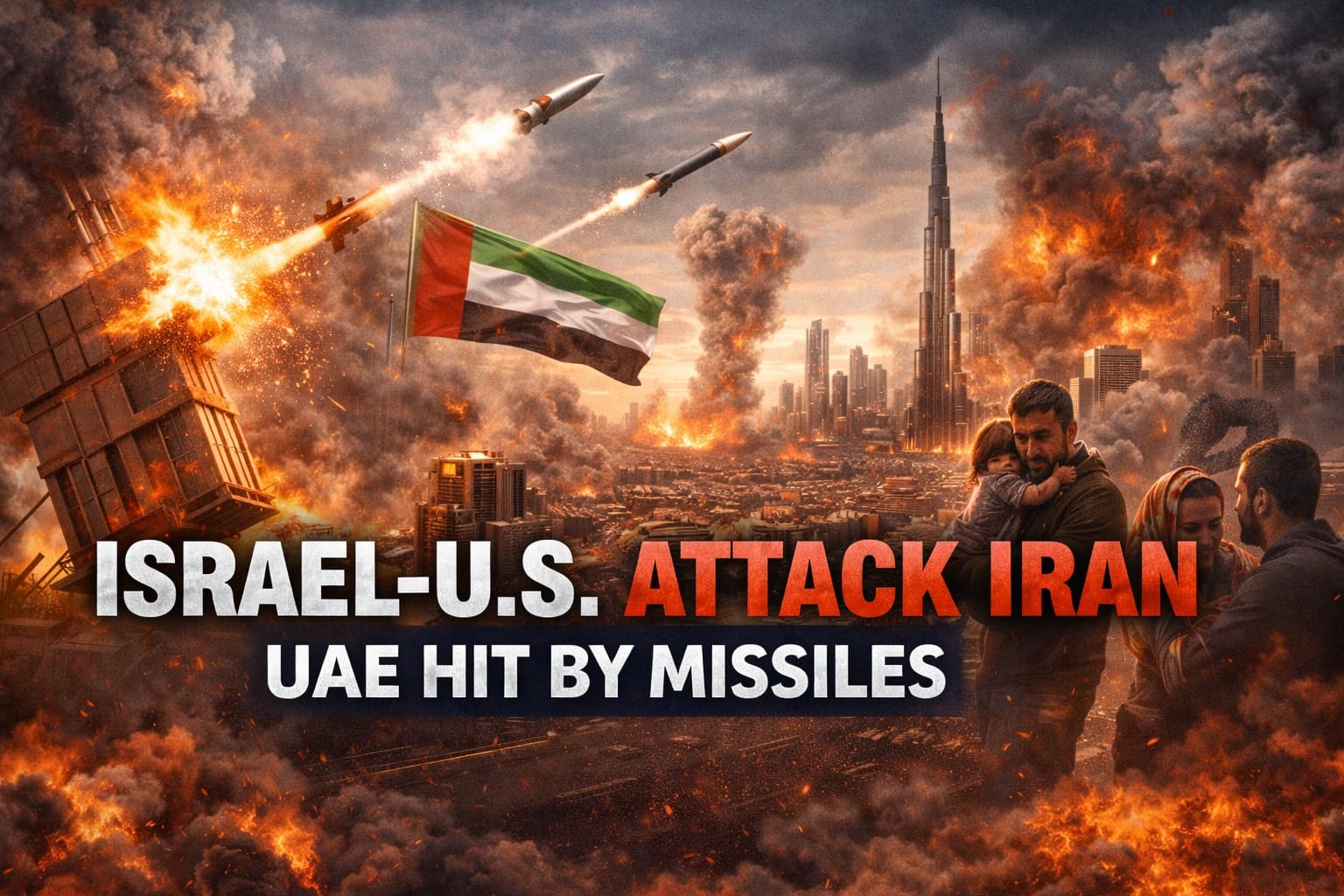
UAE Hit by Missiles
In a historic escalation on 28 February 2026, Israel and the United States launched a joint military assault on Iran, marking the most serious confrontation in years between Tehran and Western-aligned forces. The offensive — described by Israeli officials as a pre-emptive strike and by U.S. leadership as the beginning of “major combat operations” — triggered explosions in Tehran’s downtown, retaliatory missile fire across the Middle East, and direct impacts on the United Arab Emirates (UAE).
This updated report explores the latest developments, regional spillover, and civilian consequences following the widening conflict.
Explosions in Tehran & Initial Strike on Iran
Early on 28 February, explosions rocked central Tehran, with smoke rising over key districts including University Street and the Jomhouri area, according to Al Jazeera correspondents on the ground. The blasts followed Israeli Defence Minister Israel Katz’s announcement that Israel had launched a “pre-emptive missile attack” against Iran in coordination with the U.S., intended to counter perceived threats from Iran’s missile and nuclear capabilities.
The coordinated operation, widely reported by international media, targeted military and strategic sites across Tehran and other Iranian cities, while airspace throughout the region was quickly shut as tensions spiked.
Regional Spread: Iran’s Retaliation & Missile Barrages
In response to the strikes, Iran’s Revolutionary Guard and military launched multiple ballistic missiles and drones aimed at Israel and U.S. military installations throughout the Gulf region.
Explosions were reported in various locations outside Iran — including Abu Dhabi in the UAE, Manama in Bahrain, and other Gulf capitals — as regional air defences worked to intercept incoming threats. Gulf nations including Qatar, Kuwait, Iraq and the UAE closed their airspace and activated air defence systems amid the escalating exchanges.
UAE on Alert: Missile Interceptions & Civilian Impact
Missiles Intercepted Over UAE
The UAE’s air defence systems successfully intercepted several Iranian missiles targeted at its territory, with the state news agency confirming interceptions over Abu Dhabi. One person was reportedly killed in the capital when debris from a downed missile struck a civilian area, marking one of the conflict’s first recorded casualties outside Iran and Israel.
Airspace Shutdown & Travel Chaos
Sky-high tensions have forced the UAE to close its airspace, deeply disrupting commercial aviation across the Middle East. Major carriers including Turkish Airlines and others have suspended flights to and from the UAE, Qatar, Kuwait, and Israel for safety reasons, with international airlines rerouting or cancelling services entirely.
These disruptions follow the closure of regional corridors traditionally used for Europe-Asia travel, intensifying logistical challenges for global air traffic amid the conflict.
Civil Defence & Public Alerts
Residents in cities like Abu Dhabi and Dubai reported loud explosions and emergency alerts as air defence systems engaged incoming threats. Governments urged citizens and foreign residents to take shelter, heightening public anxiety and illustrating how the war’s effects now extend beyond active battlefields into urban civilian life.
Also read – Afghanistan and Pakistan War Updates
International Response & Security Warnings
With hostilities escalating beyond Iran’s borders, multiple countries — including the UK, Germany and Australia — issued warnings to their citizens in the region, urging caution and emphasizing humanitarian concerns. These diplomatic advisories underscore global fears of a broader regional conflict rather than a limited bilateral exchange.
Why This Matters: Wider Strategic Stakes
Middle East Power Balance
The Israel-Iran attacks have deep roots in decades of geopolitical rivalry — chiefly over Iran’s nuclear program, missile capabilities, and support for armed proxy groups. Israel and the U.S. have long viewed Tehran’s strategic posture as an existential threat, prompting aggressive preventative actions now manifesting in open military confrontation.
Economic Repercussions
The impact of Gulf airspace closures and missile threats has already upended global travel routes and poses risks to international trade and energy markets. The UAE, a major logistical and financial hub in the region, has borne direct consequences through disrupted flights and heightened security alerts.
Regional Stability at Risk
With missiles now flying toward sensitive locations — including military bases, civilian areas, and urban centers — fears of protracted war have grown. Analysts warn that unless de-escalation mechanisms are urgently pursued, the conflict could draw additional regional powers into open hostilities.
Conclusion: Escalation Beyond Borders
What began as a targeted military strike by Israel and the United States against Iranian strategic assets has rapidly evolved into a wider regional conflict, with the UAE experiencing missile exchanges and civilian impact alongside other Gulf states.
With flights suspended, airspace closed, and regional populations caught in the crossfire, the Middle East stands at a critical turning point. Diplomatic backchannels remain crucial to prevent further military escalation as the international community watches what could become one of the most consequential conflicts of the 21st century.
Subscribe to out YouTube Channel The Logic Stick for more video insights