







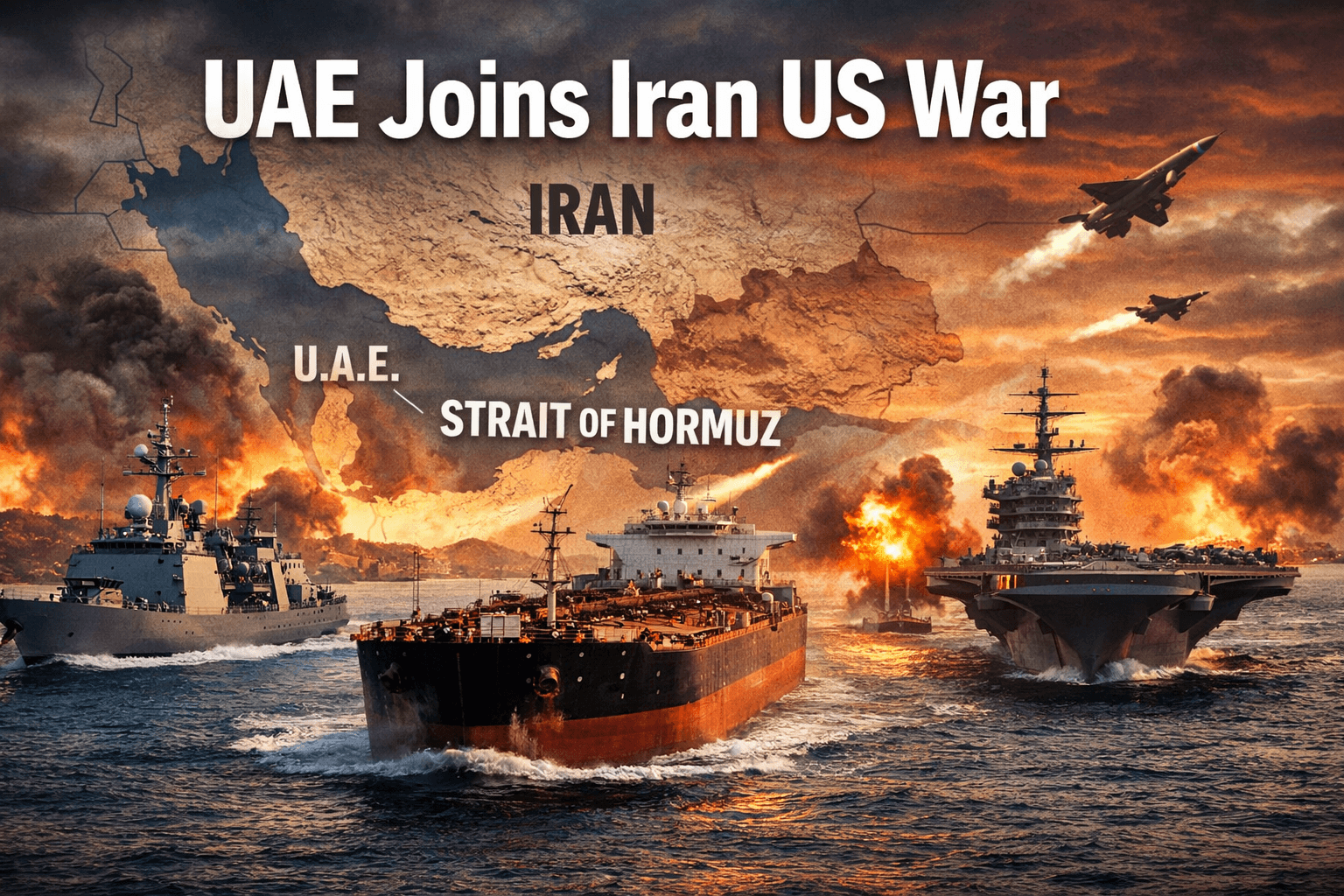
UAE Joins Iran US War? Strait of Hormuz Crisis Signals Strategic Shift, Not Full Military Entry Yet
The headline “UAE joins Iran US war” has been widely circulating across media platforms—but the reality is more complex and requires careful fact-checking.
As of early April 2026, the United Arab Emirates has NOT officially entered the Iran–US war as a combatant, but it has expressed willingness to support a US-led or multinational effort to reopen the Strait of Hormuz, a move that could still pull the Gulf nation deeper into the conflict.
This distinction is critical.
The situation represents a strategic shift—not a confirmed declaration of war—but one that could escalate into a wider regional confrontation if tensions continue to rise.
What Is Actually Confirmed: UAE’s Position
Recent verified reports confirm the following:
- The UAE is considering joining a multinational maritime coalition to reopen the Strait of Hormuz
- It is lobbying for a UN Security Council resolution to authorize military action
- It is pushing for the creation of a “Hormuz Security Force” involving multiple countries
- The UAE has not yet committed to direct combat operations, but is evaluating roles like mine-clearing and logistics support
In simple terms:
UAE is preparing for possible involvement—but has not officially “joined the war.”
Background: How the Iran War Reached This Point
The current crisis began in late February 2026 when:
- The United States and Israel launched coordinated strikes on Iran
- Iran retaliated with missile attacks across the region, including Gulf states
- The conflict rapidly expanded into a multi-front regional war
Soon after, Iran took its most consequential step:
- It restricted or effectively shut down the Strait of Hormuz, warning ships against transit
This single move triggered a global crisis.
Why the Strait of Hormuz Is the Center of the Crisis
The Strait of Hormuz is not just a regional shipping lane—it is the lifeline of global energy supply.
- Around 20% of the world’s oil passes through it daily
- Tanker traffic has dropped drastically during the crisis
- Shipping insurance costs have surged sharply
- Global energy markets have been destabilized
Within days of the conflict:
- Tanker movement dropped by over 90% in some estimates
- Oil prices and inflation fears surged worldwide
This is why reopening Hormuz has become the top strategic priority for the US and its allies.
Why UAE Is Now Considering Military Support
The UAE’s shift is driven by direct threats and economic pressure.
1. Iranian Attacks on UAE Territory
Iran has launched missile and drone attacks targeting Gulf countries, including UAE infrastructure and ports.
There have also been incidents like:
- Drone strikes on oil-related assets in the UAE region
This has pushed UAE from a defensive posture to a more aggressive strategic stance.
2. Economic Dependence on Trade & Stability
The UAE’s economy relies heavily on:
- Global trade routes
- Shipping logistics
- Oil exports
- Tourism and aviation
Any disruption in Hormuz directly threatens:
- Dubai’s port economy
- Abu Dhabi’s oil revenues
- Investor confidence
3. Regional Power Pressure
The UAE is not acting alone.
- Saudi Arabia and UAE are reportedly pushing for stronger action against Iran
- Other Gulf states are divided—some want diplomacy, others want confrontation
This creates a regional alignment pressure where neutrality becomes harder.
US Strategy: Coalition, Not Solo War
The United States has already launched a campaign to reopen the Strait:
- Airstrikes targeting Iranian naval and drone capabilities began in March 2026
- The US is actively seeking international partners to share the burden
However:
- Many countries have refused to join military operations so far
- Even allies like Europe have shown hesitation
This is where the UAE becomes crucial.
Read more on ED issues notices to Dubai Property Buyers.
Important Fact Check: UAE Has NOT Declared War
Let’s clear the biggest misinformation:
Claim: UAE has joined the Iran-US war
Reality:
- UAE is considering participation in a coalition effort
- No official declaration of war
- No confirmed direct combat deployment yet
Even official statements emphasize:
- “Freedom of navigation must be preserved”
- Collective global responsibility rather than unilateral war
What Happens If UAE Fully Joins?
If the UAE moves from support → active combat, the consequences could be massive:
1. Direct Gulf War Scenario
- Iran could target UAE cities like Dubai and Abu Dhabi
- Regional missile warfare could escalate
Experts have already warned that UAE cities could become high-risk targets if it enters the conflict
2. Expansion of War Theatre
The conflict is already spreading across:
- Israel
- Lebanon (Hezbollah involvement)
- Gulf states
Adding UAE as a direct participant could:
- Trigger wider Arab involvement
- Increase proxy warfare
3. Global Oil Shock
The biggest impact remains economic:
- Oil prices could spike dramatically
- Supply chains could collapse
- Global inflation could surge
The Strait’s closure is already affecting markets and trade routes globally.
Impact on India: A Silent Stakeholder
India is deeply connected to this crisis.
1. Oil Dependency
India imports a large portion of its crude oil from the Gulf.
Any disruption means:
- Higher fuel prices
- Inflation in daily goods
2. Indian Diaspora in UAE
Millions of Indians live and work in the UAE.
Escalation could:
- Put lives at risk
- Trigger evacuation challenges
3. Trade and Logistics
India’s trade routes pass through the Gulf.
Disruptions could:
- Delay shipments
- Increase costs
- Affect exports and imports
UN and Global Response
The United Nations has already stepped in:
- A resolution condemning Iranian attacks on Gulf states has been passed
However:
- Russia and China have shown resistance to Western-led narratives
- Global consensus remains divided
This weakens the chances of a unified international response.
Is Diplomacy Still Possible?
Despite rising tensions, diplomacy is not completely off the table:
- UAE is pushing for a UN-backed framework, not unilateral war
- Some Gulf countries still prefer negotiations
- International actors like China are advocating restraint
However, the situation is fragile.
Every new attack reduces the chances of peace.
The Real Headline: A Strategic Shift, Not War Declaration
The most accurate way to understand the situation is:
- UAE is moving from neutral observer → strategic participant
- But not yet a full military combatant
This is a grey zone moment—and these moments are often the most dangerous.
Conclusion
The phrase “UAE joins Iran US war” may sound dramatic, but the truth is more nuanced.
What we are witnessing is:
- A major geopolitical shift in the Gulf
- Rising pressure to reopen a critical global oil route
- Increasing likelihood of broader regional involvement
The Strait of Hormuz crisis is no longer just about Iran and the US—it is becoming a global issue with economic and security consequences.
If UAE crosses the line into active military engagement, the conflict could transform into:
- A full-scale Gulf war
- A global energy crisis
- A defining geopolitical moment of the decade
For now, the world waits.
But the direction is clear:
The Middle East is standing on the edge—and one decision could change everything.