







Every year, millions of Indians eagerly watch the Union Budget—the country’s most important economic event. It determines how public money will be raised and spent, influences growth and inflation, and directly affects citizens, businesses, and the markets.
In 2026, India’s Union Budget is especially significant. Against the backdrop of global geopolitical uncertainty, tariff changes internationally, and key domestic priorities like infrastructure, MSME support, tax reforms, and ordinary citizens’ financial well-being, expectations are high from Finance Minister Nirmala Sitharaman.
This article explains the Union Budget in complete detail—what it is, when and why it matters, what it includes, and its impact on diverse stakeholders, including the common man, small business owners, and financial markets.
CLICK HERE: UNION BUDGET 2026 EXPLAINED IN SIMPLE WORDS
📆 1. Date and Timing of the Union Budget 2026–27
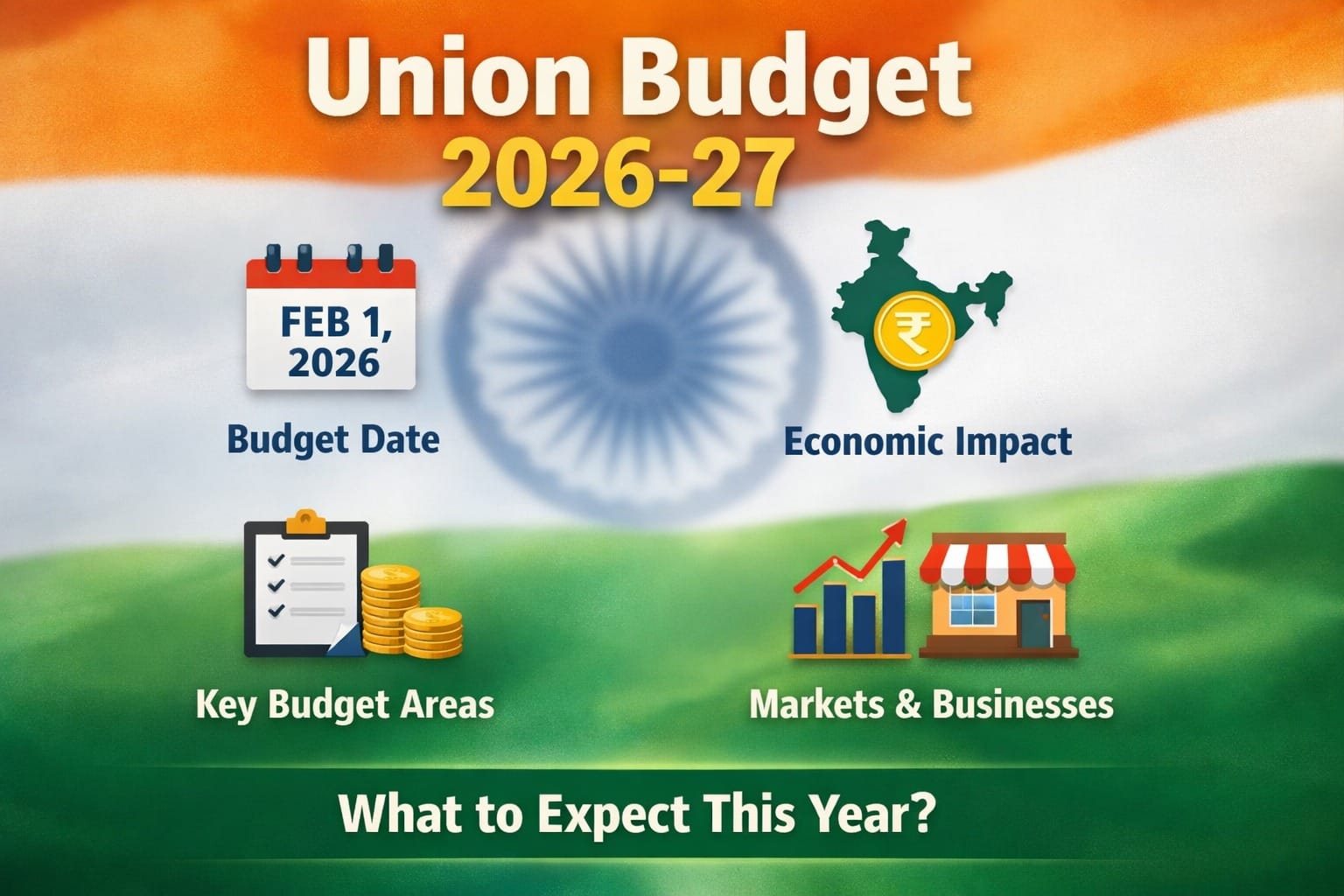
The Union Budget 2026–27 is scheduled to be presented on 1st February 2026 at around 11:00 AM in the Lok Sabha by Finance Minister Nirmala Sitharaman.
This year is notable for two reasons:
- It is the first time in India’s recent history when the Union Budget is being presented on a Sunday, reflecting a possible shift in tradition for this high-profile national event.
- The Budget session of Parliament officially begins on 28th January 2026, with the Finance Minister’s speech forming the key highlight at the start of February.
📌 2. What the Union Budget Means for India
🧠 Definition
The Union Budget of India is the annual financial statement presented by the government under Article 112 of the Indian Constitution. It outlines the estimated revenues and expenditures for the upcoming financial year.
In simple terms, the Budget shows:
- How much money the government expects to earn (through taxes, duties, fees, etc.)
- How much it plans to spend (on social welfare, infrastructure, defence, education, subsidies, and more)
- The fiscal priorities of the nation for the coming year
Thus, the Union Budget is India’s blueprint for its economic strategy—influencing growth, jobs, inflation, investment, and equity in society.
🧭 Why It Matters
The Budget is not just a technical document for economists—it directly impacts the everyday lives of citizens.
Here’s why the Union Budget is critically important:
✔ National Economic Plan: It is the government’s main tool for managing the economy’s direction for the next year.
✔ Resource Allocation: It decides how limited public money will be allocated to sectors like health, education, infrastructure, and defence.
✔ Tax Policies: Changes in tax laws directly affect disposable incomes and consumer spending.
✔ Business Climate: Corporate taxes, incentives, and regulatory changes influence business profitability and investor sentiment.
✔ Confidence Indicator: Markets and investors closely watch budget announcements as a signal of future economic policy.
In essence, the Union Budget shapes the economic health and trajectory of India year after year.
📊 3. What Is Included in India’s Union Budget?
The Union Budget is a detailed compilation of economic plans. It includes multiple financial and policy components that together define the government’s strategy.
🧾 a. Revenue Estimates
These are the expected income streams of the government, including:
- Tax Revenue: Income tax, corporate tax, GST, customs duties, excise duties, etc.
- Non-Tax Revenue: Fees, fines, interest earnings, dividends from public sector units, etc.
- Capital Receipts: Borrowings, loans, and disinvestment proceeds.
Revenue estimates show how much money the government expects to collect in total.
💰 b. Expenditure Estimates
These are planned government expenditures, including:
🔸 Plan Expenditure
Funds allocated for specific government programs.
🔸 Non-Plan Expenditure
Mandatory spending—salaries, pensions, debt servicing, subsidies.
🔸 Capital Expenditure
Spending on infrastructure, roads, railways, airports, power, and digital connectivity.
🧠 c. Fiscal Deficit
The difference between the government’s total revenue and total expenditure is the fiscal deficit. It indicates the government’s dependency on borrowings. A rising deficit affects interest rates, inflation, and long-term economic stability.
📊 d. Tax Policies & Changes
This includes:
- Income tax slabs
- Corporate tax changes
- Customs duty rationalization
- GST structure modifications
- TDS/TCS changes
- Tax incentives for investment or export:
Expectations this year include TDS rationalisation and a possible overhaul of customs duties in line with GST simplification.
🏗️ e. Sector-Specific Allocations
The Union Budget provides financial support to key sectors. These include:
✔ Infrastructure: Roads, railways, ports, urban transport
✔ Agriculture: Farmer support, rural development
✔ Education & Health: Funding for schools, universities, hospitals
✔ Technology & Innovation: Initiatives for AI, startups, digital economy
✔ Defence: Equipment procurement, modernization
✔ MSME Support: Credit support, tax benefits
✔ Exports: Schemes to boost international trade
📘 f. Welfare Schemes & Subsidies
The Budget also directs funds toward:
✔ Food subsidies and PDS support
✔ Health insurance and Ayushman Bharat expansions
✔ Schemes for women, youth, and marginalized communities
✔ Employment and skill development programs
📈 g. Policy Statements and Future Roadmap
Beyond numbers, the Union Budget often includes strategic policy declarations—guidelines for sectors like green energy, digital infrastructure, manufacturing, and social welfare.
Also read – Everything You Need To Know About BRICS Currency “UNIT”
🧑🤝🧑 4. How the Union Budget Helps the Common Man
One of the most important sections of public interest is how the Union Budget affects ordinary citizens—salaried professionals, retirees, students, homemakers, and small savers.
💵 a. Impact on Personal Income
Changes in personal income tax rates, exemptions, and rebates directly affect the take-home pay of citizens. In recent years, the new tax regime has provided relief for middle-income taxpayers with higher exemption thresholds and simplified rules—and similar adjustments are being anticipated this year too.
🏠 b. Cost of Living Adjustments
Budget policies often influence the cost of essential commodities (fuel, electricity, food grains) through subsidies or tax changes. This, in turn, affects household budgets.
A well-balanced Budget aims to prevent inflation from escalating and preserve purchasing power.
📈 c. Savings and Investments
Budget decisions influence savings behavior in multiple ways:
✔ Changes in interest income taxation
✔ Incentives for long-term investments
✔ Modifications in capital gains tax
✔ Impact on mutual funds and stock market investment
These factors affect how individuals plan retirement, child education, and other long-term goals.
🚑 d. Healthcare and Social Security
Budgets often expand funding for healthcare infrastructure, insurance schemes like Ayushman Bharat, and social welfare programs. For lower-income groups, this translates to better access to healthcare and reduced out-of-pocket expenses.
👨🎓 e. Education and Skill Development
Increased allocation to education, vocational training, and skill development helps the youth improve employability, fostering long-term income growth.
🚜 f. Rural and Urban Support
Subsidies for farmers, rural employment schemes (e.g., MNREGA), and urban development projects improve incomes for millions and create job opportunities.
👉 According to recent reporting, decisions announced in the 2026 Budget related to exemptions, tax slabs, and fund allocations will directly influence salaries, savings, and prices for common citizens.
📈 5. Impact of the Union Budget on the Stock Market
The Union Budget is one of the most closely watched economic events by stock market participants, analysts, and investors alike.
📊 a. Budget Day Volatility
On the day the Budget is presented, the markets usually react swiftly. Traders adjust positions based on announcements affecting tax rates, capital expenditure, and sector-specific incentives.
📉 b. Tax Policies and Investor Sentiment
Budget changes such as:
- Capital gains tax adjustments
- Dividend distribution tax changes
- Tax incentives for listed companies
- TDS modifications
can influence investor sentiment in the short term and affect market valuations.
For example, expectations for higher exemption limits on long-term capital gains or relief in GST have a positive influence on stock valuations and investor confidence.
🏭 c. Sector-Specific Impact
Each sector reacts differently:
🔹 Infrastructure: Increased capex allocations may drive stocks in construction, engineering, and cement sectors.
🔹 Banking & Finance: Interest rate projections and bond yields influence banks’ profitability and loan growth.
🔹 Energy & Renewables: Budget focus on green energy or fossil fuel strategy can shift valuations.
🔹 MSMEs & Startups: Incentives here can lift small and mid-cap stocks.
🔹 Technology & AI: Allocations in digital economy programs boost tech stocks.
📉 d. Long-Term Direction vs Short-Term Noise
While short-term volatility is common on Budget day, most analysts emphasize that long-term market direction depends on underlying economic fundamentals, fiscal discipline, and growth strategy—not just headlines.
📌 For example, a disciplined approach towards fiscal deficit, sensible tax policy, and investments in future-oriented sectors generally favor sustained market growth.
🏪 6. Impact on Small Business Owners and MSMEs
Small businesses and MSMEs (Micro, Small & Medium Enterprises) are the backbone of the Indian economy—employing millions and contributing significantly to GDP.
📊 a. Credit and Cash Flow Support
A Budget that provides easier access to credit, lower interest rates, and incentives such as credit guarantee schemes can boost MSME growth significantly.
💸 b. Tax Compliance and Simplification
Small business owners often find tax compliance challenging. Simplification in TDS/TCS norms, filing procedures, and rationalisation of tax slabs helps reduce compliance burdens. For Budget 2026, reforms on customs duty rationalisation and TDS simplification are being widely discussed.
📈 c. Incentives for Growth and Export
Tax incentives, export promotion schemes, and special economic zones help small businesses expand into newer markets.
Given global tariff challenges and industry feedback, there is a push in this Budget to support export-facing MSMEs with favorable policies.
📦 d. Cost Competitiveness
Reduction in customs duties or rationalisation of GST for intermediate goods makes inputs cheaper for small manufacturers and traders, thereby improving competitiveness.
🔄 e. Digitalization and Formalization Incentives
Government initiatives promoting digital payments and formal registration (GST, UDYAM, etc.) help small businesses become part of the formal economy, allowing easier financing and scaling.
📘 7. What to Expect in This Year’s Union Budget by Nirmala Sitharaman
As Finance Minister Nirmala Sitharaman prepares to present the Ninth consecutive Union Budget in 2026, expectations are shaped by India’s macroeconomic priorities, global trade realities, and domestic demands from citizens and industries alike.
📌 a. Income Tax Relief and Rationalisation
Taxpayers and analysts expect:
✔ Potential adjustments in income tax slabs
✔ Higher exemptions or rebates for middle-class taxpayers
✔ Simplification of the new tax regime compared to the old system
✔ Revisions to reliefs related to home loan interest, insurance premiums, etc.
📌 b. Customs Duty Overhaul
There are strong calls for rationalising customs duties similar to the GST structure, which would reduce complexity, enhance transparency, and lower compliance costs.
📌 c. TDS and TCS Rationalisation
Stakeholders expect reforms in Tax Deducted at Source (TDS) and Tax Collected at Source (TCS) to reduce compliance pressure on individuals and businesses—making tax compliance less onerous.
📌 d. Capital Expenditure Push
Enhanced allocation for capital expenditure—especially in transport (railways, roadways), ports, and digital infrastructure—remains a top priority for boosting economic growth and improving connectivity across regions.
📌 e. Support for Export-Facing Industries
With global tariff tensions and trade barriers, export-oriented sectors seek targeted incentives, duty rationalisation, and ease of doing business measures.
📌 f. Green Energy and Sustainability
India is charting a course toward a greener economy, and budgetary support for clean energy, carbon reduction incentives, and climate-smart agriculture is widely expected.
📌 g. MSME and Startup Ecosystem Support
Proposals for credit facilities, tax incentives, and formalisation support for the huge MSME and startup ecosystem are anticipated.
📌 h. Social Welfare and Inclusive Growth
The budget is expected to continue funding for health, education, employment, and rural programs—that support inclusive growth across demographics.
8. Sector-Wise Expectations from Union Budget 2026–27
One of the most closely tracked aspects of every Union Budget is sector-specific allocation and policy direction. Each sector reacts differently based on how much financial and policy support it receives.
a. Infrastructure and Capital Expenditure
Infrastructure has been the backbone of India’s growth strategy over the last few years, and Budget 2026 is expected to continue this momentum.
Key expectations include:
- Higher allocation for roads, highways, and expressways
- Expansion of railway modernisation, including station redevelopment and freight corridors
- Increased focus on urban infrastructure, metro rail projects, and smart cities
- Continued support for ports, logistics, and warehousing
Infrastructure spending has a strong multiplier effect—it creates jobs, boosts demand for steel, cement, and construction materials, and improves long-term productivity. This is why economists widely expect capital expenditure to remain a top priority.
b. Railways: A Standalone Focus Area
Railways, once presented as a separate budget, now form a significant part of the Union Budget.
Expectations include:
- New semi-high-speed and Vande Bharat train expansions
- Improved safety measures and signalling systems
- Station redevelopment under PPP models
- Dedicated freight corridors to improve logistics efficiency
Railway investment not only enhances passenger convenience but also reduces logistics costs for businesses, especially MSMEs and exporters.
c. Agriculture and Rural Economy
Agriculture continues to employ a large section of India’s population, making it politically and economically significant.
Budget 2026 expectations for agriculture include:
- Enhanced allocation for PM-KISAN and rural income support schemes
- Increased investment in irrigation, storage, and cold-chain infrastructure
- Support for climate-resilient farming and sustainable agriculture
- Expansion of agricultural credit at affordable interest rates
Strengthening the rural economy directly boosts consumption, which in turn supports overall GDP growth.
d. Education and Skill Development
India’s demographic dividend depends heavily on education and skills.
Likely focus areas:
- Higher funding for school and higher education infrastructure
- Expansion of digital education platforms
- Skill development programs aligned with AI, data, manufacturing, and green jobs
- Greater public-private collaboration in vocational training
Investment in education is a long-term growth strategy, ensuring employability and innovation.
e. Healthcare and Social Security
Post-pandemic, healthcare has become a non-negotiable priority.
Budget 2026 expectations include:
- Increased healthcare spending as a percentage of GDP
- Expansion of Ayushman Bharat coverage
- Investment in medical infrastructure, diagnostics, and digital health
- Support for preventive healthcare and mental health programs
Healthcare spending reduces long-term economic burden by improving workforce productivity and lowering household medical expenses.
9. Impact of Union Budget on Inflation and Interest Rates
While not always discussed openly, the Union Budget plays a crucial role in influencing inflation and interest rates.
a. Government Borrowing and Inflation
If government spending significantly exceeds revenue, borrowing increases. Excessive borrowing can:
- Push up bond yields
- Increase interest rates
- Put pressure on inflation
Therefore, maintaining a controlled fiscal deficit is essential to prevent inflationary pressures.
b. RBI Coordination and Monetary Policy
Although the Reserve Bank of India controls interest rates, Budget policies indirectly influence RBI decisions.
For example:
- Higher capital expenditure without excessive borrowing supports growth without stoking inflation
- Fiscal discipline gives RBI room to manage rates effectively
- Subsidy rationalisation helps control price pressures
A well-balanced Budget supports macroeconomic stability, which benefits consumers, borrowers, and investors alike.
10. Union Budget and Employment Generation
Employment creation remains one of India’s biggest challenges.
a. Direct Employment Through Government Spending
Infrastructure projects, public works, and housing schemes generate large-scale employment—especially for semi-skilled and unskilled workers.
b. Indirect Employment via MSMEs
Support for MSMEs leads to:
- Expansion of small businesses
- Increased hiring
- Formalisation of jobs with better social security
c. Startup and Innovation-Driven Jobs
Budgetary support for startups, R&D, and innovation creates high-skill jobs in technology, manufacturing, and services.
Thus, employment impact is one of the most important hidden outcomes of the Union Budget.
11. How the Union Budget Affects Different Income Groups
a. Low-Income Groups
Benefits typically include:
- Food and fuel subsidies
- Affordable housing schemes
- Healthcare and education support
- Rural employment programs
For this segment, the Budget acts as a social safety net.
b. Middle-Income Groups
The middle class looks for:
- Income tax relief
- Higher exemption limits
- Lower indirect tax burden
- Affordable education and healthcare
Any tax rationalisation directly affects consumption patterns and household savings.
c. High-Income Individuals
For high earners, expectations revolve around:
- Capital gains taxation
- Wealth and inheritance-related clarity
- Simplification rather than additional complexity
Policy stability is often more important than concessions for this segment.
12. Union Budget and India’s Global Position
India’s Budget is closely watched by global investors, rating agencies, and foreign governments.
a. Foreign Investment Sentiment
Clear tax laws, stable fiscal policy, and infrastructure push improve India’s attractiveness as an investment destination.
b. Trade and Export Competitiveness
Customs duty rationalisation and export incentives help Indian businesses compete globally, especially amid global trade tensions.
c. Credit Rating and Sovereign Confidence
Fiscal discipline and growth-oriented policies influence sovereign credit ratings, which affect borrowing costs for the government and private sector.
13. Challenges Before the Union Budget 2026
Despite strong expectations, the government faces multiple constraints:
- Managing fiscal deficit while increasing spending
- Balancing tax relief with revenue needs
- Addressing global economic uncertainty
- Supporting growth without triggering inflation
- Ensuring inclusive development across regions
The success of Budget 2026 will depend on how effectively these challenges are addressed.
14. Why Union Budget 2026 Is Especially Important
Budget 2026 is significant because:
- India is aiming to maintain high growth momentum
- Global economic conditions remain uncertain
- Domestic demand needs continued support
- Structural reforms must continue without disruption
This Budget will likely set the tone for India’s medium-term economic direction, not just the next fiscal year.
Final Conclusion: Understanding the Union Budget Beyond Numbers
The Union Budget is far more than a financial statement—it is a reflection of the government’s vision for India.
Union Budget 2026–27 will:
- Influence how much you earn, save, and spend
- Shape business confidence and job creation
- Determine infrastructure growth and social welfare reach
- Guide investor sentiment and market direction
- Impact India’s global economic standing
Whether you are a salaried professional, a small business owner, an investor, or a student, the Union Budget affects your life in ways both visible and subtle.
As Finance Minister Nirmala Sitharaman presents this Budget, its true success will be measured not just by announcements, but by how effectively policies translate into sustainable growth, economic stability, and improved quality of life for Indians.
Subscribe to our YouTube Channel The Logic Stick for more video insights