







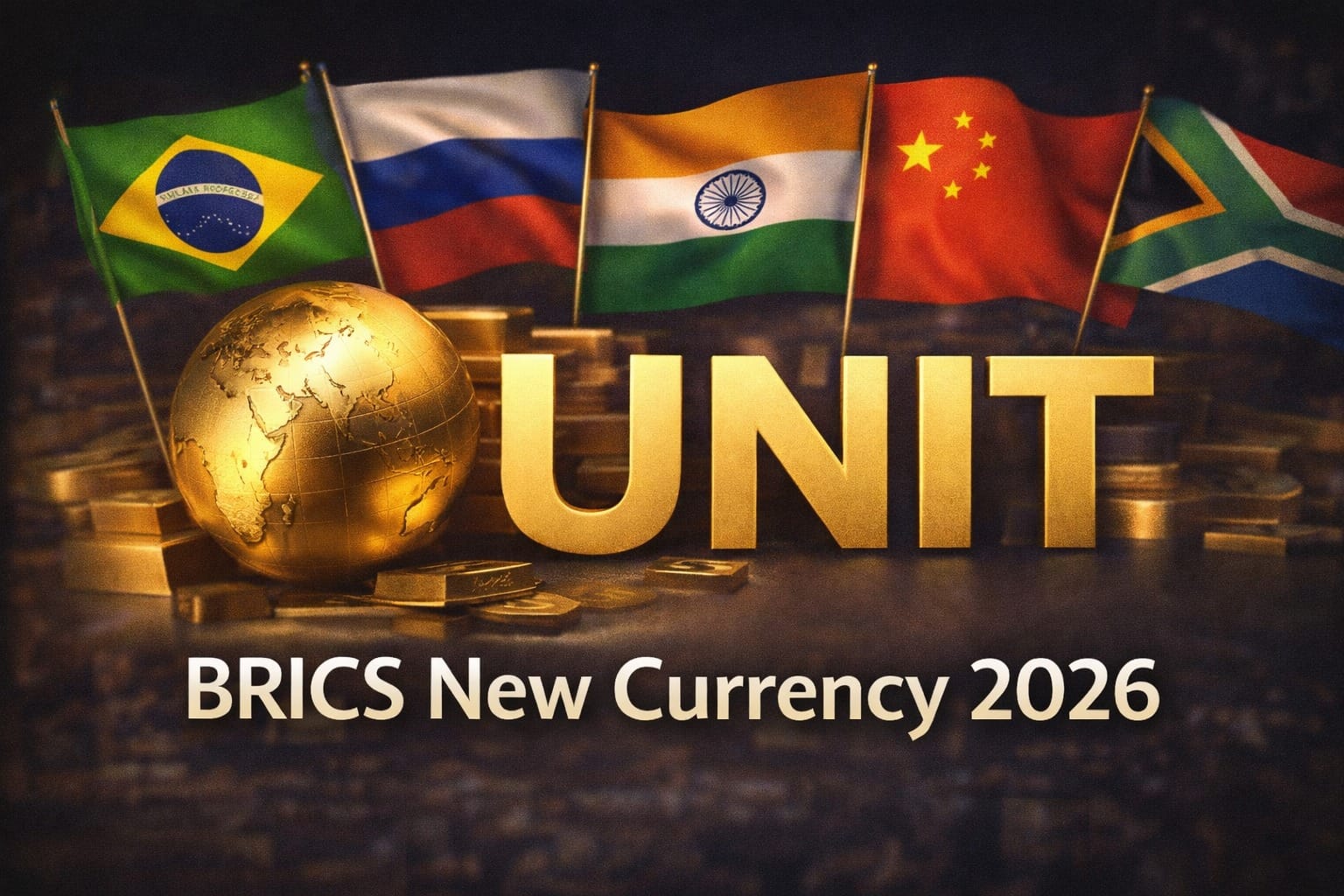
In 2025–2026, the international financial landscape witnessed one of the most ambitious monetary experiments in decades — the emergence of a BRICS settlement currency known as the “Unit.” Unlike a traditional fiat currency, the Unit is a gold-backed, multi-currency digital settlement instrument intended to facilitate trade and reduce reliance on the U.S. dollar, which has dominated global finance for nearly a century.
As BRICS (Brazil, Russia, India, China, South Africa, and expanding members like Egypt, UAE, Indonesia and others) continues to grow in economic and geopolitical influence, the Unit and related initiatives such as BRICS Pay and proposed CBDC linkages are increasingly discussed as steps toward de-dollarization, financial autonomy, and a more multipolar monetary system.
This comprehensive article answers key questions about the UNIT currency:
- What exactly is the Unit?
- How does it work?
- How does it fit into broader de-dollarization efforts?
- What is the RBI’s stance, and how could India benefit?
- Can it really replace the U.S. dollar?
1. What Is the BRICS UNIT Currency?
The Unit is a planned digital settlement currency being developed under the broader BRICS+ framework — a grouping that includes the original five BRICS members plus several new participants. It was conceptualized in response to long-standing financial imbalances exposed by global events such as sanctions and increasing dissatisfaction with the dollar-centric financial architecture.
Importantly:
➡️ The Unit is not a traditional fiat currency like the dollar or rupee.
➡️ It is also not a cryptocurrency in the unregulated sense.
➡️ It is designed as a digital settlement instrument backed by a basket of assets — including gold and BRICS national currencies — to enable cross-border trade and settlement.
Core Structure
According to multiple reports and analyses:
- 40% of the Unit’s backing is physical gold (measured by weight, not nominal price).
- 60% is a basket of BRICS member currencies (such as the Brasilian real, Russian ruble, Indian rupee, Chinese renminbi, and South African rand).
This hybrid backing gives the Unit a degree of stability and diversification that pure fiat or unbacked digital tokens lack. Gold acts as an anchor, while the currency basket spreads risk.
Also read – How Netflix Beats Estimates But Subscriber Risk Continues
How the Unit Is Valued
The Unit’s daily value is determined by a formula combining:
- A fixed gold weight component
- A weighted basket of BRICS national currencies
This function ensures the Unit reflects real economic conditions rather than arbitrary peg values.
2. How the Unit Works: Mechanism and Use Cases
The Unit is envisioned to function as a settlement asset — primarily used for trade transactions between BRICS member states and possibly extended partners in BRICS+.
Settlement Workflow
Here’s a simplified sequence of how it could work in practice:
- Trade Contract Denominated in Units: Two BRICS trading partners agree to use Units for pricing and settlement.
- Digital Unit Issuance: Units are digitally created on a blockchain-based platform that records asset backing.
- Central Bank Settlement: Once trade concludes, central banks settle using the gold and currency components behind the Units.
- Conversion: The receiving party can convert Units into a local currency or take delivery of the gold component.
This process — although still conceptual and in pilot phases — points toward a system less dependent on the U.S. dollar or Western payment rails.
Technology: Blockchain and Transparency
Unlike volatile cryptocurrencies, the Unit’s blockchain backing is designed to ensure:
- Transparent asset tracking
- Smart contracts for weight adjustments
- Real-time settlement without traditional banking intermediaries
- Immutable records secured across member nodes
This combination of real asset collateral + decentralized architecture aims to provide confidence and stability.
3. The Broader Context: De-Dollarization and Global Finance
To understand the significance of the Unit, we must first understand de-dollarization — a strategic shift many countries are exploring.
What Is De-Dollarization?
De-dollarization refers to the effort by nations to reduce reliance on the U.S. dollar for international trade, financial reserves, and settlement mechanisms.
Historically:
- After World War II, the U.S. dollar became the primary global reserve currency under Bretton Woods.
- Even after the end of Bretton Woods, the dollar remained dominant due to its liquidity, deep markets, and trust.
Today, it still constitutes a major share of global reserves and transactions.
ALSO WATCH
Why De-Dollarization Matters
Countries pursuing de-dollarization aim to:
- Reduce vulnerability to U.S. policy and sanctions
- Lower dependence on SWIFT and Western financial infrastructure
- Protect against sudden changes in U.S. monetary policy
- Promote regional or bloc currencies for settlement
These motivations gained momentum particularly after punitive sanctions on Russia in recent years exposed systemic vulnerabilities associated with dollar dependence.
Alternative Systems Emerging
BRICS is not alone in this trend. Wider initiatives include:
- Local currency trade agreements
- Central Bank Digital Currencies (CBDCs) linkage
- Alternative payment networks such as BRICS Pay
These efforts collectively represent a multipronged approach to gradually reduce dollar dominance in select trade flows.
4. The RBI and India’s Position on De-Dollarization and the Unit
India’s approach to de-dollarization and the Unit is nuanced — supportive of modernization but cautious regarding direct currency replacement.
RBI’s CBDC Linkage Proposal
Recently, the Reserve Bank of India (RBI) proposed linking the official digital currencies of BRICS nations — known as CBDCs — to improve cross-border trade and reduce transaction costs. This proposal could be formally discussed at the 2026 BRICS Summit in India.
Key points:
- RBI aims to facilitate seamless cross-border digital payments.
- It is not explicitly targeting de-dollarization but aims to enhance efficiency and cooperation.
RBI’s Public Stance on De-Dollarization
India has historically maintained that de-dollarization is not a core national agenda, even while supporting local-currency trade within BRICS. Government officials have clarified that joining BRICS does not mean abandoning the dollar system outright.
India’s Push for Rupee Internationalization
Beyond BRICS, India continues to advance the international use of the Indian rupee through bilateral trade agreements and currency swap arrangements with countries like UAE, Indonesia, and others. This effort helps reduce exposure to exchange-rate volatility while preserving financial sovereignty.
India’s Digital Rupee
India’s digital currency — the e-rupee — launched in 2022 with several million users. Though primarily domestic today, its integration with international systems like BRICS CBDC linkages could enhance its global role.
5. How the Unit Is Made: Structure and Governance
Unlike national currencies issued by individual central banks, the Unit’s governance and structure are designed to be decentralized and asset-backed:
Asset Composition
- 40% backed by physical gold, measured by weight, not nominal dollar value.
- 60% backed by a weighted basket of BRICS national currencies.
This model provides:
- Stability from gold’s inherent value
- Diversification across major emerging market currencies
- Resistance to domination by any single member country
Governance
The initiative is not controlled by one nation but requires all BRICS members’ cooperation in:
- Reserve asset contributions
- Operational infrastructure
- Regulatory and legal frameworks
- Blockchain and settlement technology development
This decentralization mirrors how the International Monetary Fund’s Special Drawing Rights (SDR) functions but with a more tangible asset backing and potential broader use.
6. Can the Unit Replace the US Dollar? Realistic Assessment
This is the million-dollar question. Can the Unit truly rival or replace the U.S. dollar as a global currency? The short answer: not in the near term.
Why the Dollar Still Dominates
- It remains the primary global reserve currency.
- Most international trade and commodity pricing (e.g., oil) is dollar-denominated.
- Dollar liquidity and payment networks like SWIFT are deeply entrenched.
Even BRICS proposals seek parallel systems, not immediate replacement.
Practical Limitations
Several barriers exist:
- Liquidity depth: The dollar far exceeds any alternative in terms of available capital and ease of exchange.
- Network effects: Financial infrastructure, contracts, derivatives, and global finance are heavily dollar-centric.
- Political and legal fragmentation: BRICS members have diverse economic systems and priorities, complicating consensus.
Long-Term Potential
Over decades, if systems like CORBICS Pay, CBDC linkages, and asset-backed units grow in adoption, we may see reduced reliance on the dollar for trade settlement within BRICS and aligned partners. However, a total replacement of the dollar globally is highly unlikely in the next decade.
7. Benefits of the Unit to BRICS Nations
Even if it doesn’t replace the dollar, the Unit offers several strategic advantages:
Reduced Transaction Costs
For trade between member states, using the Unit could eliminate currency conversion fees and reduce dependence on dollar liquidity.
Shield Against Sanctions
Countries that have experienced sanctions (e.g., Russia) see value in alternative settlement systems, which provide financial autonomy and security.
Diversification of Reserves
Backed by both gold and a basket of currencies, the Unit helps spread risk and reduce volatility associated with holding a single reserve currency.
Catalyst for Technological Integration
Infrastructure like blockchain-based settlement systems, CBDC linkages, and multilateral payment rails could modernize financial systems within BRICS and beyond.
8. Challenges and Risks Ahead
Despite theoretical advantages, several challenges remain:
Governance and Coordination
Aligning independent central banks and fiscal policies of diverse economies is complex.
Liquidity and Adoption
The Unit currently lacks scale and broad acceptance. Its value is contingent on trust, governance, and liquidity — all still developing.
External Pushback
Western financial systems may resist or marginalize alternative currencies. Debate and uncertainty around geopolitical ramifications continue.
Technical and Regulatory Frameworks
Establishing a robust legal system for cross-border settlement, smart contracts, and dispute resolution is still in progress.
9. The Road Ahead: What 2026 Means for the Unit
As of 2026:
- The Unit remains in pilot phase, with ongoing research and limited issuance.
- BRICS Pay and digital currency linkages are advancing in parallel, albeit with varied timelines.
- Broader adoption depends on political will, technical readiness, and economic stability across member states.
India, hosting the 2026 BRICS Summit, will play a pivotal role in shaping discussions around these issues and promoting collaborative systems that align with its interests in currency stability and transactional efficiency.
10. Conclusion: Evolution, Not Revolution
The BRICS Unit is a visionary step toward a multipolar financial system. It embodies long-term trends in de-dollarization, trade settlement innovation, and blockchain-enabled finance. However, it is not a coup against the U.S. dollar — at least not yet.
Instead, the Unit represents:
🔹 A strategic complement to existing systems
🔹 A risk-diversifying trade settlement tool
🔹 A symbol of financial autonomy for major emerging economies
Whether the Unit becomes widely adopted or remains a niche instrument will depend on negotiations, technological progress, and geopolitical evolution in the years ahead.
SUSBCRIBE TO OUR YOUTUBE CHANNEL THE LOGIC STICK FOR VIDEO INSIGHTS