




US Supreme Court Cancels Trump Tariffs
Introduction
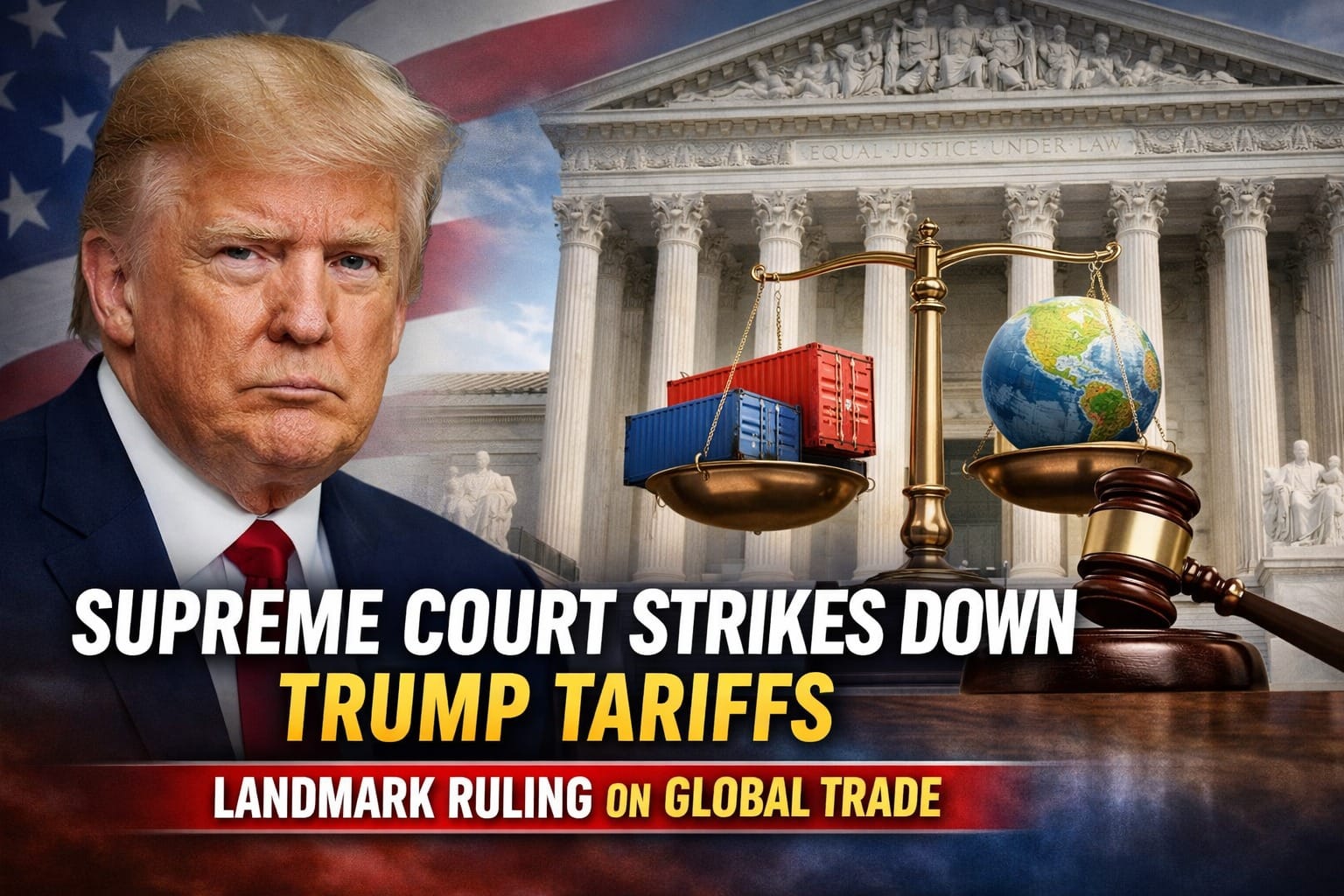
In one of the most consequential economic and constitutional rulings in recent American history, the United States Supreme Court struck down a significant portion of tariffs imposed by Donald Trump, ruling that the president exceeded his statutory authority when he used emergency economic powers to levy sweeping import duties on global trade partners.
The decision — delivered on February 20, 2026 in Learning Resources, Inc. v. Trump — is widely regarded as a landmark judgment defining the limits of presidential trade power and reinforcing congressional authority over tariffs.
The ruling has profound implications for:
- US constitutional law
- Global trade architecture
- Domestic economic policy
- Refund claims worth billions
- India-US trade relations
- Future presidential tariff powers
This article provides a comprehensive breakdown of the ruling, its legal reasoning, economic consequences, geopolitical impact, and future policy outlook.
Background: Trump’s Tariff Strategy and Protectionist Trade Agenda
Protectionism as Core Economic Doctrine
Donald Trump’s economic philosophy emphasized:
- Reducing trade deficits
- Reviving domestic manufacturing
- Countering unfair trade practices
- Protecting national security
- Negotiating favorable trade deals
Tariffs became a central instrument in achieving these objectives.
The “Liberation Day” Tariffs (April 2025)
On April 2, 2025, Trump announced sweeping tariffs during a Rose Garden address dubbed “Liberation Day,” declaring a national emergency linked to trade deficits and supply chain vulnerabilities.
The tariff structure included:
- A baseline 10% universal tariff on imports
- Country-specific “reciprocal tariffs” ranging from 11% to 50%
- Punitive tariffs targeting China, Mexico, Canada, India, Brazil, and others
- Tariffs justified partly by fentanyl trafficking and national security concerns
These tariffs affected nearly all imports and became a cornerstone of Trump’s second-term economic policy.
Legal Basis Used by Trump
Trump invoked the International Emergency Economic Powers Act (IEEPA), a 1977 law allowing presidential action during national emergencies affecting foreign economic transactions.
The administration argued:
- Trade deficits created an economic emergency
- Supply chain vulnerabilities threatened national security
- Drug trafficking justified emergency economic measures
However, critics argued the law does not authorize tariff imposition.
Also read – The Landmark India-EU Free Trade Deal: Everything You Need To Know
Legal Challenges Leading to the Supreme Court Case
Lower Court Rulings
The tariffs faced immediate legal challenges from:
- Businesses
- States
- Trade groups
- Importers
In May 2025, the US Court of International Trade ruled the tariffs illegal, holding that IEEPA does not grant presidents broad tariff authority.
This decision was upheld by appellate courts, setting the stage for Supreme Court review.
The Supreme Court Case: Learning Resources, Inc. v. Trump
Case Details
- Argued: November 5, 2025
- Decided: February 20, 2026
- Vote: 6-3 majority
The central question:
Does IEEPA authorize the president to impose tariffs?
The Supreme Court answered NO.
The Supreme Court Ruling Explained
Key Holding
The Court ruled that IEEPA does not authorize the president to impose tariffs, emphasizing that tariff authority rests with Congress unless explicitly delegated.
Chief Justice John Roberts authored the majority opinion.
Constitutional Reasoning
1. Separation of Powers
The Court reaffirmed that:
- Tariff and taxation powers are core legislative functions
- Congress holds primary authority over trade policy
The ruling stressed that the president cannot unilaterally impose sweeping tariffs without congressional authorization.
2. Statutory Interpretation
The Court concluded that:
- IEEPA allows regulation of economic transactions
- It does not authorize tariffs or revenue-raising duties
This interpretation rejected the administration’s reading of the statute.
3. Major Questions Doctrine
The Court applied the “major questions doctrine,” which requires clear congressional approval for policies with major economic impact.
Tariffs affecting nearly all imports qualified as a major economic policy.
Dissenting Opinion
Three justices dissented, raising concerns about:
- Refund complexities
- Financial disruption
- Administrative challenges
They warned that undoing tariffs worth billions could create logistical difficulties.
Immediate Consequences of the Ruling
1. Invalidated Tariffs
The ruling invalidated a major portion of Trump’s tariff regime, affecting billions in duties collected from global imports.
2. Refund Claims Worth Billions
Businesses that paid tariffs may now seek refunds, creating potentially massive legal and financial liabilities for the US government.
3. Revenue Uncertainty
Tariffs generated over $133 billion in revenue, now placed in legal limbo following the ruling.
Trump’s Reaction and Policy Response
Trump sharply criticized the ruling and announced alternative tariff strategies.
He signed an executive order imposing a temporary 10% global tariff under Section 122 of the Trade Act of 1974, which allows short-term tariffs for 150 days.
This demonstrates that while the ruling limits one legal pathway, it does not eliminate tariff policy.
Economic Impact
Effects on Businesses
Positive effects:
- Lower import costs
- Supply chain stability
- Refund opportunities
Negative effects:
- Continued uncertainty
- Ongoing legal disputes
Effects on Consumers
The ruling may reduce inflationary pressure by lowering import prices.
Effects on US Economy
Studies indicate that tariffs increased costs for households and businesses and slowed job growth in 2025.
Global Trade Implications
1. Relief for Trade Partners
Countries affected by tariffs welcomed the decision as reducing protectionist pressures.
2. Strengthening Multilateral Trade
The ruling reinforces rules-based trade and limits unilateral tariff actions.
3. Continued Trade Uncertainty
Experts note that alternative legal tariff tools may sustain trade tensions.
Impact on India
India was among countries affected by Trump’s tariffs.
Following the ruling:
- India’s government stated it is studying implications
- Export sectors may benefit from reduced tariffs
- Trade negotiations could become more favorable
India’s textile industry and exporters view the ruling as a potential opportunity.
Political Implications
The ruling represents:
- A major setback for Trump’s economic agenda
- A judicial rebuke of executive power expansion
- A potential catalyst for congressional trade legislation
Legal Significance
1. Limits Presidential Emergency Powers
The ruling clarifies boundaries of emergency economic authority.
2. Reasserts Congressional Authority
Congress retains primary tariff authority unless explicitly delegated.
3. Establishes Constitutional Precedent
Future presidents must rely on clear statutory authorization for sweeping tariffs.
What Happens Next?
Expected developments:
- Refund litigation
- Alternative tariff mechanisms
- Congressional trade reform debates
- Continued geopolitical trade tensions
Expert Analysis
Legal scholars describe the ruling as:
- A major separation-of-powers decision
- A check on executive overreach
- A landmark trade law precedent
Economists warn that policy volatility may continue.
FAQs: US Supreme Court Ruling on Trump Tariffs
1. What did the US Supreme Court rule about Trump tariffs?
The US Supreme Court ruled that many tariffs imposed by Donald Trump under emergency economic powers were unlawful because the president exceeded statutory authority. The Court held that the International Emergency Economic Powers Act (IEEPA) does not authorize tariff imposition, reaffirming that tariff powers primarily belong to Congress.
2. Why were Trump tariffs cancelled by the Supreme Court?
The tariffs were cancelled because:
- IEEPA allows regulation of economic transactions but not tariffs
- The Constitution grants tariff authority mainly to Congress
- The Court applied the major questions doctrine requiring explicit congressional approval for sweeping economic measures
- The administration exceeded delegated authority
3. What case led to the Supreme Court ruling on Trump tariffs?
The decision was delivered in Learning Resources, Inc. v. Trump, a case filed by businesses and trade groups challenging the legality of tariffs imposed using emergency powers.
4. How much money is affected by the tariff cancellation?
The ruling places over $130 billion in tariff revenues in legal uncertainty, as businesses may seek refunds for duties paid on imports during the tariff period.
5. Will businesses receive refunds for Trump tariffs?
Possibly, but refunds are not automatic.
Businesses must file legal claims, and courts will determine:
- Eligibility
- Calculation of refund amounts
- Administrative processes
- Timeline for repayment
This could lead to years of litigation.
6. Does the ruling end Trump’s trade war strategy?
No.
The ruling limits tariff use under IEEPA but does not eliminate other legal tools available to impose tariffs, such as:
- Section 122 of the Trade Act of 1974
- Section 301 investigations
- National security tariffs under Section 232
- Congressional tariff legislation
7. What was Trump’s reaction to the Supreme Court decision?
Trump criticized the ruling and quickly announced alternative tariff measures, including a temporary 10% tariff under Section 122, showing intent to continue a protectionist trade strategy through different legal pathways.
8. How does the ruling impact US consumers?
The ruling could benefit consumers by:
- Lowering import costs
- Reducing inflationary pressure
- Improving product availability
- Stabilizing supply chains
However, uncertainty about replacement tariffs may limit immediate impact.
9. How does the ruling affect global trade?
The decision:
- Reduces unilateral tariff risks
- Strengthens rules-based trade
- Improves predictability for exporters
- Encourages diplomatic trade negotiations
But continued US tariff policies may maintain geopolitical trade tensions.
10. What is the impact of the Supreme Court ruling on India?
For India, the ruling may:
- Improve export competitiveness
- Reduce tariff pressure on sectors like textiles and engineering goods
- Strengthen India-US trade negotiations
- Create opportunities for Indian manufacturers
The Indian government is assessing long-term implications.
11. What constitutional principle did the Court reinforce?
The Court reinforced the separation of powers, emphasizing that Congress holds primary authority over tariffs and taxation unless explicit delegation is provided.
12. What is the major questions doctrine and why was it used?
The major questions doctrine requires clear congressional authorization for policies with large economic or political impact.
Because Trump’s tariffs affected nearly all imports, the Court held that Congress must explicitly approve such actions.
13. Can future presidents impose tariffs without Congress?
Yes, but only through:
- Explicit statutory authority
- National security provisions
- Trade investigation mechanisms
- Congressional legislation
Presidents cannot use emergency economic powers broadly to impose tariffs without clear authorization.
14. How does the ruling affect US economic policy going forward?
The ruling:
- Limits executive economic power
- Strengthens congressional role in trade policy
- Creates legal precedent for future tariff disputes
- Encourages more structured trade legislation
15. Why is this Supreme Court ruling considered historic?
It is historic because:
- It sets limits on presidential trade authority
- Clarifies emergency economic power boundaries
- Impacts billions in tariff revenue
- Reshapes global trade expectations
- Establishes a major constitutional precedent
Conclusion
The US Supreme Court’s decision cancelling Trump’s tariffs is a landmark ruling with deep constitutional, economic, and geopolitical implications.
By holding that emergency economic powers do not authorize tariff imposition, the Court reaffirmed congressional authority over trade policy and established a powerful precedent limiting presidential economic action.
However, the ruling does not end tariff politics. With alternative legal pathways available and ongoing global trade tensions, the future of US trade policy remains uncertain.
For countries like India and global markets, the decision represents both opportunity and continued unpredictability.
Subscribe to our YouTube Channel The Logic Stick for more video insights