




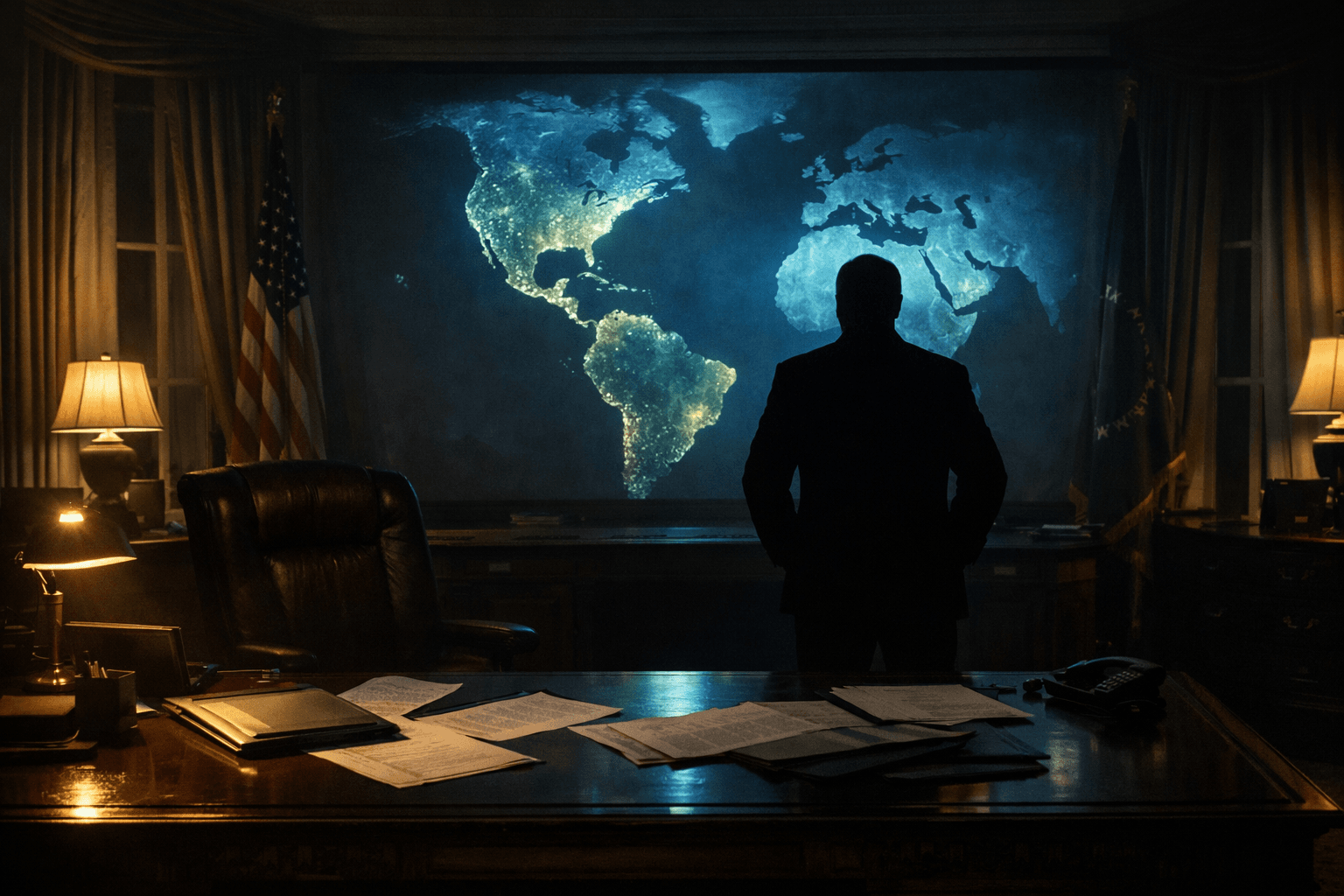
In the first week of January 2026, USA–Venezuela Crisis became the center of a shock geopolitical escalation after the United States carried out a dramatic operation that U.S. officials framed as a “law enforcement” mission — but which much of the world described as a violation of sovereignty and a dangerous precedent.
The immediate headline event was the seizure and transfer of Venezuelan President Nicolás Maduro (and his wife, Cilia Flores) to the United States to face criminal charges. But the deeper story is bigger: competing narratives about legality, the risk of regional instability, the scramble to define Venezuela’s interim authority, and the unresolved question that has haunted the country for years — how to move from authoritarian entrenchment and economic collapse toward a legitimate, workable political settlement.
What follows is a curated, end-to-end explainer of what happened, how the Trump administration described the action, what the Venezuelan government and opposition are saying, the international reaction, and the most plausible “next chapters” for Venezuela.
1) The Flashpoint of USA–Venezuela Crisis: A U.S. Operation Ends With Maduro in a New York Court
What the U.S. says it did
Across multiple U.S. and international reports, the operational outline is broadly consistent: U.S. forces carried out a high-risk action in/around Caracas that resulted in Maduro being removed from Venezuelan control and transferred to the United States. U.S. messaging emphasized that the target was an indicted figure tied to narcotics and organized crime, not a nation-state population — and that the action was “surgical,” limited, and not an “occupation.” Reuters+2AP News+2
Several outlets also describe the U.S. operation using terms such as “raid,” “strike,” and “capture,” and report that Maduro and Flores were taken to New York to face U.S. federal charges. CBS News+1
Maduro’s court appearance (and why it matters)
By January 5–6, reports indicate Maduro and Flores appeared in a U.S. court in New York and entered not-guilty pleas. Maduro reportedly insisted he remained the legitimate president even while in U.S. custody — a crucial detail, because it signals the legal and political battle ahead: Maduro’s camp is likely to treat this as abduction/war-prisoner politics, while Washington will treat it as an extradition-like criminal process. Hindustan Times+1
This split is not just rhetorical. It shapes:
- whether governments treat Maduro as a criminal defendant or a head of state under coercion,
- whether Venezuelan institutions (military, courts, ministries) defect or harden,
- and how any transition government claims legitimacy.
2) Trump’s Political Framing vs Rubio’s Damage Control
Trump’s maximal framing: “We’re in charge / we’ll run it”
In the immediate aftermath, reporting shows President Donald Trump publicly using language suggesting direct U.S. control or stewardship over what happens next in Venezuela. This “we’re in charge” tone became the accelerant — it elevated fears of open-ended intervention and nation-building, and it alarmed governments across Latin America. ABC News+1
Rubio’s counter-framing: “Not a war” and “we won’t govern”
Secretary of State Marco Rubio and other officials then moved to narrow the claim, repeatedly emphasizing that the U.S. was “not at war with Venezuela,” and that Washington did not intend to run day-to-day governance. Multiple reports describe Rubio steering the policy story toward leverage tools — especially oil enforcement measures — rather than direct administration. AP News+2The Indian Express+2
This split messaging matters because it creates uncertainty on three fronts:
- Domestic U.S. legality: whether the administration can sustain the “law enforcement, not war” argument to avoid war powers constraints and congressional pushback. Axios+1
- International legitimacy: whether allies see a bounded operation or an attempted regime-change playbook. Reuters+1
- Venezuelan stability: whether Venezuelan actors treat the U.S. as a temporary coercive player or a new sovereign sponsor.
Also read – Putin’s India Visit – Breakdown & Complete Story
3) Inside Venezuela: Interim Authority, Gunfire Near the Palace, and a Country on Edge
The interim power question: Delcy Rodríguez
A key post-operation development reported by major outlets is the emergence of Delcy Rodríguez (a long-time senior figure within the Maduro-era power structure) as an “acting” or interim leader. Reuters reporting describes an official message from Rodríguez seeking improved relations and a collaborative agenda with the U.S., while stressing sovereignty and non-interference — a classic attempt to calm markets, prevent defections, and reduce the risk of further strikes. Reuters+1
This creates a paradox:
- If Rodríguez is seen as “continuity Maduroism,” the opposition rejects her.
- If she becomes the only figure able to keep the security apparatus functioning, international actors may pragmatically engage her anyway to prevent a collapse.
The palace gunfire incident: drones, confusion, and nerves
In Caracas, reports describe gunfire near or around the Miraflores presidential palace, with security forces opening fire at drones spotted overhead. The important thread across coverage is that the situation was described as “under control,” and at least some accounts suggest confusion and heightened anxiety after the Maduro seizure — not necessarily a coordinated coup attempt. New York Post+2Hindustan Times+2
For Venezuelans, this kind of incident is more than spectacle:
- it signals fractured command-and-control,
- it increases the risk of accidental escalation,
- and it deepens public fear of shortages, violence, and sudden shutdowns.
Daily life and economic anxiety
Even without a full collapse, the first response in fragile economies is often “panic shopping” and cash-hoarding. AP reporting described long lines and anxiety in Caracas after the operation, reflecting how quickly ordinary citizens feel the shock even when elite politics are still in flux. AP News+1
4) The Opposition: Support for Maduro’s Removal, But a Fight Over the Transition
María Corina Machado and the opposition stance
One of the clearest opposition signals in reporting is that opposition leader María Corina Machado welcomed the removal of Maduro — framing it as an opening — but rejected the idea that a Maduro-era insider should be the transitional face of Venezuela. Coverage describes Machado vowing to return and positioning herself against a Rodríguez interim arrangement. The Guardian+2Hindustan Times+2
That stance is strategically consistent:
- The opposition’s central argument for years has been that Maduro’s system is not reformable from within.
- So an “interim” led by a key Maduro-era pillar looks like rebranding, not transition.
The opposition’s strategic dilemma
Even if the opposition celebrates Maduro’s exit from power, it still faces difficult questions:
- How to prevent a “security-state restoration.”
If the armed forces and intelligence services remain intact and loyal to the old network, they can choke a transition. - How to claim legitimacy.
The opposition may argue that any interim authority must be grounded in constitutional mechanisms, credible elections, and international monitoring — not just U.S. force. - How to avoid being seen as a U.S. proxy.
In Latin America, U.S. intervention narratives are politically toxic. If the opposition is framed as Washington’s chosen partner, it may lose nationalist and swing segments even among anti-Maduro Venezuelans.
5) The World Reacts: Condemnation, Concern, and a UN Legality Storm
The UN’s alarm: stability and legality
Reuters reports UN Secretary-General António Guterres expressing deep concern over instability and questions of legality, urging a peaceful, democratic resolution and warning about precedents for international relations. Reuters
The legality debate centers on competing claims:
- U.S. framing: a limited action against alleged transnational criminal threats (often linked to self-defense logic). Reuters+1
- Critics’ framing: a violation of sovereignty and prohibition on the use of force, risking a “might makes right” precedent. Reuters+1
International condemnation and geopolitics
Reporting shows a wide set of countries criticizing U.S. involvement, including major powers and regional actors. Reuters also compiled reactions emphasizing sovereignty and international law concerns. Reuters+1
This matters because Venezuela is not just a political crisis — it is also:
- an energy and sanctions puzzle,
- a migration driver in the region,
- and a great-power influence zone where Russia/China (and others) weigh U.S. precedent-setting behavior carefully.
6) Information Warfare: AI Images, Viral Clips, and the “Fog of Crisis”
One of the most underappreciated features of this event is the information environment. The Guardian reported a surge of AI-generated or misleading images and videos claiming to show dramatic “proof” of Maduro’s capture, rallies, or attacks — some fabricated, some recycled from older footage — spreading rapidly on major platforms. The Guardian
This has real consequences:
- It hardens beliefs faster than facts can stabilize.
- It can provoke panic or retaliation.
- It allows every side to “find” evidence for its narrative.
For anyone trying to understand what happened, the practical rule is: treat viral clips as unverified until corroborated by multiple credible outlets, and prioritize wire services and established reporting over influencer reposts.
7) What Is the “Conflict” Now?
It’s no longer a conventional “Maduro vs opposition” story. The crisis has widened into four interlocking conflicts:
- Legitimacy conflict (Who governs?)
- Maduro claims he is still president (even from U.S. custody). Hindustan Times+1
- Rodríguez signals continuity but seeks accommodation. Reuters
- The opposition rejects an insider-led transition and pushes for a clean break. Hindustan Times+1
- Legal conflict (What was the U.S. action?)
- “Law enforcement / counter-crime” vs “illegal aggression / abduction.” Axios+1
- Security conflict (Who controls the guns?)
Drone gunfire near the palace is a symptom: nerves + unclear command lines can spiral into real violence. New York Post+1 - Economic conflict (Oil, sanctions, and collapse risk)
Rubio’s emphasis on oil enforcement suggests Washington sees energy leverage as the primary tool to shape Venezuela’s next steps. AP News+1
8) Is There a “Solution” Yet?
As of January 6, 2026, reporting does not show a single, agreed “solution.” What exists instead are competing pathways:
Pathway A: Insider interim + negotiated stabilization
Rodríguez’s conciliatory message hints at this: keep institutions functioning, reduce risk of chaos, negotiate sanctions/oil relief steps, and attempt managed elections later. Reuters
Upside: avoids immediate collapse and violence.
Downside: risks becoming “Maduroism without Maduro,” which the opposition and many Venezuelans may reject.
Pathway B: Opposition-led transitional authority + rapid election timetable
The opposition vision is: no Maduro-era insider as interim, credible electoral roadmap, international observation, political prisoners/issues addressed, and clear institutional reset. Hindustan Times+1
Upside: higher legitimacy for a real break.
Downside: hard to implement without security force buy-in — and could trigger sabotage from entrenched networks.
Pathway C: Prolonged standoff + external pressure tools
Rubio’s approach suggests heavy reliance on oil/quarantine enforcement and conditional engagement, not direct U.S. governance. AP News+1
Upside: avoids occupation.
Downside: pressure campaigns often deepen civilian suffering and migration unless paired with a credible political offramp.
9) What’s Next for Venezuela: The 6 Questions That Decide 2026
If you want to track “what happens next,” focus on six concrete questions rather than daily rumor:
- Who does the Venezuelan military recognize in practice?
Public statements matter less than who controls deployments, pay, and internal security. - Does Rodríguez consolidate authority, or do rival factions emerge?
Drone-fire confusion is a warning sign: factional competition can turn accidents into clashes. New York Post+1 - Can the opposition unify around one transition plan and one legitimacy story?
Machado’s rejection of Rodríguez signals a line in the sand. Hindustan Times+1 - Will Washington clarify “end goals”?
Mixed Trump/Rubio messaging increases risk of miscalculation. ABC News+1 - Will the UN and regional blocs broker a framework?
Guterres’ concerns suggest the UN sees rising instability and wants a political process, but enforcement power is limited. Reuters - What happens to oil policy, sanctions, and humanitarian channels?
Energy leverage is central; humanitarian consequences follow quickly if trade/shipping tightens. AP News+1
10) A Reality Check: The Three Narratives You’ll See Everywhere
As global coverage continues, most content will fall into one of these narratives:
Narrative 1: “Criminal takedown”
The U.S. position: Maduro is indicted for narco-terrorism/drug trafficking and the operation prevents transnational crime. Reuters+1
Narrative 2: “Illegal regime change”
Many governments’ position: sovereignty violated; dangerous precedent; destabilization risk. Reuters+1
Narrative 3: “Liberation opening”
Opposition-leaning position: Maduro’s removal creates an opening, but only a real transition (not a regime insider) counts as change. Hindustan Times+1
The truth that matters for Venezuelans may be less ideological: whether food/medicine access improves, whether violence stays contained, whether migration pressures ease, and whether an election roadmap becomes real.
11) Bottom Line
What “happened in Venezuela” is not one event — it is a chain reaction:
- The U.S. executed an unprecedented operation resulting in Maduro facing charges in New York. Hindustan Times+1
- Trump’s rhetoric implied direct U.S. control, while Rubio tried to reframe it as not-war and not-governance, leaning on oil enforcement as leverage. ABC News+2AP News+2
- Inside Venezuela, interim authority is contested, and the security environment is jittery (including drone-linked gunfire near the presidential palace). New York Post+1
- The opposition welcomed Maduro’s removal but rejected a Maduro-insider interim structure, signaling the next legitimacy fight. Hindustan Times+1
- The UN and many countries raised legality and stability concerns, while the information environment was flooded with AI and misleading content that amplified confusion. Reuters+1
What comes next will be decided less by speeches and more by: security force alignment, a credible transition blueprint, and whether external pressure is paired with a political offramp instead of open-ended coercion.
FOR MORE DETAILED INSIGHTS SUBSCRIBE TO OUR YOUTUBE CHANNEL THE LOGIC STICK