






Why the Women SSC Officers Supreme Court Case Matters Today.
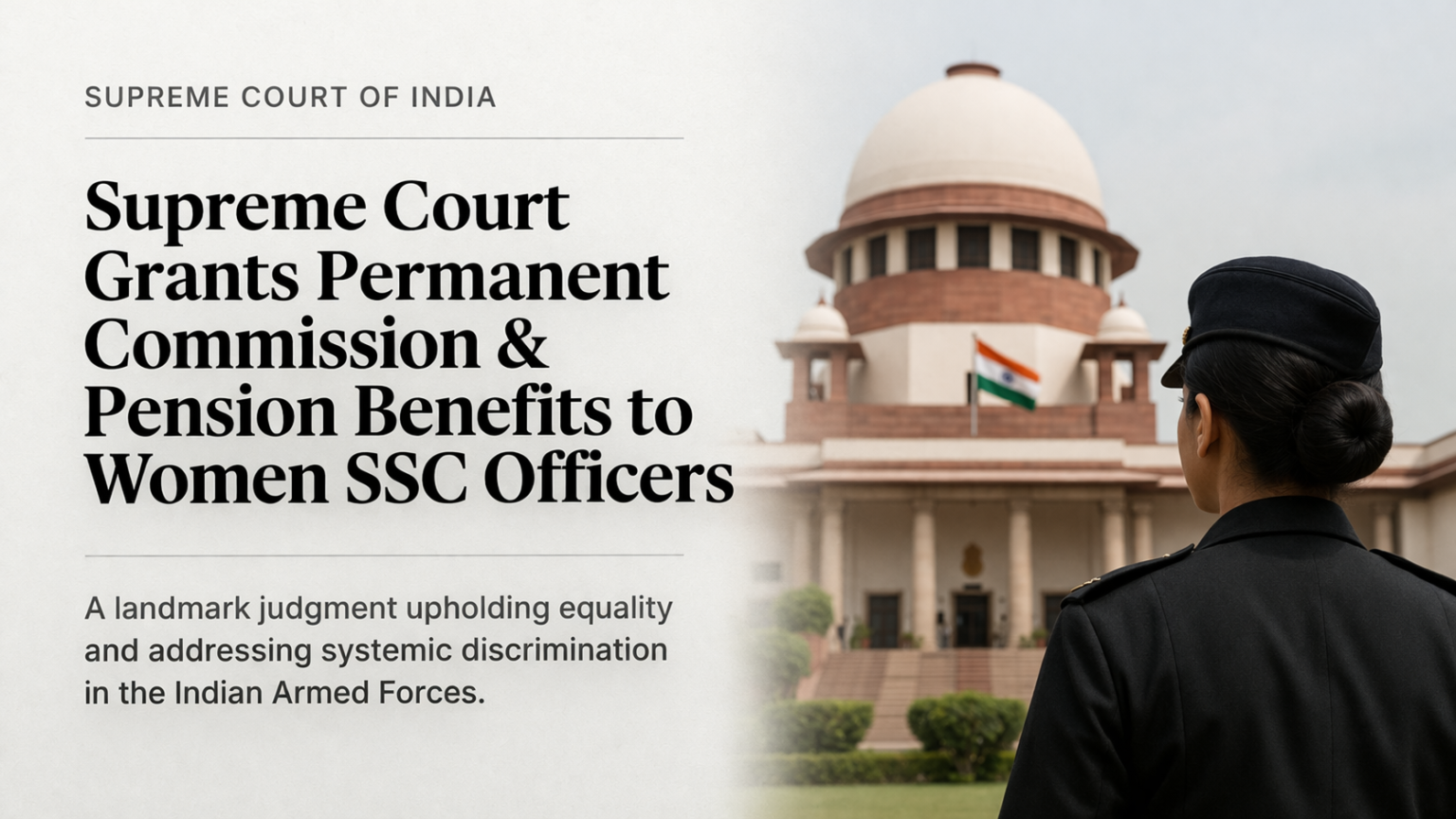
The women SSC officers Supreme Court verdict has emerged as one of the most significant legal decisions in India’s defence history, addressing long-standing concerns around permanent commission, pension rights, and gender equality in the armed forces.
The women SSC officers Supreme Court verdict delivered in March 2026 is more than a judgment. It is a correction of history.
For decades, women officers in the Indian Armed Forces wore the same uniform, trained under the same harsh conditions, and carried the same responsibility as their male counterparts. Yet, when it came to long-term recognition, stability, and leadership opportunities, the path ahead for them was often cut short—not by capability, but by policy.
This ruling changes that narrative.
The Reality Behind the Uniform: A Career With an Expiry Date
Imagine dedicating the most physically and mentally demanding years of your life to the nation—only to be told that your journey must end earlier than others, not because you lacked merit, but because of your gender.
That has been the lived reality for many women inducted through the Short Service Commission (SSC) route since 1992.
Unlike Permanent Commission officers, who build lifelong careers in the armed forces, SSC officers serve within a defined time frame—typically between 10 to 14 years. For male officers, this route often opens doors to Permanent Commission. For women, however, that door remained partially closed for years.
The consequences were not just professional, but deeply personal:
- Careers were abruptly halted
- Leadership potential remained unrealized
- Financial security through pensions was denied
Behind every statistic was a story of discipline, sacrifice, and an unfinished journey.
Also Read: SC Ruling Explained.
A System Built on Assumptions, Not Merit
As the women SSC officers Supreme Court case unfolded, what emerged was not just a policy gap, but a pattern.
The Court observed that the system itself was built on preconceived assumptions about women officers:
- That they may not serve long enough
- That their career trajectory would be limited
- That their roles should remain restricted
These assumptions quietly seeped into evaluation frameworks.
The Silent Bias in Performance Reports
One of the most striking revelations was related to Annual Confidential Reports (ACRs)—documents meant to objectively measure an officer’s performance.
In reality, these reports often reflected:
- Lower grading due to presumed shorter careers
- Lack of serious evaluation compared to male counterparts
- A feedback loop where low expectations led to lower outcomes
The Court recognized this as a form of institutional bias, where the system itself influenced results before merit could even be fairly assessed.
The Court Speaks: Calling Out Systemic Discrimination
What makes the women SSC officers Supreme Court verdict truly powerful is its language.
The Court did not describe the issue as a mere oversight or administrative lapse. Instead, it used a far stronger and more significant term:
“Systemic discrimination.”
This acknowledgment shifts the conversation.
It tells us that:
- The problem was not individual—it was structural
- Bias was not occasional—it was embedded
- Inequality was not accidental—it was designed into the system
Such recognition is rare and sets a strong precedent not just for the armed forces, but for institutions across the country.
From Observation to Action: Real Relief for Real People
Unlike many judgments that remain theoretical, this ruling delivers tangible outcomes.
Pension: Restoring Dignity to Past Service
For women officers who had already left service, the verdict brings long-awaited relief.
They will now be:
- Considered as having completed 20 years of service
- Eligible for pension and associated benefits
This is more than financial compensation—it is a recognition of their service as equal and complete.
However, the Court has balanced practicality by limiting arrears to January 1, 2025, ensuring feasibility in implementation.
Permanent Commission: Opening the Door That Stayed Closed
For serving officers, the ruling creates an immediate pathway forward.
Eligible candidates will now:
- Receive Permanent Commission
- Be evaluated on fair and consistent criteria
- Be freed from repetitive and uncertain selection processes
The introduction of a one-time corrective measure ensures that justice is not delayed any further.
Click here to know more about : Iran War Latest Updates.
The Long Road to This Moment
This judgment did not emerge overnight. It is the result of years of persistence.
From the early days of induction in 1992 to multiple legal battles in the 2010s, women officers have consistently questioned a system that limited their growth.
The 2020 Supreme Court ruling, which allowed women to take on command roles, was a major step. But implementation gaps remained.
The 2026 verdict builds on that foundation, addressing not just rights in theory, but fairness in practice.
Beyond Policy: A Cultural Shift in the Armed Forces
The impact of the women SSC officers Supreme Court verdict extends far beyond policy documents.
It challenges deeply held beliefs within the system:
- That leadership in defence is inherently male
- That women’s roles must be limited
- That long-term commitment is uncertain
By enforcing equality, the Court is also encouraging a shift in mindset.
Over time, this could lead to:
- More women in senior leadership roles
- Greater acceptance of diversity in command positions
- A culture that values capability over convention
A Strong Message to Future Generations
For young women across India, especially those aspiring to serve in the armed forces, this judgment carries immense significance.
It tells them:
- Your entry into the system will not be symbolic
- Your growth will not be restricted
- Your service will be valued equally
In a country where representation often shapes ambition, this ruling could inspire an entire generation.
Challenges That Still Remain
While the judgment is transformative, its success depends on execution.
Implementation Complexity
Ensuring that:
- Pension calculations are accurate
- Eligible officers are identified without delay
Institutional Adaptation
Changing:
- Long-standing internal practices
- Evaluation systems and reporting structures
Monitoring Fairness
Preventing:
- New forms of bias
- Selective or inconsistent implementation
The real test begins now.
A Broader Reflection on Equality in India
The women SSC officers Supreme Court ruling is not just about the armed forces—it is a reflection of India’s evolving understanding of equality.
It reinforces a crucial idea:
Equality is not achieved by opening doors—it is achieved by ensuring everyone can walk through them equally.
This judgment highlights the importance of:
- Reviewing systems, not just outcomes
- Questioning long-standing norms
- Ensuring fairness in both policy and practice
Conclusion: More Than a Verdict, A Reset
The women SSC officers Supreme Court verdict stands as a powerful reminder that institutions must evolve with the values they claim to uphold.
By addressing systemic discrimination and offering meaningful relief, the Court has done more than resolve a legal dispute—it has reset expectations.
It has ensured that:
- Service is recognized, regardless of gender
- Merit is evaluated fairly
- Opportunity is not restricted by outdated assumptions
In doing so, it has not only honored the past contributions of women officers but has also secured a more equal future for those who will follow.
FAQs: Women SSC Officers Supreme Court Verdict
What is the women SSC officers Supreme Court verdict about?
It addresses the denial of Permanent Commission and pension benefits to women officers and recognizes systemic discrimination.
What relief has been provided?
Pension benefits for released officers and Permanent Commission opportunities for eligible serving officers.
Why is this judgment important?
It ensures fairness, equality, and structural reform in the armed forces.
Also Checkout our You Tube Channel to know more details
Conclusion
The women SSC officers Supreme Court verdict is not just a legal milestone—it is a long-overdue acknowledgment of merit, service, and equality. For years, women officers stood shoulder to shoulder with their male counterparts, fulfilling the same duties under the same uniform, yet facing an unequal system that limited their future.
With this judgment, the Supreme Court of India has done more than correct a policy—it has corrected a mindset.
By granting pension rights, opening pathways to Permanent Commission, and exposing systemic discrimination, the Court has ensured that fairness is no longer optional but foundational. It sends a clear message: institutions must evolve, and equality cannot be conditional.
This verdict will not only redefine careers within the armed forces but will also inspire a broader shift across institutions in India—where opportunity, recognition, and growth are determined by capability, not gender.
In the end, this is not just about women officers.
It is about the kind of nation India chooses to be—one where service is respected equally, and justice, even if delayed, is ultimately delivered.