







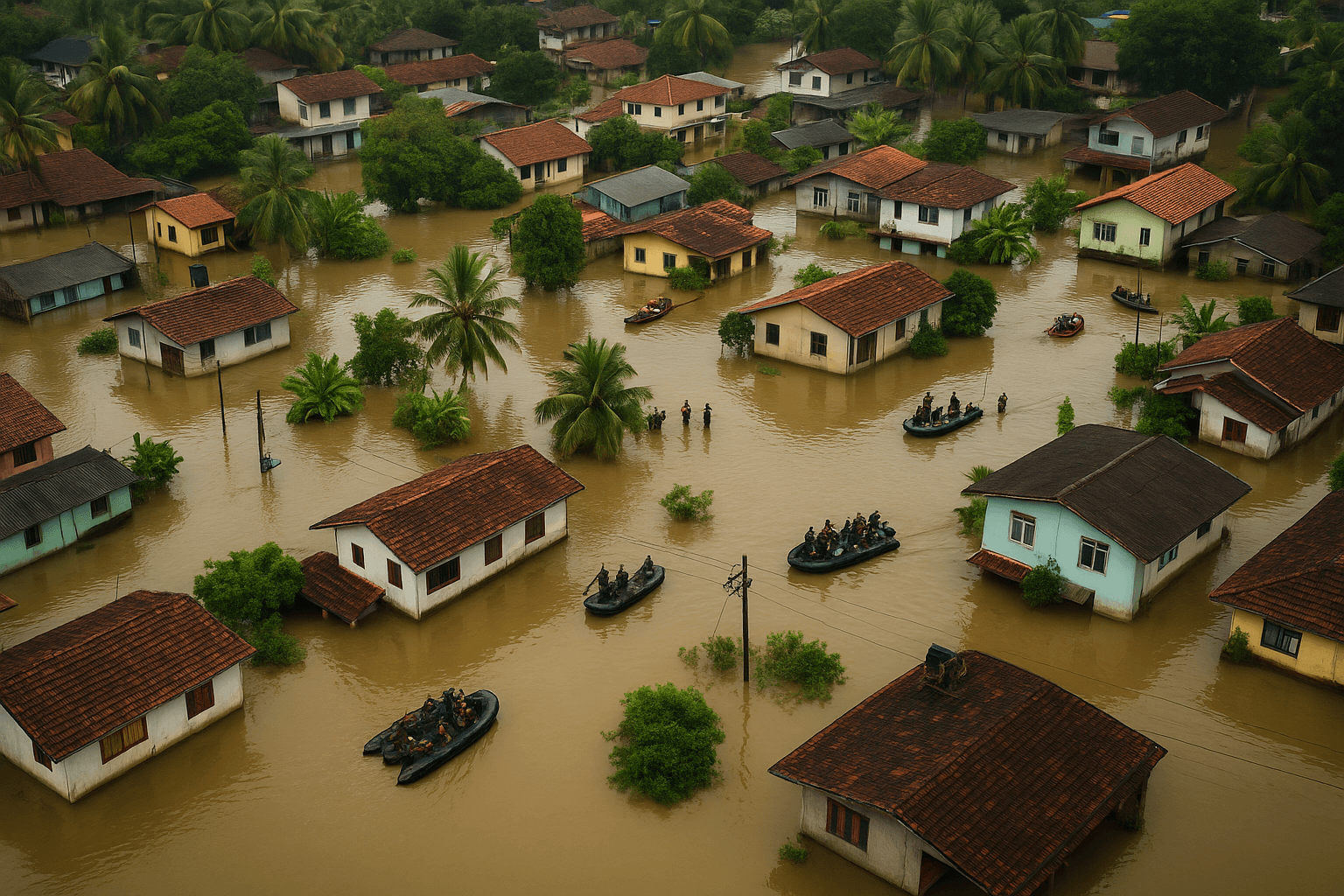
Cyclone Ditwah – What happened, ground zero over the last 48 hours
In the past two days, Sri Lanka has been rocked by one of its worst natural disasters in recent memory. Cyclone Ditwah — originating in the Bay of Bengal — slammed into the island with torrential rains, triggering widespread floods, landslides, and dam breaches.
- As of December 1, 2025, the official death toll has climbed to at least 212, with 218 people reported missing. Reuters
- Nearly one million people have been impacted by the floods and landslides, with around 200,000 individuals displaced and seeking shelter in 1,275 emergency centres across the island.
- The deluge has caused catastrophic infrastructural damage: entire towns submerged by overflowing rivers, landslides burying homes, and a dam breach which worsened the flooding in eastern regions. Reuters+2Wikipedia+2
- Critical utilities — electricity, water supply, roads and railway links — have been severely disrupted; major hydropower plants have shut down, compounding the crisis of basic services.
In many affected areas — from hilly central districts to low-lying coastal zones — floodwaters remain stubbornly high. Rescue teams and military units have mounted large-scale search, relief, and evacuation operations, including dramatic air-lifts of families stranded on rooftops or in remote, cut-off zones. The Indian Express+2Reuters+2
The overall picture: tens of thousands of homes damaged or destroyed, mass displacement, loss of life, and essential services knocked out. For many communities across Sri Lanka, this is ground zero — all normal life, routines, and livelihoods disrupted in an instant.
Why this calamity occurred: the causes behind the collapse
Cyclone Ditwah + Extreme Rainfall
The immediate cause is the violent landfall of Cyclone Ditwah. The system intensified over the Bay of Bengal and unleashed exceptionally heavy rains over Sri Lanka’s eastern, central and southern regions. Wikipedia+2Travel And Tour World+2
In some districts, rainfall exceeded 200–300 mm, and isolated areas reportedly recorded up to 400 mm, overwhelming rivers, reservoirs and drainage systems. Travel And Tour World+1
Such intense precipitation in a short span caused rivers to overflow, dams to rupture (most notably the breach of the Mavil Aru Reservoir dam), and rapid landslides — especially in the tea-growing highlands of the central region, where geological vulnerability is high. Wikipedia+2Reuters+2
Also read : Everything you need to know about the recent Epstein files
Vulnerability of Terrain and Infrastructure
Several factors worsened the impact:
- The central highlands — with steep slopes and fragile soil — are prone to landslides once the soil gets saturated. The heavy rains rapidly destabilised hillsides, leading to massive landslides that buried homes and roads. Wikipedia+2The Guardian+2
- Flood defenses and dams — though meant to regulate water — were overwhelmed. The dam breach at Mavil Aru triggered sudden surges, flooding downstream zones with little warning. Wikipedia+1
- Urban flood resilience was tested to its limit. Rivers like the Kelani River surged dangerously; in parts of the capital region, flood defences and water-treatment systems were under serious threat, risking cut-offs of water supply. Wikipedia+1
Larger Context: Climatic Trends and Timing
While the immediate trigger is Cyclone Ditwah, underlying climate stressors — especially patterns of increasing rainfall extremes — likely played a role. Some analysts have linked the intensity and frequency of such storms to changing climate conditions, which bring heavier monsoons and more moisture-laden storms. The Washington Post+1
That such a powerful cyclone hit Sri Lanka at this time — just after recurring monsoon patterns — compounded the risks. The convergence of a strong cyclone with saturated soils and swollen rivers created a perfect storm, so to speak.
The human cost: lives lost, displacement, and destruction
The human toll is severe and growing. According to the latest official reports, over 212 people have died, and more than 200 remain missing — with the count expected to rise as rescue teams reach remote, cut-off regions. Reuters+2The Times of India+2
The scale of displacement is massive: nearly a million people have been affected, and hundreds of thousands are now dependent on emergency shelters. Families have lost homes, livelihoods, and in many cases — loved ones. Reuters+1
In the central hilly regions — important for tea cultivation — entire villages and estates have been flattened by landslides. The economic cost will be substantial, as many depend on agriculture, plantations, or small-scale businesses that are now wiped out or severely damaged. Wikipedia+2Travel And Tour World+2
Critical infrastructure has been hit hard: key power plants are offline, transport networks (roads, railways) are blocked or destroyed, water treatment plants at risk, and communication lines cut — leaving people isolated and hampering relief efforts. Wikipedia+2The Guardian+2
Psychologically and socially too, the impact is enormous: communities uprooted, deep trauma for those who lost everything, and uncertainty about when — or if — they can rebuild their lives.
Rescue, Relief & Help: What’s being done now
Within hours of the disaster, authorities launched what is being described as one of the largest rescue and relief operations in decades. The national Disaster Management Centre (DMC) along with military, police and air-force units have mobilised. As many as 24,000 personnel — army, air force, police — are engaged in rescue and evacuation efforts. Reuters+2Wikipedia+2
Hundreds have been airlifted to safety; many more moved to higher ground or relief shelters. A handful of dramatic rescues — families stranded on rooftops or trapped in mud-buried homes — have been carried out, often under extremely difficult conditions. The Times of India+3The Indian Express+3Wikipedia+3
International help and support from neighbouring countries has started pouring in. Notably, the government of India, under Operation Sagar Bandhu, has dispatched humanitarian aid — dry rations, medicines, rescue equipment — along with transport aircraft to assist relief operations. Wikipedia+2Reuters+2
Efforts are also underway to restore essential services: power, water supply, communications — though in many regions, damage is so severe that full restoration may take days to weeks. Reuters+2Wikipedia+2
Despite all efforts, the scale of the disaster continues to overwhelm resources, and rescue teams warn that more casualties may be discovered as waters recede and landslide-buried regions are accessed. The Times of India+1
Also Read: Airbus Grounded over terrifying solar radiation
What does the future look like? — Recovery timeline & key challenges
Rebuilding Sri Lanka after Cyclone Ditwah will be a long, arduous process. Several factors make recovery especially daunting:
1. Massive scale of damage and homelessness
Given the millions affected and hundreds of thousands displaced, planning and executing housing reconstruction — especially in rural and hilly areas — will take months, if not longer. Homes destroyed by landslides and floods may not be reparable; new housing or relocation will be needed for many.
2. Infrastructure restoration: electricity, water, transport
Critical infrastructure — power plants, water treatment plants, roads, bridges, communication lines — has been heavily damaged. Restoring them will require large-scale investment, resources, and coordination. Given the widespread nature of damage, phased restoration across regions may take weeks to months.
3. Livelihood loss and economic impact
Much of the affected population depends on agriculture (tea estates, plantations, small farms), small businesses, services — many of which have been wiped out. Recovery isn’t just rebuilding homes, but reviving livelihoods. In regions like central highlands (tea belts), rebuilding plantations, clearing landslides, replanting, and soil restoration will take significant time.
Tourism — a major sector for Sri Lanka — will also suffer. Flooded hotels, destroyed infrastructure, and uncertainty will deter travellers, impacting revenue. One travel-industry report already warns of long-term implications for 2025 tourist inflows. Travel And Tour World+1
4. Humanitarian, health, and social recovery
With many displaced, still missing, and homes destroyed, there is a real risk of disease, lack of sanitation, and long-term mental health trauma. Relief agencies will need to ensure not only food and shelter, but also medical support, clean water, sanitation, psychological counselling, and eventual resettlement support.
5. Need for external aid and global support
Given the scale and complexity, Sri Lanka will likely require substantial international assistance — financial, technical, humanitarian — to rebuild. As one former minister reportedly said, once the full scale of damage is known, external financial aid and reconstruction assistance will become essential. The Indian Express+2Wikipedia+2
Realistic Timeline: What to expect
- Short-term (next few days to 2–3 weeks): Rescue operations, relief distribution, basic services restoration (temporary water, electricity, shelter), identification of missing people, damage assessments begin.
- Medium-term (1–3 months): Clearing debris, repairing roads/bridges, restoring permanent electricity and water supply to as many areas as possible, rebuilding temporary shelters or starting housing reconstruction, restart of basic governance & public services.
- Long-term (3–12 months and beyond): Reconstruction of homes, rebuilding of livelihoods (plants, farms, businesses), restoring agricultural output (especially in central hills), reviving tourism, infrastructure rebuilding, long-term social and psychological rehabilitation, and possibly revisiting urban planning, flood-resilience infrastructure, and climate adaptation policies.
It is likely the full recovery will stretch into late 2026 — depending heavily on resources mobilized, international aid, and Sri Lanka’s ability to coordinate rebuilding efforts at scale.
Why this disaster should concern the world: climate, lessons & preparedness
Cyclone Ditwah is not just a tragic headline. It underscores a broader reality: extreme weather events — intensified by climate change — are no longer rare; they are becoming the “new normal.” As atmospheric moisture increases and monsoon patterns become erratic, islands like Sri Lanka are especially vulnerable.
The scale of devastation serves as a wake-up call for governments worldwide — especially in similarly vulnerable regions — to strengthen climate adaptation, invest in resilient infrastructure, early-warning systems, flood-defences, sustainable land use (especially in high-risk zones), and disaster preparedness.
Moreover, in a globalised world with tight economic and human interlinkages (tourism, trade, diaspora, aid networks), what happens in Sri Lanka will ripple beyond its borders. International support, timely humanitarian response, and equitable climate financing will become crucial in the coming years — not just for Sri Lanka, but for many nations on the frontline of climate disasters.
Conclusion: A nation in shock, a long road ahead
Over the last 48 hours, Sri Lanka has witnessed overwhelming devastation. Homes flattened, lives lost, communities displaced — Cyclone Ditwah has left a deep scar on the island nation. From the images of flooded towns, landslide-buried villages, stranded families on rooftops, to rescue helicopters airlifting survivors — the crisis captures not just a natural disaster, but a humanitarian tragedy.
But in the chaos and despair, there are glimpses of hope: dedicated rescue teams working tirelessly, neighbouring nations rushing in aid, communities sheltering each other, and the world watching with solidarity.
What matters now is the resolve for rebuilding — not just houses and roads, but lives, dignity, stability. With coordinated efforts, international support, and long-term planning, Sri Lanka can rise from this calamity stronger — perhaps better prepared for the climate-shakeups the 21st century promises.
SUBSCRIBE TO OUR YOUTUBE CHANNEL THE LOGIC STICK FOR MORE INSIGHTS AND NEWS PIECES