






What Is the UGC Bill / UGC Equity Regulations 2026?
The UGC Bill 2026 — formally known as the University Grants Commission (Promotion of Equity in Higher Education Institutions) Regulations, 2026 — is a set of new rules notified by the University Grants Commission (UGC) on 13 January 2026.
UGC is the statutory body under the Ministry of Education tasked with regulating and maintaining standards in higher education across India.
The stated purpose of the new regulations is to combat caste-based and other discrimination in colleges and universities, and to replace the previous 2012 anti-discrimination framework with a much stricter, enforceable regime.
🧩 Key Objectives of the UGC Bill
- Define and prohibit discrimination based on caste, religion, gender, disability, etc.
- Mandate institutional mechanisms like Equal Opportunity Centres, Equity Committees, and Equity Officers to enforce equity on campuses.
- Require annual reporting to track complaints and actions taken by colleges.
- Introduce penalties and compliance checks for institutions that fail to address discrimination.
In simple terms, the regulation seeks to create a legal structure that goes beyond mere policy statements — making institutions accountable for equity and anti-discrimination outcomes.
🤔 Why Is the UGC Bill 2026 Controversial?
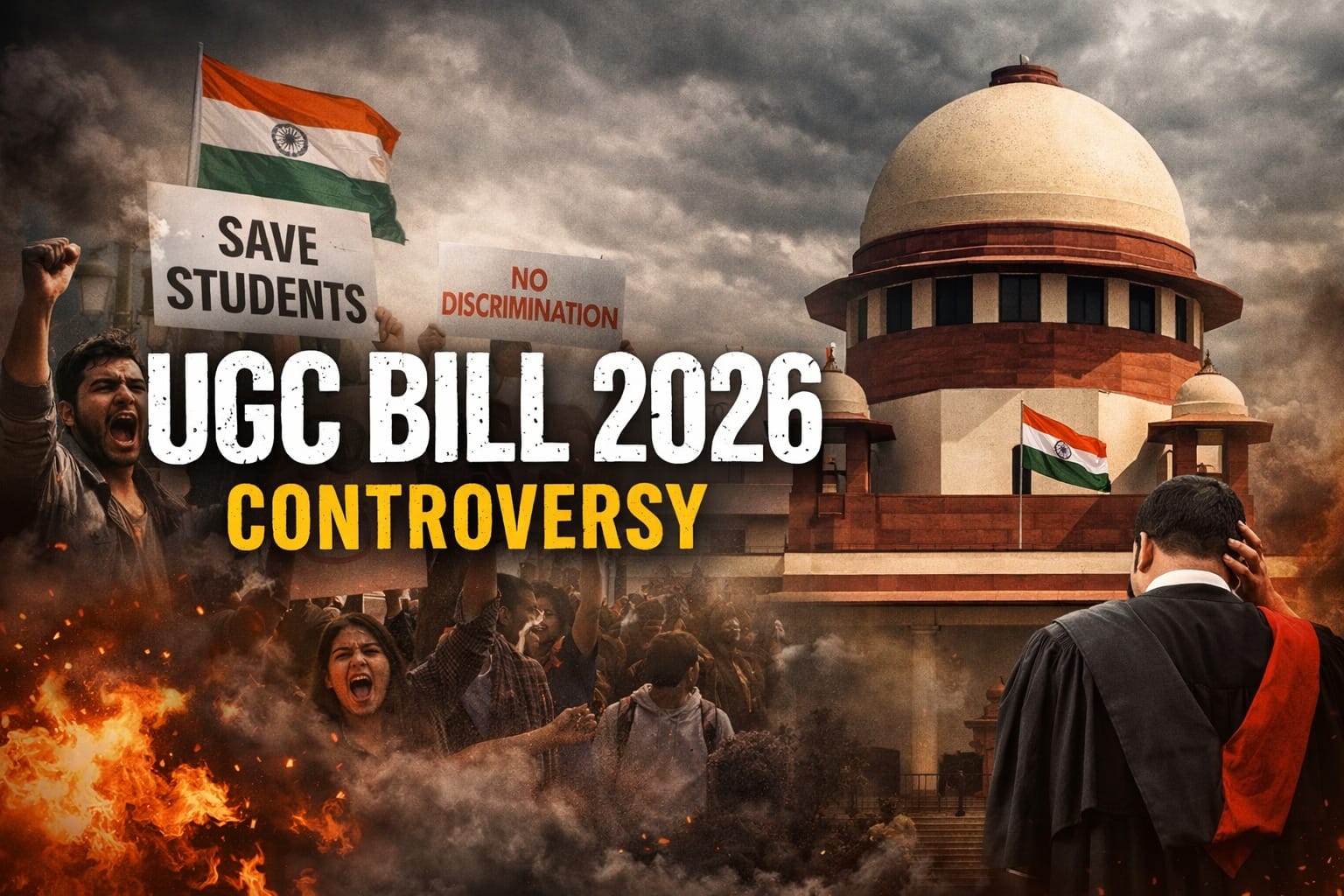
The regulations have sparked nationwide debate, protests, litigation, and political discourse — much more than most educational policies in recent years.
The controversy stems from several key issues:
🧠 1. Broad and Vague Definitions
Many critics — including student groups and legal petitioners — argue that the definitions of discrimination in the new regulations are vague and potentially overbroad.
Specifically, the term “caste-based discrimination” is defined in a way that some argue limits protection to only particular categories (SC/ST/OBC) and excludes general category students, even if they face discrimination.
Opponents say this exclusion could:
- Amount to reverse discrimination
- Leave upper-caste students without protection or recourse
- Enable misuse of the rules against innocent individuals
These objections form the basis of Public Interest Litigations (PILs) filed in the Supreme Court.
⚖️ 2. Concerns About Misuse & False Complaints
Protesters — especially in the general category student community — are deeply concerned that the complaint mechanism lacks adequate safeguards. They argue that:
- False allegations could lead to institutional action or reputational damage
- There is no clear penalty for filing frivolous or malicious complaints
- Equity committees could become a source of campus conflict and surveillance
These concerns have animated protests in multiple states and campuses.
Critics also point out that some procedural protections present in earlier drafts — like explicit penalties for false complaints — were removed in the final regulations.
🏛️ 3. Impact on University Autonomy
Several student unions and academic associations argue that the UGC rules intrude on the autonomy of universities by imposing:
- Excessive reporting and compliance requirements
- Equity committees with external oversight
- Heavy bureaucratic involvement in internal campus affairs
Protestors claim the changes could lead to over-regulation, censorship, or administrative overload.
Also read – The Mother of all Trades: The India-EU Free Trade Deal Explained
🏫 4. Protests & Public Backlash
Across India, protests have erupted involving:
- Upper-caste student groups and organisations
- Teachers’ associations
- Community leaders
- Religious and social figures
Some critics have even dubbed the regulations a “kala kanoon” (black law) and argued that they could divide communities if implemented without transparency and consultation.
Despite the Supreme Court stay, protests in regions like Rajasthan have continued, with demands for complete withdrawal of the regulations.
🏛️ Supreme Court’s Intervention: Why the Apex Court Stayed the Regulations
On 29 January 2026, the Supreme Court of India issued a stay order, temporarily halting the implementation of the 2026 UGC equity regulations.
⚖️ What Did the Supreme Court Say?
The Court expressed deep concern about aspects of the regulations that could have “very sweeping consequences” and potentially divide society if allowed to operate in their current form.
Key concerns raised by the Court include:
- Ambiguity in wording and definitions that could lead to misuse or arbitrary interpretation.
- Lack of clarity on how discrimination complaints against any student or faculty member would be processed fairly.
- Possible tension between equity and equality principles — whether the rules truly align with constitutional protections.
Importantly, the Supreme Court has directed institutions to continue following the older 2012 UGC regulations until further orders.
👩🎓 Who Is Affected by the UGC Bill 2026?
The regulations, if implemented, would apply to all higher educational institutions in India, including:
🎓 Students
- From all social categories
- Undergraduate, postgraduate, and research levels
- Across public and private colleges and universities
👨🏫 Faculty & Staff
- Teachers and academic staff
- Non-teaching employees
🎓 Institutions & Administrators
- Vice-chancellors
- Deans and department heads
- Equity Officers and grievance redressal bodies
Overall, the policy’s scope covers every campus regulated by UGC, influencing everyday student life and institutional governance.
📢 Protests & Public Sentiment: What Students Are Saying
The Supreme Court’s stay has prompted mixed reactions among the student community:
🟢 General Category Students
- Welcomed the stay, calling it a win against vague and potentially harmful rules.
- Argued for clearer definitions and protections to prevent misuse.
🔴 SC/ST & OBC Students
- Worried that a stay delays safeguards aimed at tackling caste discrimination on campuses.
- Called for reforms to ensure protections without ambiguity.
⚖️ Student Unions & Experts
- Some groups emphasize the need for transparent discussions with stakeholders before enacting such sweeping changes.
📆 Latest Updates & Political Responses
Political figures and parties have weighed in on the controversy:
- Mayawati criticized protests by some groups as inappropriate and casteist.
- Samajwadi Party leaders urged balanced intentions and a review of older regulations.
- Social leaders and seers in regions like Prayagraj warned that the bill could “divide Hindu society”.
These responses reflect how the issue has spilled beyond campuses into broader political and social discourse.
📍 Why the Supreme Court Has Not Fully Accepted the Bill
The Supreme Court haven’t rejected the regulations permanently — but they have stayed implementation. Here’s why:
⚠️ 1. Vagueness & Potential for Misuse
The language used in several provisions could allow arbitrary interpretation, leading to unintended consequences.
⚖️ 2. Constitutional Questions
Petitions argue that the structure could violate Articles 14 (Equality), 15 (Non-discrimination), and 21 (Life & Personal Liberty) of the Indian Constitution.
🔍 3. Exclusionary Definitions
By specifying certain groups and excluding others from the definition of caste-based discrimination, the Court is alarmed by potential reverse discrimination or inequality of protection.
🧠 4. Need for Expert Review
The Court has encouraged a committee of jurists and experts to re-examine the framework, its definitions, and safeguards before a final decision.
📌 What Happens Next?
🗓️ Supreme Court Hearings
The case is now listed for further hearings, where the Court will examine:
- Whether the regulations are constitutional
- If revisions are needed
- How to balance equity with equality and academic freedom
🛠️ Possible Amendments
The UGC and Ministry of Education may be instructed to:
- Refine definitions
- Add clear safeguards against misuse
- Include neutral and caste-agnostic language
- Consult stakeholders (students, teachers, legal experts)
📄 Continued Enforcement of 2012 Rules
Until a final judgment, the 2012 UGC equity regulations remain in force.
📣 Public Engagement & Feedback
Experts, academics, students and public inputs are expected to shape the next iteration of the policy — possibly a revised, clearer, and more inclusive framework.
🧠 Conclusion: A Defining Moment for Indian Higher Education
The UGC Bill 2026 controversy is far from just an administrative update — it reflects larger debates about:
- Equality vs equity
- Campus governance & autonomy
- Caste, identity and discrimination policy
- Role of regulatory bodies vs academic agencies
Whether the final outcome strengthens campus protections or reshapes policy design, this episode will likely influence how education policy is crafted and contested in India for years to come.
Subscribe to our YouTube Channel The Logic Stick for more video insights