






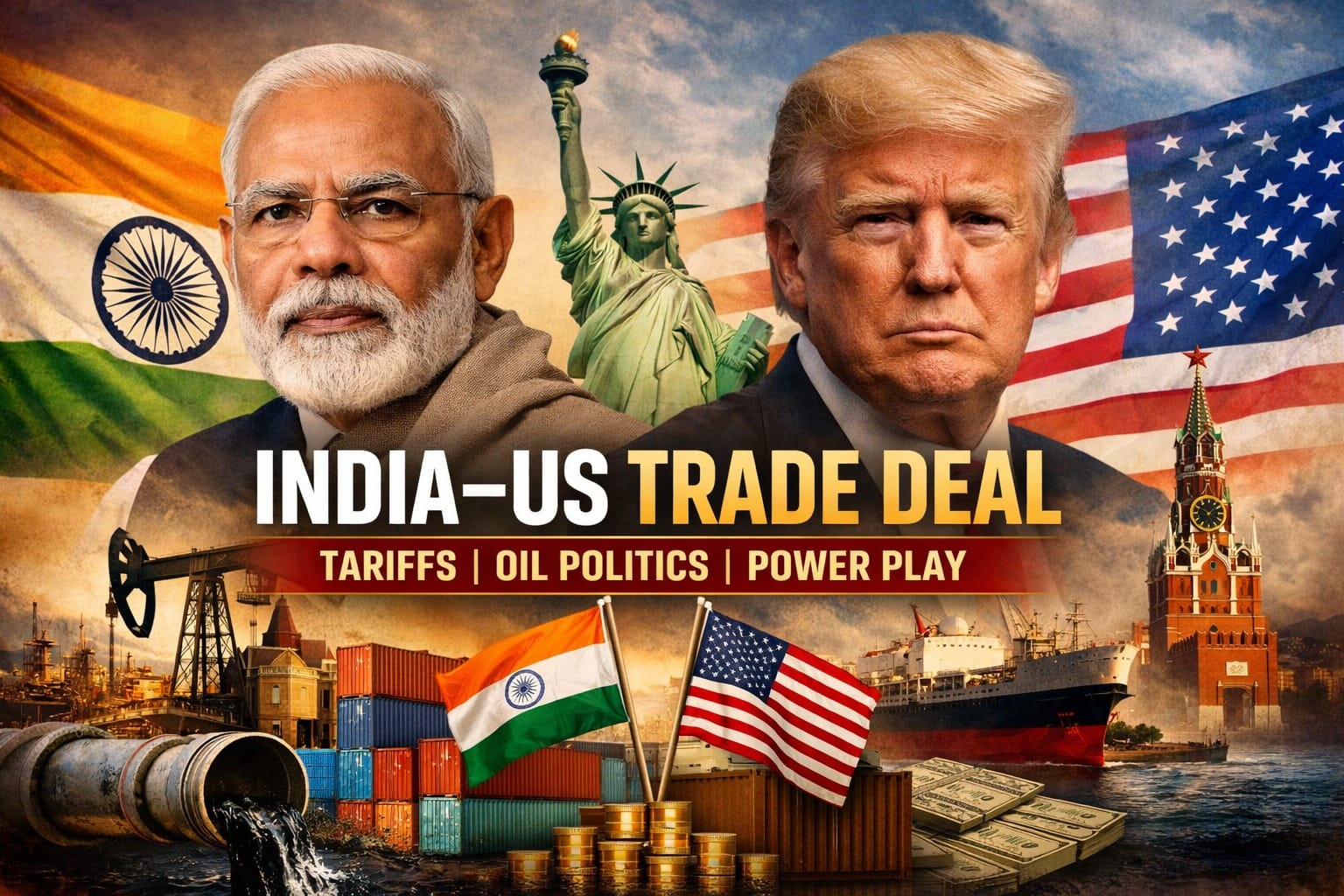
India-US Trade Deal: Reality Check on Tariffs, Oil Politics, Power Plays and What Comes Next
The phrase “India–US trade deal” is being used very confidently right now, but the reality is more nuanced: what’s public so far looks less like a fully-documented free trade agreement and more like a high-level political understanding that still needs paperwork, timelines, and enforceable text to become fully real on the ground. That gap between announcement and implementation is exactly why reactions are mixed—some see it as a breakthrough that cuts the heat of tariffs, while others see it as a transaction built on pressure points (especially energy and Russia-related geopolitics).
Below is a detailed, up-to-date breakdown of what has been announced, what’s actually confirmed, what the Trump administration is saying, what the Kremlin is saying about India’s oil purchases, the reported “Ajit Doval firm stand” angle, and how effective this trade deal is likely to be once it moves from headlines to execution.
1) What triggered the India–US trade deal conversation in the first place?
To understand the India–US trade deal, you have to start with the tariff escalation that came before it.
According to reporting, most Indian goods had been facing an effective 50% US tariff since late August—composed of a 25% “reciprocal” tariff plus an additional 25% punitive tariff linked to India’s purchases of Russian oil.
That’s the backdrop: a sharp, public tariff conflict that became tied to a geopolitical demand—reduce Russian oil exposure—not just trade math.
2) What has been announced in the India–US trade deal?
A) The headline: US tariffs cut to 18%
The biggest headline item is the claim that the US will reduce tariffs on Indian goods to an 18% rate, down from the peak levels tied to the dispute.
Reuters reported that a US official said the extra 25% punitive tariff would be removed, helping take the effective rate down sharply.
B) The linked trade-off: India to halt (or significantly reduce) Russian oil purchases
This is the most controversial part. Reuters reported Trump said India would halt Russian oil purchases and shift to buying from the US and “potentially Venezuela.”
But multiple credible analyses also stress a key point: the publicly available details are thin, and India has not publicly mirrored every claim in the way Trump framed them.
C) Big purchase numbers: $500 billion by 2030 (being reported)
NDTV reported (citing sources) that India would commit to buying $500 billion in US energy and tech products by 2030, while also emphasizing that sensitive Indian sectors were protected.
Independent analysis has also flagged how large that number is relative to recent annual trade volumes—meaning timelines, definitions, and accounting will matter if this becomes a real obligation rather than a political projection.
D) “Zero tariffs” claims and market access
Trump’s public messaging included claims that India would reduce tariffs and non-tariff barriers against the US to “zero.”
At the same time, reporting from India indicates red lines remain around sensitive areas like agriculture and dairy—so any “zero” framing is almost certainly selective by category, not universal across the board.
Also read – India-EU Trade Agreement Explained
3) The most important reality check: details are still not fully public or legally operational
This is the single biggest reason the public reaction is split.
Reuters reported that Trump’s post provided few details, including key items like start dates, deadlines for oil changes, exact barrier reductions, and which US products India committed to buy—and noted that the formal steps (proclamations/notices) were not immediately visible at the time.
Al Jazeera also summarized the “what we know vs what we don’t” aspect: an announced deal, but limited public documentation.
Even supportive commentary from experienced diplomats has cautioned that in this “proclamation-first” style, what is announced can also be reversed quickly if compliance is judged politically rather than via a stable treaty mechanism.
So the reality is: the India–US trade deal is not a single switch. It’s a process—and the process can reshape outcomes.
4) What the Trump administration is saying (beyond Trump’s post)
A major reason the story is moving is that US officials have started giving rationale and color to the deal.
Reporting captured comments that the US is maintaining an 18% baseline tariff because it views the trade balance as a problem and wants to keep leverage.
The same reporting also described claims that India agreed to reduce tariffs on some US goods (industrial and certain agricultural items), while keeping protections around sensitive agricultural goods.
And importantly, US officials have publicly signaled that they are monitoring India’s “winding down” of Russian oil purchases, making energy compliance a visible barometer of whether the relationship stays smooth.
In simple terms: the Trump administration’s message is transactional and measurable—tariffs ease if India delivers on the energy/purchase commitments.
5) What the Kremlin is saying about India’s oil purchases
Russia’s response has been blunt and consistent:
The Kremlin said it sees “nothing new” in India diversifying oil supplies, because India has always bought oil from multiple countries and Russia is not the only supplier.
This matters because it directly pushes back on the idea that India has made an extraordinary, binding pledge to stop Russian oil. The Kremlin framing suggests: “India buying from others isn’t a rupture; it’s normal.”
This also aligns with the practical constraints analysts highlight: oil substitution isn’t just political—it’s operational (grades, shipping, pricing, refinery configurations).
6) The Ajit Doval “firm stand”: “We can wait till 2029, we won’t be bullied”
This angle is gaining traction because it reframes India not as a passive recipient of US pressure, but as a negotiator willing to absorb pain rather than sign a bad deal.
Multiple outlets reported (attributing to Bloomberg’s account of a private meeting) that NSA Ajit Doval told US Secretary of State Marco Rubio that India would not be “bullied” and could wait out Trump’s term—ending in 2029—if necessary.
If accurate, it’s significant for two reasons:
- It signals strategic patience: India telling the US it won’t negotiate under public pressure.
- It signals experience: the message reportedly referenced India having handled difficult US administrations in the past.
This matters for the India–US trade deal’s “effectiveness” because it indicates India’s objective may not be to maximize short-term concessions, but to protect long-term policy autonomy—especially in politically explosive sectors (agriculture, dairy) and strategic sectors (energy security).
7) Major “deals” within the deal: what likely changes in real terms?
Because the final text is still not fully public, we have to separate reported/claimed components from verified effects.
Deal Component 1: Tariff de-escalation (verified direction, partial detail)
What it means: Indian exporters get relief versus the prior 50% tariff environment.
What’s unclear: exact implementation date, product-level exclusions, and whether 18% is flat or “effective” (varies by category).
Who benefits most (likely):
- Labour-intensive exports: textiles, apparel, leather, gems & jewellery, certain machinery and chemicals—sectors repeatedly mentioned as sensitive to US market access in current commentary around the deal.
Deal Component 2: Energy realignment (high impact, hardest to execute)
What it means: The US is trying to turn trade leverage into energy market outcomes—getting India to shift away from Russia.
Execution problems: Oil grades differ (Russian Urals vs much of US shale), and replacing large volumes is not frictionless.
Most realistic outcome: not “zero Russian oil overnight,” but a gradual diversification where India buys more from the US (and others) when price/terms allow—exactly the “nothing new” idea the Kremlin pushed.
Deal Component 3: Market access for US goods (selective “zero,” not universal)
US-side messaging suggests tariff cuts to zero for certain items, but the same reporting notes India keeps protection around sensitive farm categories.
Likely Indian objective: offer “win” categories where domestic backlash is limited, while shielding dairy/fisheries/rice-like political flashpoints.
Deal Component 4: Big-ticket purchases ($500B by 2030)
This is the number that draws both excitement and skepticism.
- Supporters see it as “India locking in US energy + tech supply chains.”
- Skeptics see it as “a headline number” that will be met through creative accounting, long timelines, or conditional definitions.
It’s being reported via Indian sources that such a purchase commitment is part of the package.
But independent analysis also notes how large that figure is compared to recent annual trade, implying the structure matters more than the slogan.
8) Why reactions are mixed: the deal has real upsides, but also real risk
Why many in India are positive
- Export breathing room: moving from 50% down to 18% changes the competitiveness equation overnight.
- Stability narrative: it signals the relationship is back from escalation.
- Investor sentiment: markets generally like de-escalation, even if details come later.
Why many are cautious or critical
- 18% is still a tariff wall: it’s relief vs 50%, but it’s not “free access.”
- Conditionality risk: if enforcement becomes political (“are you buying less Russian oil?”), tariff threats can return quickly.
- Energy sovereignty optics: India doesn’t like appearing to take foreign instructions on oil. The Kremlin response highlights the contested narrative.
- No full text yet: uncertainty reduces planning confidence for exporters and importers.
9) How effective will the India–US trade deal be?
Effectiveness depends on what you mean by effective. Let’s measure it through five lenses.
Lens 1: Immediate economic relief for exporters
High likelihood of benefit if the tariff cut is implemented broadly and quickly. A drop from the previously reported effective peak levels to 18% is a meaningful competitive shift.
Lens 2: Long-term certainty
Medium-to-low until paperwork is public. Even supportive voices warn this “announcement-first” model can be reversible.
Lens 3: Energy transition feasibility
Medium at best in the short term. India can diversify, but fully replacing Russian barrels is logistically complex, and may not even be economically rational at all times.
Lens 4: Political sustainability in India
High only if sensitive sectors are protected. Domestic backlash risk rises sharply if dairy/farming livelihoods look threatened—hence the consistent messaging that sensitive sectors are shielded.
Lens 5: Strategic autonomy and negotiation posture
This is where the Ajit Doval “we won’t be bullied” account becomes relevant: it signals India wants to avoid a precedent where trade terms are dictated via public pressure.
If that posture holds, the deal may be “effective” not because it is perfect economics, but because it sets boundaries: India will cooperate, but not be seen as coerced.
10) What happens next: the checklist that will decide the real outcome
If you want the “reality of what is currently happening,” track these developments over the coming days/weeks:
- Formal joint statement / signed text (product categories, dates, enforcement)
- Legal implementation steps on the US side (not just announcements)
- India’s official language on Russian oil: “stop,” “reduce,” or “diversify” (these are very different)
- Energy purchase contracts: volumes, pricing, and timeline
- Sector-specific tariff schedules: which Indian exports actually face 18% and which have exceptions
- Non-tariff barriers: what is removed, what stays, and what is “under discussion”
- Political messaging: whether the relationship stays calm or returns to public pressure tactics
11) Bottom line: the clearest truth about the India–US trade deal
Right now, the India–US trade deal is best understood as:
- A tariff de-escalation framework that could materially help Indian exporters if executed as described.
- A geopolitically-loaded package where energy sourcing (Russia vs US) is being treated as a compliance signal by Washington.
- A narrative battle where Russia publicly rejects the idea of anything “new,” framing India’s diversification as normal.
- A negotiation story (via the Doval–Rubio reporting) that suggests India tried to draw a line against being pressured—“we can wait till 2029.”
So is it effective? Potentially yes for exports and sentiment—if the legal and sector-level details match the headlines. But until the text is public and timelines are clear, the most honest position is: this is a powerful announcement with incomplete documentation—promising, but not fully proven yet.
FAQ 1: Is the India–US trade deal officially signed?
No. As of now, it is a high-level political agreement with limited public documentation. Legal implementation details are still awaited.
FAQ 2: Did India agree to stop buying Russian oil?
There is no official confirmation that India will completely stop. The agreement points toward diversification, not an outright ban.
FAQ 3: Why is the 18 percent US tariff still important?
While lower than earlier levels, 18 percent is still significant and keeps leverage with the US, making the deal conditional rather than absolute.
FAQ 4: What did Ajit Doval mean by “we can wait till 2029”?
It signals India’s willingness to endure short-term pressure rather than accept a deal that compromises long-term strategic autonomy.
FAQ 5: Will this trade deal help Indian exporters?
Yes, if implemented as announced. Export-heavy sectors stand to gain the most from tariff reduction.
Subscribe to our YouTube channel The Logic Stick for more video insights