







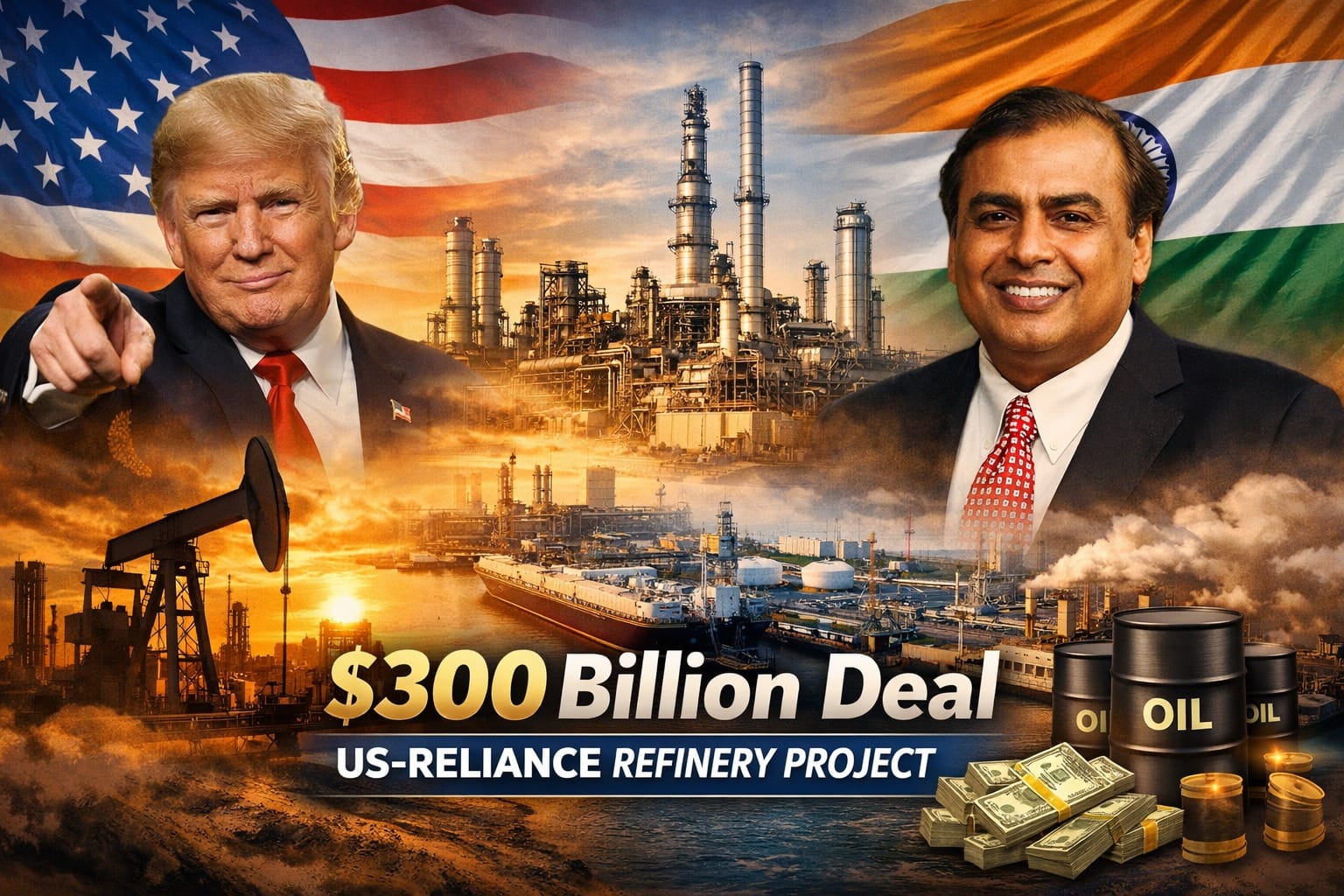
US-Reliance Energy Deal Explained
In March 2026, the global energy sector witnessed a major announcement that could reshape the dynamics of oil refining and international energy cooperation. U.S. President Donald Trump revealed plans for a massive oil refinery project in Texas backed by investment from India’s energy giant Reliance Industries, calling it a “historic $300 billion deal” and the largest energy deal in U.S. history.
The project has drawn global attention because it would mark the first new oil refinery built in the United States in nearly 50 years, highlighting the scale of the investment and the strategic importance of energy infrastructure in a rapidly shifting global oil market.
This article explains everything currently known about the US–Reliance deal, including the project details, investment structure, strategic goals, geopolitical implications, and potential impact on global energy markets.
The Historic US–Reliance Energy Deal
The refinery project is being developed by America First Refining (AFR), a U.S.-based energy company, with significant backing from Reliance Industries. The proposed facility will be located at the Port of Brownsville in South Texas, close to the U.S.–Mexico border.
President Trump announced the deal on his social media platform Truth Social, describing it as a major step toward strengthening U.S. energy dominance and revitalizing American industrial infrastructure.
Trump said the project will:
- Boost American energy production
- Create thousands of jobs
- Increase U.S. fuel exports
- Strengthen national energy security
According to the announcement, the refinery is expected to generate billions of dollars in economic impact while helping reduce the U.S. trade deficit.
Why This Refinery Is So Significant
One of the most notable aspects of this deal is that the United States has not built a completely new large-scale refinery in nearly five decades.
Most U.S. refining facilities today were built decades ago and later expanded or upgraded rather than constructed from scratch. Environmental regulations, high capital costs, and market uncertainty have discouraged companies from building entirely new refineries.
The Brownsville refinery would therefore represent:
- The first new U.S. refinery since the late 1970s
- A major expansion of U.S. refining capacity
- A significant cross-border energy investment involving India
This makes the project one of the most ambitious oil infrastructure developments in recent years.
Location: Port of Brownsville, Texas
The refinery will be built at the Port of Brownsville, a deepwater port located along the Gulf Coast near the U.S.–Mexico border.
This location was chosen for several strategic reasons:
1. Export Hub
The Gulf Coast is already a major center for oil refining and fuel exports, supplying markets in Latin America and other regions.
2. Transport Infrastructure
Brownsville has:
- Rail connectivity
- Road access
- Shipping infrastructure
These features make it easier to transport crude oil and refined products.
3. Proximity to Oil Production
Texas is one of the largest oil-producing regions in the world, especially due to shale oil production from the Permian Basin.
Also read – How Russian Intelligence is helping Iran hit US Targets
Capacity and Technical Details of the Refinery
According to available information, the refinery is expected to process around:
- 168,000 barrels of oil per day
The facility will specifically process American shale oil, also known as light sweet crude.
This is important because many existing U.S. refineries were designed decades ago to process heavier crude oil, which means they are not optimized for shale oil.
The new refinery will therefore be designed specifically to refine:
- U.S. shale crude
- Light sweet crude oil
This could help increase domestic refining capacity for American oil production.
Investment Structure of the Deal
While the project has been widely described as a $300 billion deal, the exact breakdown of the investment remains unclear.
Current information suggests:
- Reliance Industries made a nine-figure investment in the project.
- The company invested at a ten-figure valuation of the project.
- The refinery construction cost is estimated to exceed $4 billion to $6.7 billion.
The $300 billion figure likely refers to the long-term economic value, including crude purchases, fuel production, and exports generated over time rather than just the construction cost.
Reliance Industries’ Role in the Project
Reliance Industries is India’s largest private-sector company and one of the world’s biggest energy companies.
The company operates the Jamnagar refinery complex in Gujarat, which is currently the largest refining complex in the world.
Reliance’s involvement in the U.S. refinery project includes:
Financial Investment
Reliance has provided capital investment into the refinery development.
Long-Term Offtake Agreement
The company has signed a binding 20-year offtake agreement to purchase refined products from the facility.
This agreement ensures that:
- The refinery will have guaranteed buyers for its fuel output
- Reliance will secure a long-term supply of refined products
Such agreements are common in large energy projects because they reduce financial risk.
The Company Behind the Refinery
The refinery project is being led by America First Refining, a company focused on expanding U.S. refining capacity.
Key leadership includes:
- John V. Calce – Chairman and founder
- Energy and infrastructure investors linked to the project
According to the company, the refinery will:
- Strengthen the U.S. energy supply chain
- Increase domestic refining of American crude
- Support thousands of jobs in Texas.
Construction is expected to begin in the second quarter of 2026 if regulatory approvals move forward as planned.
Strategic Importance for the United States
The project comes at a time when global energy markets are experiencing volatility due to geopolitical tensions and supply disruptions.
Several strategic benefits have been highlighted:
1. Energy Security
The refinery could reduce reliance on foreign refined fuels by increasing domestic refining capacity.
2. Export Growth
The Gulf Coast already exports large volumes of refined fuel to Latin America and other regions.
The new refinery could further strengthen U.S. export capacity.
3. Job Creation
The project is expected to create thousands of jobs in construction and operations.
4. Regional Economic Development
The refinery will be built in a federally designated economic opportunity zone, which aims to boost investment in underdeveloped regions.
Strategic Importance for India and Reliance
For Reliance Industries, the deal represents a major strategic move.
1. Expansion into U.S. Energy Infrastructure
Reliance traditionally focused on refining and petrochemicals in India, but this deal expands its footprint into American energy infrastructure.
2. Access to U.S. Shale Oil
The U.S. shale revolution has transformed global oil markets.
By investing in a refinery processing shale oil, Reliance strengthens its position in the global fuel supply chain.
3. Strengthening India–US Energy Ties
The investment signals growing energy cooperation between India and the United States.
Industry Reactions and Skepticism
Despite the excitement around the announcement, some analysts remain cautious about the project.
Energy experts point out that:
- The U.S. Gulf Coast already hosts many large refineries.
- Several analysts believe the region may already have sufficient refining capacity.
Some experts suggest that the Brownsville refinery may function more as an export refinery rather than serving domestic demand.
Another point of uncertainty is the true financial structure of the $300 billion figure, which may include long-term economic projections rather than direct investment.
Global Oil Market Context
The announcement comes during a period of significant volatility in global energy markets.
Factors influencing the deal include:
- Rising fuel prices
- Geopolitical tensions in the Middle East
- Shifting global oil supply chains
Energy infrastructure investments like this refinery are often driven by the need to secure reliable fuel supplies and increase export capacity.
Potential Economic Impact
If completed, the refinery could have several long-term impacts:
United States
- Expansion of refining capacity
- Job creation
- Increased fuel exports
India
- Strategic energy investments
- Stronger ties with the U.S. energy sector
Global Energy Markets
- Increased availability of refined fuels
- Greater integration between U.S. shale production and international fuel markets
Timeline of the Project
2024
Initial site preparation reportedly began for an energy facility at the Brownsville port site.
2026 (March)
President Trump announces the refinery project and Reliance investment.
2026 (Q2)
Construction is expected to begin.
Future
Once operational, the refinery will process shale oil and export refined fuels globally.
Conclusion
The US–Reliance refinery deal represents one of the most ambitious energy infrastructure projects announced in recent years.
With plans to build the first new U.S. refinery in nearly 50 years, the project could reshape refining capacity in the United States while strengthening energy ties between India and the U.S.
While the exact financial structure of the $300 billion deal remains unclear, the project highlights the strategic importance of energy infrastructure in a world where oil supply chains, geopolitical tensions, and global demand continue to evolve.
If the refinery is successfully completed, it could become a landmark example of cross-border energy investment, combining American shale oil production with global refining expertise from Reliance Industries.
Subscribe to our YouTube Channel The Logic Stick for more video insights