







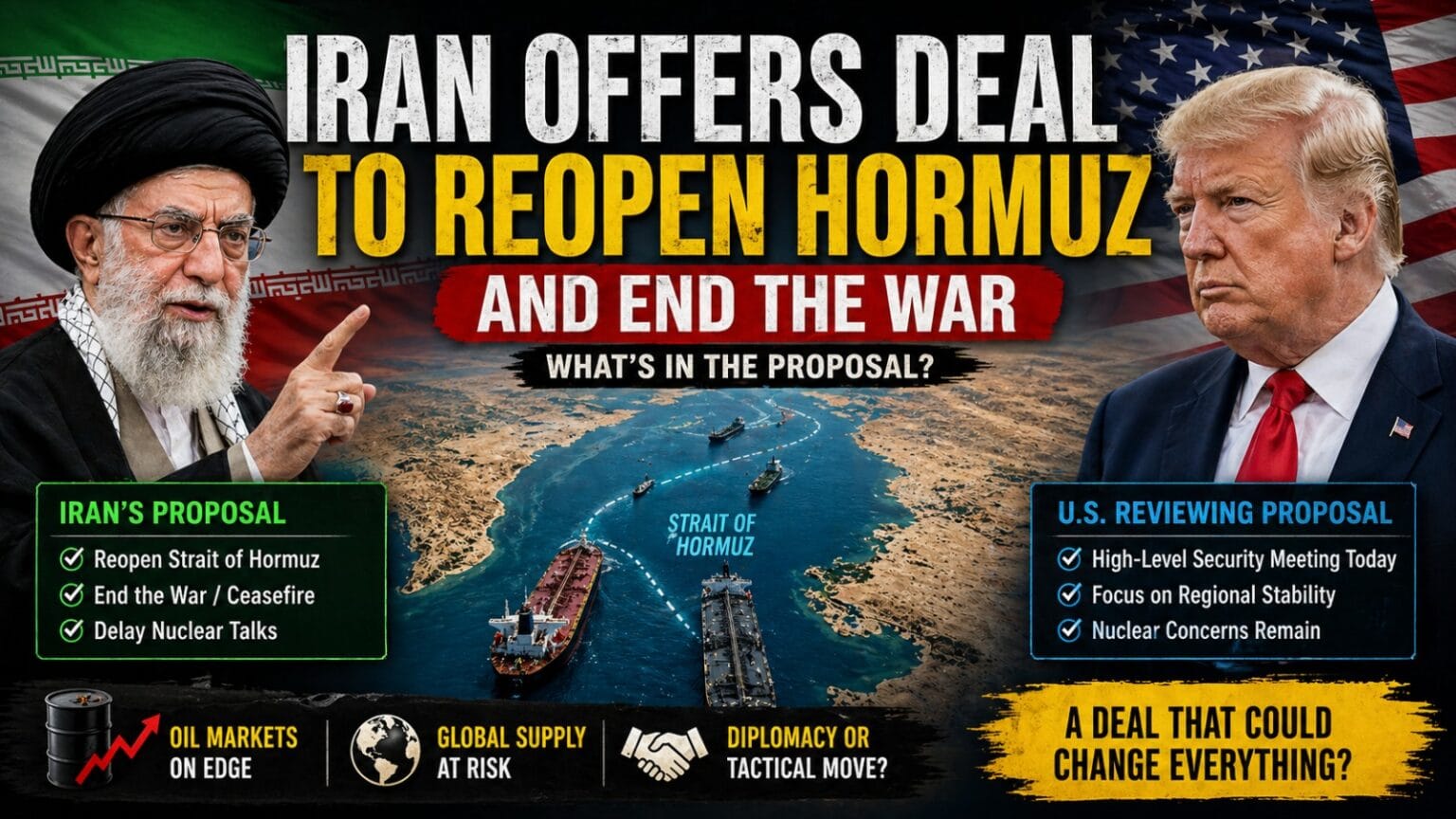
Iran Offers Deal to Reopen Strait of Hormuz
Introduction
In a significant geopolitical development, Iran has reportedly offered a new deal to the United States aimed at reopening the strategically critical Strait of Hormuz and ending the ongoing conflict in West Asia. The proposal comes amid escalating tensions, economic pressure, and a prolonged blockade that has disrupted global oil supply chains.
The move is being seen as a potential breakthrough — but also raises critical questions about timing, strategy, and the future of US-Iran relations.
What Is Iran’s Latest Proposal?
According to multiple reports, Iran has presented a two-stage proposal to the United States through intermediaries:
Key Elements of the Proposal
- Immediate reopening of the Strait of Hormuz
- Ceasefire and de-escalation of hostilities
- Postponement of nuclear negotiations to a later phase
Iran’s approach prioritizes stabilizing the region first, while deferring more contentious issues like uranium enrichment and nuclear capabilities.
This proposal reportedly reached Washington through Pakistani mediators and is being evaluated at the highest levels of US leadership.
Why the Strait of Hormuz Matters
The Strait of Hormuz is one of the most strategically important waterways in the world.
Global Importance
- Handles a significant portion of global oil and gas shipments
- Connects the Persian Gulf to international markets
- Critical for energy security of countries like India, China, and Europe
Even minor disruptions in this region can lead to:
- Spike in global oil prices
- Supply chain instability
- Economic uncertainty across markets
Recent tensions have already led to a sharp decline in shipping traffic and increased volatility in energy markets.
Background: What Led to This Crisis?
The current crisis is rooted in a broader conflict involving:
- US and Israeli strikes on Iran (February 2026)
- Iran’s retaliatory military actions
- A naval blockade imposed by the United States
In response, Iran has repeatedly:
- Closed or restricted access to the Strait
- Seized vessels
- Threatened prolonged disruption of maritime routes
At one point, Iran even declared reopening the strait “impossible” amid ongoing violations of ceasefire agreements.
Also read – Delhi IRS Officer’s Daughter Rape-Murder Case
Iran’s Strategy: Why Now?
Iran’s proposal reflects a calculated geopolitical strategy.
1. Economic Pressure
- Iran is reportedly losing massive revenue due to the blockade
- Oil exports — a key economic pillar — are heavily impacted
2. Diplomatic Leverage
- By offering a deal, Iran positions itself as open to negotiation
- Shifts global narrative towards diplomacy rather than aggression
3. Separation of Issues
- By delaying nuclear talks, Iran avoids immediate confrontation
- Focus remains on restoring trade and reducing tensions
This phased approach suggests Iran is aiming for a pragmatic compromise rather than a full resolution.
US Response: Cautious and Strategic
The United States has responded cautiously.
Key Points
- The US insists on ensuring Iran does not develop nuclear weapons
- Any deal must align with American strategic interests
- A high-level Situation Room meeting has been scheduled to assess the proposal
US leadership has also maintained that reopening the Strait alone is not sufficient without broader agreements, especially on nuclear issues.
Challenges and Roadblocks
Despite the proposal, several obstacles remain:
1. Nuclear Disagreement
- The US demands restrictions on Iran’s nuclear program
- Iran refuses to compromise on uranium enrichment
2. Lack of Trust
- Both sides accuse each other of ceasefire violations
- Previous negotiations have repeatedly failed
3. Internal Divisions
- Reports suggest no consensus within Iranian leadership on how to proceed
Global Impact: Why This Deal Matters
If accepted, the deal could have far-reaching consequences:
Positive Outcomes
- Stabilization of global oil markets
- Reduced geopolitical tension in West Asia
- Restoration of trade routes
Negative Risks
- Temporary solution without addressing core issues
- Future escalation if nuclear talks fail
- Strategic advantage shifts between global powers
Market Reaction and Economic Implications
Even temporary reopening of the Strait has previously caused:
- Immediate drop in oil prices
- Positive movement in global stock markets
However, inconsistent policy shifts — reopening one day and closing the next — have created uncertainty for investors and traders.
Is This a Real Breakthrough or Tactical Move?
Experts are divided:
Optimistic View
- A step toward de-escalation
- Opportunity to restart broader negotiations
Skeptical View
- A tactical move to ease economic pressure
- Temporary solution without long-term commitment
Conclusion
Iran’s proposal to reopen the Strait of Hormuz marks a critical moment in the ongoing US-Iran conflict. By prioritizing a ceasefire and postponing nuclear talks, Tehran is attempting to shift the dynamics of negotiation.
However, with deep-rooted disagreements, lack of trust, and geopolitical complexities, the path forward remains uncertain.
The coming days — especially the US response — will determine whether this is:
- A genuine turning point
- Or just another chapter in a prolonged geopolitical standoff
Subscribe to our YouTube Channel The Logic Stick for more video insights