






Trump Signals Endgame?
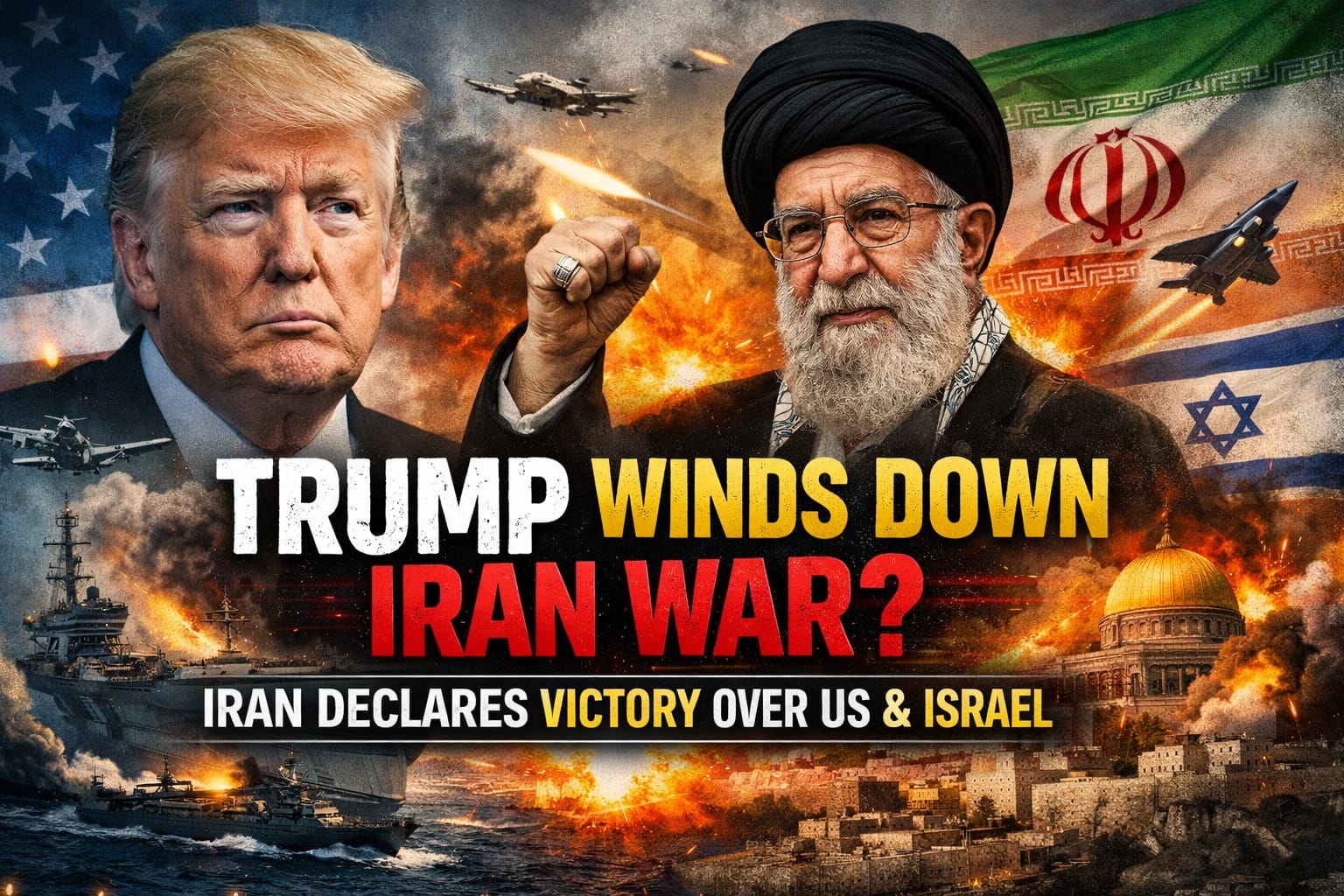
The ongoing US–Israel vs Iran war in 2026 has reached a critical turning point. In a surprising yet strategically calculated shift, former U.S. President Donald Trump has stated that he is “considering winding down” military operations against Iran, even while refusing to agree to a formal ceasefire.
This development comes amid escalating regional violence, rising global oil prices, and Iran’s bold declaration that it has successfully resisted the combined might of the United States and Israel.
This article provides a complete breakdown of the war, Trump’s strategy, Iran’s response, and the geopolitical consequences shaping the Middle East and global economy.
Background: How the 2026 Iran War Started
The current conflict began on February 28, 2026, when the United States and Israel launched coordinated strikes on Iranian military and strategic infrastructure.
The objectives included:
- Weakening Iran’s missile and nuclear capabilities
- Disrupting its regional influence
- Pressuring internal political instability within Iran
Iran responded almost immediately with:
- Missile strikes on Israeli cities
- Attacks on U.S. bases in the Gulf
- Activation of proxy groups like Hezbollah
The situation escalated into a multi-front regional conflict, involving Lebanon, Gulf nations, and critical energy routes like the Strait of Hormuz.
Trump’s Statement: ‘Winding Down’ But No Ceasefire
In a key statement, Donald Trump confirmed that the U.S. is considering reducing military operations, but clearly ruled out a ceasefire with Iran.
His reasoning is strategic:
- He claims the U.S. is already “obliterating” Iranian capabilities
- A ceasefire would signal weakness
- The primary goal—neutralizing Iran’s military threat—is nearing completion
At the same time, the U.S. continues to:
- Deploy additional warships and troops
- Conduct operations in the Strait of Hormuz
- Maintain pressure through targeted strikes
This contradictory stance—de-escalation without peace—defines Trump’s current war strategy.
Ground Reality: War Intensifying Despite ‘Wind Down’ Signals
Despite talk of winding down, the war is far from over.
Key Developments:
- Over 1,300 deaths in Iran and 1,000 in Lebanon reported so far
- Iranian missile attacks continue on Israel
- Israel has launched strikes deep into Tehran
- Hezbollah remains actively engaged in Lebanon
The conflict has expanded geographically:
- Gulf countries like Saudi Arabia intercepted drones targeting oil facilities
- Attacks have reached cities like Dubai and Jerusalem
This shows that while the U.S. may be reconsidering its long-term involvement, the region remains highly volatile and unstable.
Also Read – Iran Strikes Tel Aviv Railways Stations
The Strait of Hormuz Crisis: The Economic Battlefield
One of the most critical elements of this war is the Strait of Hormuz, through which nearly 20% of global oil passes.
What Happened:
- Iran closed the Strait of Hormuz in retaliation
- The U.S. launched military operations to reopen it
- Naval and aerial strikes targeted Iranian assets in the region
Impact:
- Oil prices surged to nearly $120 per barrel
- Global shipping and trade disrupted
- Airlines and industries preparing for economic shocks
This has turned the war into not just a military conflict, but a global economic crisis trigger.
Major US Military Operations Against Iran
One of the most significant attacks was the Kharg Island raid:
- Over 90 Iranian military sites destroyed
- Target: strategic oil export hub and military installations
- Message: cripple Iran’s ability to control oil routes
Additionally:
- U.S. deployed A-10 jets, Apache helicopters, and Marines
- Continuous strikes on Iranian drones and naval units
These actions highlight the U.S. goal:
Control energy routes and weaken Iran’s strategic dominance
Iran’s Response: Declaring Victory Against US and Israel
Despite heavy losses, Iran has made a bold narrative shift.
Iran’s Claims:
- The U.S. and Israel failed to stop its weapons programs
- Iran has successfully resisted military pressure
- The war has exposed Western dependency on Middle East oil
Iran’s leadership is framing this as a psychological and strategic victory, even if militarily it remains under pressure.
This aligns with a broader strategy:
- Use asymmetric warfare
- Target global economic vulnerabilities
- Maintain internal morale
Israel’s Position: Victory Claimed, But War Continues
Interestingly, Israel has also claimed success.
- Israeli officials declared they have “won” the war against Iran
- Key targets like missile infrastructure have been damaged
- Iran is described as “dramatically weakened”
However:
- Iran continues missile attacks
- Core objectives remain incomplete
This creates a paradox:
Both sides are claiming victory while the war continues
US–Israel Rift: Differences in War Objectives
A major development is the growing strategic divide between the U.S. and Israel.
Trump’s Approach:
- Limited war
- Avoid economic collapse
- No regime change
Israel’s Approach:
- Full-scale dismantling of Iranian leadership
- Targeting energy infrastructure
- Long-term destabilization
This disagreement has:
- Strained diplomatic coordination
- Increased unpredictability in military decisions
- Raised concerns among global allies
Global Reactions: NATO, Europe, and Allies
Trump has openly criticized NATO allies for their lack of support.
- Called them “cowards” for not joining the war
- European nations demanded de-escalation before involvement
Countries like:
- France
- Germany
- UK
have emphasized diplomacy and international law over military action.
This reflects a broader concern:
The war risks turning into a global conflict if escalated further
Economic Fallout: Oil, Markets, and Global Uncertainty
The economic impact of the war is already visible:
Key Effects:
- Oil prices spiking near $120/barrel
- Risk of reaching $175/barrel worst-case scenario
- Airline and shipping industries under pressure
- Global inflation concerns rising
The U.S. has even:
- Considered lifting sanctions on Iranian oil to stabilize prices
This highlights the contradiction:
War with Iran, but economic dependence on its oil
Internal US Pressure and Political Divide
The war is also causing political tensions within the U.S.
- A top counterterrorism official resigned in protest
- Critics argue the war was influenced by external pressure
- Trump’s own coalition is divided on foreign policy
This internal pressure may be one of the reasons Trump is now considering winding down operations.
Why Trump Is Considering a ‘Wind Down’
There are multiple strategic reasons:
1. Economic Pressure
- Rising oil prices
- Global market instability
2. Military Fatigue
- Extended regional involvement
- Risk of escalation into a wider war
3. Political Pressure
- Internal dissent
- Global criticism
4. Strategic Achievement
- Major Iranian targets already hit
- Perception of military success
However, Trump’s refusal to declare a ceasefire shows:
He wants to exit on his terms, not Iran’s
Is the War Really Ending?
The answer is complex.
Signs of De-escalation:
- Trump considering winding down
- Calls for diplomacy from global powers
Signs of Escalation:
- Continued missile attacks
- Military deployments increasing
- Regional conflict expanding
Even as the U.S. considers stepping back, the situation on the ground suggests:
The war is transitioning, not ending
Conclusion: A War Without a Clear Ending
The 2026 Iran war represents a new kind of conflict:
- Militarily intense
- Economically disruptive
- Politically complex
Trump’s statement about winding down operations marks a potential shift in strategy, but not necessarily peace.
Meanwhile:
- Iran claims resilience and symbolic victory
- Israel claims military dominance
- The U.S. claims strategic success
Yet, the reality remains:
The conflict is unresolved, the region unstable, and the world watching closely.
Subscribe to our YouTube Channel The Logic Stick for more video insights