





Introduction: The Next Industrial Revolution Is Leaving Earth
When Elon Musk talks about the future, it often sounds like science fiction—until it starts becoming reality.
From electric vehicles to reusable rockets, Musk has repeatedly pushed the boundaries of what industries thought was possible. Now, his latest vision may be the most ambitious yet:
- Building Terafab, the world’s largest AI chip factory
- Creating space-based data centers powered entirely by solar energy
- Scaling computing power to levels never seen before
This isn’t just about technology—it’s about redefining how civilization functions in the age of artificial intelligence.
But how real is this vision?
How much will it cost?
And when could it actually happen?
Let’s break it down.
What Is Terafab? The Foundation of Musk’s AI Empire


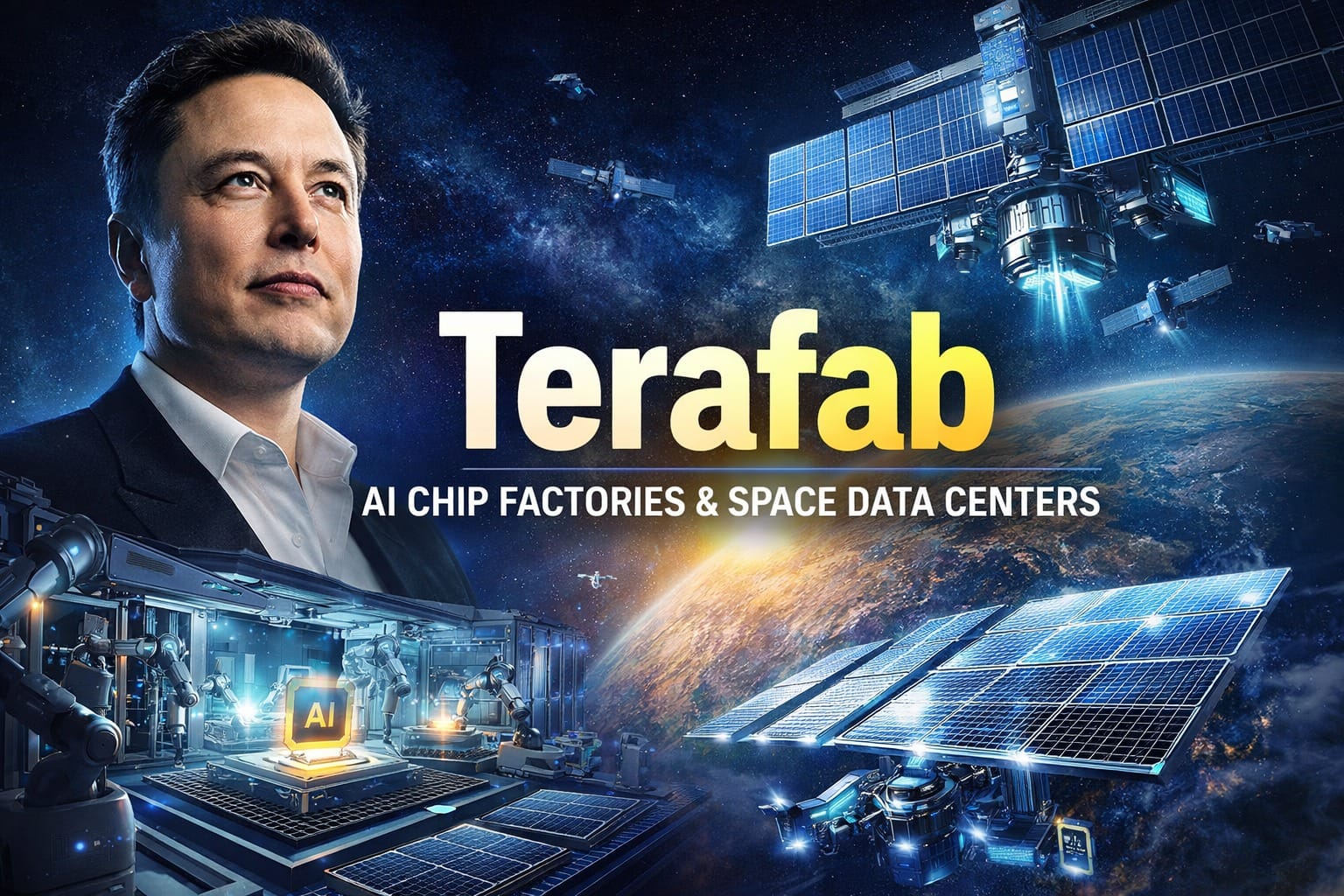
Terafab is a massive semiconductor manufacturing project announced in 2026—a joint initiative involving:
- Tesla
- SpaceX
- xAI
Its goal is simple but staggering:
To produce 1 terawatt (TW) of AI computing capacity annually
To put that into perspective:
- The entire world currently produces ~20 gigawatts of AI compute annually
- Musk wants to scale that by 50 times
This isn’t just a factory.
It’s an attempt to control the entire AI supply chain—from chip design to deployment.
Why Musk Needs Terafab
The reasoning is strategic:
- AI demand is exploding globally
- Existing chipmakers (like Nvidia, TSMC) cannot meet future needs
- Musk’s own companies (Tesla robots, autonomous cars, SpaceX satellites) require massive compute
As Musk himself has implied:
If we don’t build it, we won’t have the chips
Terafab becomes the infrastructure backbone of his AI + space vision.
The Bigger Move: SpaceX + xAI Merger
Why This Matters
In early 2026, SpaceX acquired xAI, creating a combined entity worth around $1.25 trillion
This merger wasn’t random.
It signals a shift in thinking:
AI is no longer just software — it’s an infrastructure problem
Musk’s strategy is now built on three layers:
- Compute (Terafab)
- Launch capability (SpaceX Starship)
- AI intelligence (xAI models like Grok)
Together, they create a vertically integrated system that could dominate the next era of computing.
The Most Radical Idea: Data Centers in Space
This is where things get truly disruptive.
Musk’s long-term vision is to build orbiting AI data centers.
Why?
Because Earth is running out of:
- Power
- Cooling capacity
- Physical space
Why Space Makes Sense
1. Unlimited Solar Energy
In space:
- Solar energy is 36% stronger than on Earth
- No clouds, no night cycles (in certain orbits)
This allows continuous, clean power generation.
2. No Grid Constraints
On Earth, AI data centers strain power grids.
In space:
- No land cost
- No grid dependency
- Infinite scalability
3. Better Cooling Potential (Theoretical)
Space offers:
- Vacuum conditions
- Potential for radiative cooling
Though technically challenging, it could reduce energy costs long-term.
How It Will Work
The plan involves:
- Launching thousands (eventually millions) of satellites
- Each acting as a mini data center
- Powered by solar arrays
- Connected via satellite networks like Starlink
These would process AI workloads in orbit.
The Scale: Almost Impossible to Imagine
According to Musk’s projections:
- Each satellite could generate 100 kW compute power
- Total target: 1 terawatt per year
To achieve this:
- Up to 1 million tons of infrastructure may need to be launched annually
- Potentially tens of thousands of Starship launches per year
This is not evolution.
This is industrialization of space.
Cost: The Most Expensive Project in Human History?
The numbers are staggering.
Base Terafab Cost
- Estimated: $20–25 billion initially
Full Scale AI Infrastructure
Some analysts estimate:
- $5 trillion or more for full-scale deployment
- Possibly even higher depending on scale and materials
To put that in perspective:
- That’s more than the GDP of most countries
- Comparable to the largest economic programs in history
Where Will This Money Come From?
Likely sources:
- SpaceX IPO
- Sovereign wealth funds
- Government partnerships
- Private capital
But raising this capital will be one of the biggest challenges.
Timeline: When Will This Actually Happen?
Short Term (2026–2028)
- Terafab prototype begins production
- Small-scale chip manufacturing starts
- Initial testing of AI hardware
Mid Term (2027–2030)
- First orbital computing experiments
- Limited satellite-based AI clusters
Long Term (2030s+)
- Large-scale space data centers
- Industrial deployment in orbit
- Integration with Moon/Mars missions
Realistic Expectation
Even optimistic analysts agree:
- Full vision may take 10–20 years
- Many parts may never fully materialize
The Challenges: Why Experts Are Skeptical
1. Launch Costs & Logistics
Even with reusable rockets:
- Launching millions of tons is unprecedented
2. Space Engineering Problems
Major issues include:
- Radiation damage to electronics
- Cooling in vacuum
- Maintenance challenges
3. Orbital Debris Risk
Massive satellite deployments could:
- Increase collision risks
- Trigger Kessler Syndrome (chain-reaction debris)
4. Supply Chain Constraints
Building Terafab requires:
- Materials
- Skilled labor
- Advanced machinery
All of which are already limited globally.
5. Financial Risk
Even Musk’s track record doesn’t guarantee success here.
Many analysts believe:
- The scale may be too ambitious even for him
Solar-Powered Data Centers: The Energy Revolution
One of the most important aspects of this vision is energy.
AI is becoming extremely power-hungry.
Why Solar in Space Is the Future
On Earth:
- AI data centers consume massive electricity
- Increasing dependence on fossil fuels
In space:
- Solar energy is constant
- No carbon emissions
- Scales infinitely
What This Means
If successful:
- AI could become 100% renewable-powered
- Energy costs for computing could drop dramatically
- Carbon footprint of AI could shrink significantly
What Will the World Look Like If This Works?
Let’s imagine the impact.
1. AI Becomes Limitless
Today:
- AI is limited by compute power
Future:
- Massive compute unlocks superintelligence-level models
2. Robotics Everywhere
With cheap AI chips:
- Tesla robots
- Autonomous systems
- AI assistants
Could become commonplace globally
3. Space Economy Explodes
- Satellites
- Manufacturing in orbit
- Moon and Mars infrastructure
Could become new economic frontiers
4. Power Structures Change
Countries and companies controlling:
- Compute
- Energy
- Space infrastructure
Will dominate the future.
5. Humanity Moves Toward “Type II Civilization”
Musk’s long-term vision aligns with:
- Harnessing energy at planetary or solar scale
- Becoming a multi-planetary species
The Reality Check: Vision vs Truth
Let’s separate hype from reality.
What Is Real Today
- Terafab is officially announced
- SpaceX-xAI merger has happened
- Early plans for space computing exist
What Is Still Speculative
- Full-scale orbital data centers
- 1 terawatt AI infrastructure
- Mass satellite deployment
What Is Likely
- Incremental progress
- Hybrid Earth + space AI systems
- Slow but steady evolution
Conclusion: The Beginning of a New Tech Era
Elon Musk’s Terafab and space-based AI vision represent something far bigger than a tech project.
It’s an attempt to:
- Redefine computing
- Rebuild energy systems
- Expand human civilization beyond Earth
Whether it fully succeeds or not, one thing is certain:
The future of AI will not be limited to Earth.
And if even 20–30% of this vision becomes reality:
We are looking at the biggest technological shift since the internet.
Also read – Bibi Files Explained: Hamas Funding & Corruption Allegation on Netanyahu
Subscribe to our YouTube Channel The Logic Stick for more video insights