







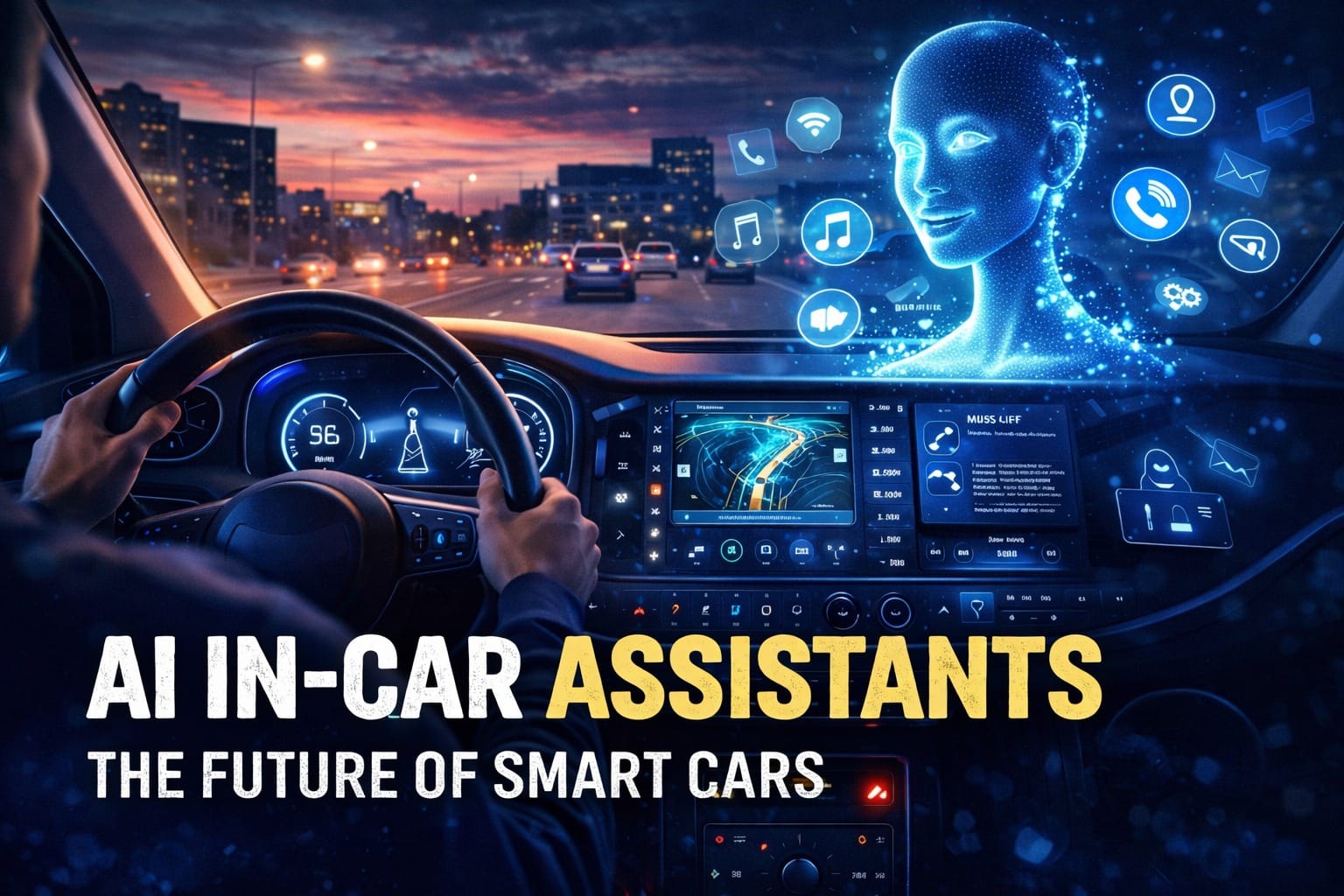
Introduction
Imagine this.
You enter your car after a long day.
Before you even say a word, the AC adjusts to your usual temperature. Your playlist resumes from where you left off. A soft voice says:
“Traffic is heavy today. Want me to take the faster route home?”
You didn’t ask.
But your car already knew.
This is not the future anymore. This is AI in-car assistants — and they are quietly changing how we drive, think, and interact with machines.
What Are AI In-Car Assistants (In Simple Words)?
At the surface, they feel like voice assistants — like Siri or Alexa.
But underneath, they are far more powerful.
AI in-car assistants are systems that don’t just respond to commands.
They observe, learn, predict, and adapt.
They learn:
- How you drive
- What you like
- Where you go
- Even when you get tired
And slowly, they stop waiting for instructions.
They start taking initiative.
The Shift: From Commands to Conversations
Earlier, technology worked like this:
You give command → Machine responds.
Now, AI in-car assistants work like this:
You say something vague → The system understands context → It responds intelligently.
For example:
You say, “I’m hungry.”
A normal system would do nothing.
An AI assistant will:
- Suggest nearby restaurants
- Filter based on your past choices
- Ask: “Do you want something quick or healthy?”
It feels less like using a device…
and more like talking to someone who knows you.
Your Car Is Quietly Studying You
This is where things get interesting.
AI in-car assistants are always learning — not in a creepy way, but in a pattern recognition way.
They notice:
- You call a specific person every evening
- You take the same route to work
- You increase AC at a certain time
Over time, your car builds a behavior profile.
And then one day, without asking, it starts doing things automatically.
That moment — when your car acts before you — is where the real shift happens.
Also read – How AI can threaten Banking Systems
Safety: The Most Underrated Power of AI in Cars
We often talk about convenience.
But the biggest impact is actually safety.
AI systems can now:
- Detect if your eyes are closing
- Notice if your steering pattern changes
- Alert you when you’re distracted
Some cars can even say:
“You seem tired. Let’s take a break.”
Think about that.
A machine… noticing your fatigue before you do.
This is where AI stops being a feature — and becomes a co-pilot.
Predicting Problems Before They Exist
One of the most powerful abilities of AI in-car assistants is prediction.
Not just routes. Not just music.
But problems.
Your car can now monitor internal systems and say:
- “Your battery may need replacement soon”
- “Brake performance is slightly reduced”
Earlier, you reacted to breakdowns.
Now, your car prevents them.
This shifts driving from reactive → proactive.
The Real Game-Changer: Generative AI Inside Cars
With the rise of generative AI, cars are becoming conversational.
Not robotic. Not command-based.
But fluid.
You can now:
- Ask follow-up questions
- Change your mind mid-conversation
- Talk naturally without repeating instructions
Example:
“Find a café.”
“Sure. Do you prefer something quiet or busy?”
This is not a feature upgrade.
This is a behavioral shift in machines.
But Here’s the Flip Side (And It’s Important)
Every powerful technology comes with a shadow.
AI in-car assistants are no different.
1. Are We Becoming Too Dependent?
If your car:
- Drives better routes
- Reminds you of everything
- Makes decisions for you
At some point, you stop thinking.
Convenience slowly turns into dependency.
2. Data: The Invisible Trade
To work well, AI needs data.
A lot of it.
Your:
- Location
- Voice
- Driving habits
The question is not whether data is being collected.
The real question is:
Who controls it?
3. Distraction — Not Physical, But Mental
Even if your hands are on the wheel, your mind may not be.
Conversations with AI can:
- Pull your focus
- Increase cognitive load
And sometimes, distraction doesn’t look like distraction.
4. Cybersecurity Risks
When cars become connected systems, they also become targets.
The more intelligent your car is, the more exposed it becomes to:
- Hacks
- System manipulation
Which makes security just as important as innovation.
Why This Shift Is Happening So Fast
This isn’t random.
Three major forces are driving this:
1. Cars Are Becoming Software Platforms
Cars are no longer mechanical products.
They are digital ecosystems on wheels.
2. Consumer Expectations Have Changed
People now expect:
- Personalization
- Intelligence
- Effortless experiences
3. Big Tech Has Entered the Game
Companies like Google, Tesla, and others are pushing AI deeper into mobility.
And when Big Tech enters — things scale fast.
The Future: Your Car Will Know You Better Than You Think
We’re heading toward a world where:
- Cars will understand your mood
- Suggest actions based on behavior
- Connect with your home, office, and devices
Your car won’t just take you from point A to B.
It will:
- Assist
- Advise
- Adapt
And maybe… influence your decisions.
Conclusion
AI in-car assistants are not just about voice commands or smart features.
They represent a deeper shift:
From machines that respond… to machines that understand.
And once machines start understanding humans, the relationship changes forever.
The real question is not:
“Are AI in-car assistants useful?”
The real question is:
How much control are we willing to give them?
Subscribe to our YouTube Channel The Logic Stick for more video insights