







Nepal-India Dispute Over Kailash Mansarovar
Introduction
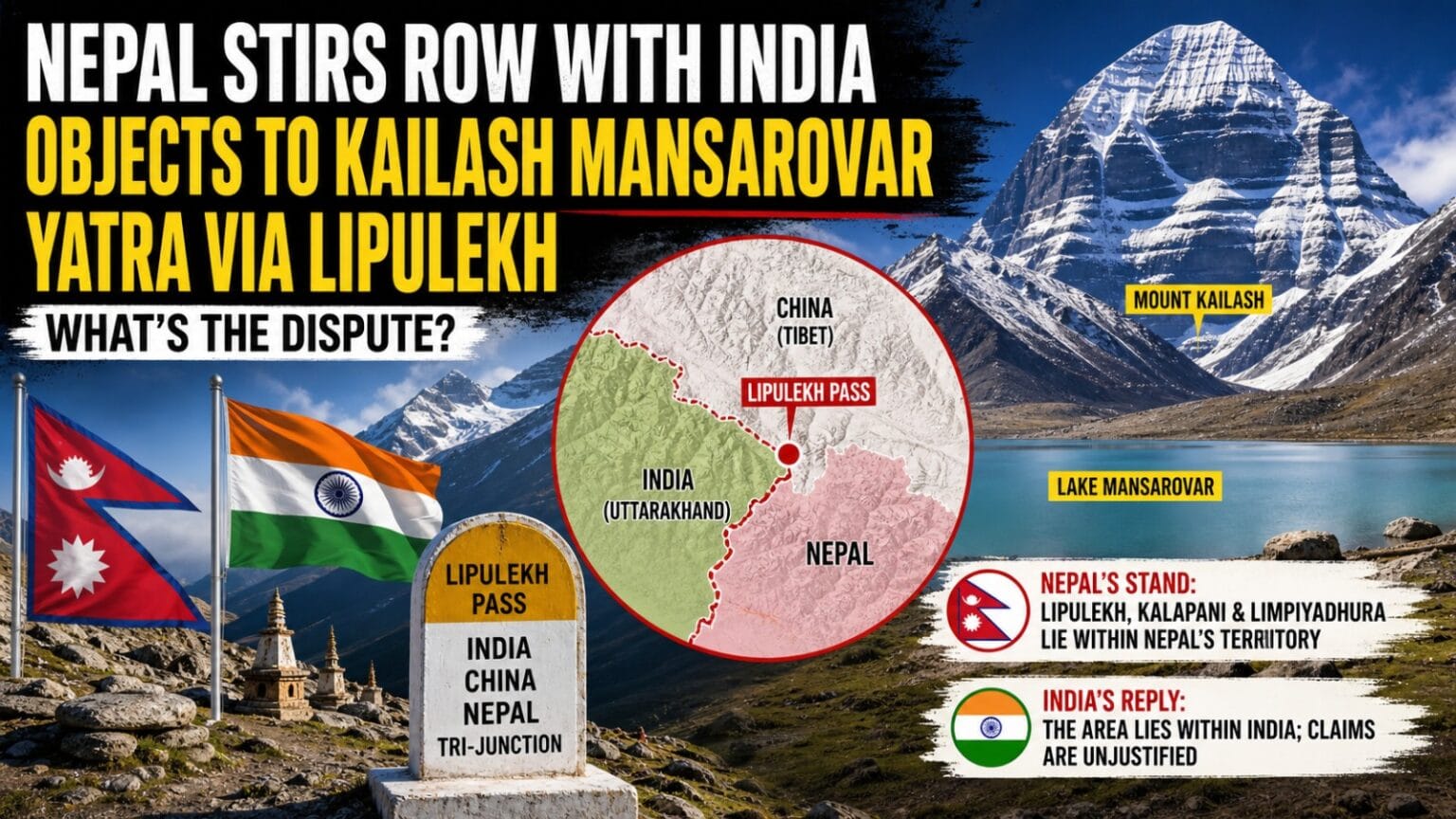
The Kailash Mansarovar Yatra 2026—one of the most sacred pilgrimages for Hindus, Buddhists, and Jains—has triggered fresh diplomatic tensions between India and Nepal. The controversy revolves around the use of the Lipulekh Pass, a strategic Himalayan route that both countries claim as their own.
Nepal has formally objected to India and China conducting the yatra through this route, calling it a violation of its territorial sovereignty. India, however, has firmly rejected these claims, stating that the route lies within its territory and has been used traditionally for decades.
This dispute has once again brought the long-standing India–Nepal border issue into the spotlight.
What Is the Kailash Mansarovar Yatra?
The Kailash Mansarovar Yatra is an annual pilgrimage to Mount Kailash and Lake Mansarovar in Tibet (China). For devotees:
- Mount Kailash is considered the abode of Lord Shiva
- Lake Mansarovar is believed to cleanse sins
- The journey is both physically demanding and spiritually significant
The yatra typically operates through two main routes:
- Lipulekh Pass (Uttarakhand, India)
- Nathu La Pass (Sikkim, India)
The Lipulekh route is shorter and historically preferred, making it central to the current dispute.
Why Has Nepal Objected to the Lipulekh Route?
Nepal’s objection is rooted in territorial claims. The country argues that:
- Lipulekh, along with Kalapani and Limpiyadhura, lies within Nepal’s borders
- These claims are based on the 1816 Sugauli Treaty, which defined boundaries after the Anglo-Nepal war
- India and China cannot use this route without Nepal’s consent
Nepal has even sent formal diplomatic notes to both India and China expressing its concerns.
The government in Kathmandu maintains that this is not just about a pilgrimage route—but about sovereignty and territorial integrity.
India’s Response: “Unjustified Claims”
India has categorically rejected Nepal’s objections, stating that:
- The Lipulekh Pass lies within Indian territory
- The route has been used for decades for pilgrimage and trade
- Nepal’s claims are “not justified and not based on historical evidence”
India also emphasized that the yatra is a longstanding traditional route, reinforcing its stance on sovereignty.
The Role of China in the Dispute
China is a key player because:
- Mount Kailash and Lake Mansarovar lie in Tibet (under Chinese control)
- The yatra is conducted in coordination between India and China
- China has shown little inclination to support Nepal’s territorial claims
This makes the issue triangular—involving India, Nepal, and China.
Also read – Delhi IRS Officer’s Daughter Rape Murder Case
Historical Background of the Lipulekh Dispute
The Lipulekh dispute is not new. It dates back decades, but tensions escalated significantly in recent years:
1. 1816 Sugauli Treaty
- Defined Nepal’s borders with British India
- Nepal interprets it as including Lipulekh within its territory
2. Post-1962 Developments
- India strengthened its presence in the Kalapani region after the India-China war
3. 2020 Map Controversy
- Nepal released a new political map including Lipulekh, Kalapani, and Limpiyadhura
- India rejected the move
4. Road Construction Row
- India built a road to Lipulekh for easier pilgrimage access
- Nepal protested strongly
The current yatra dispute is essentially a continuation of these unresolved tensions.
Why Lipulekh Is Strategically Important
Lipulekh is not just a pilgrimage route—it has geopolitical significance:
- Located near the India–Nepal–China tri-junction
- Important for trade between India and Tibet
- Critical for military logistics in the Himalayan region
This makes control over the area extremely sensitive.
Impact on India–Nepal Relations
The dispute could have several consequences:
1. Diplomatic Strain
Relations between India and Nepal—traditionally close—may face renewed tension.
2. Political Signaling
Nepal’s stance reflects a more assertive foreign policy under its current leadership.
3. Regional Stability
The issue adds complexity to South Asia’s already sensitive geopolitical environment.
What Happens Next?
Despite the strong positions, both countries have indicated:
- Willingness to resolve the issue through diplomatic dialogue
- Commitment to maintaining long-standing ties
However, without a clear boundary settlement, such disputes are likely to recur.
Conclusion
The Nepal–India row over the Kailash Mansarovar Yatra via Lipulekh is more than just a disagreement over a pilgrimage route. It reflects:
- Historical boundary disputes
- Strategic regional interests
- Evolving geopolitical dynamics involving China
As both nations balance religious, political, and territorial considerations, the issue underscores a key reality:
In South Asia, even spiritual journeys can become geopolitical flashpoints.
Subscribe to our YouTube Channel The Logic Stick for more video insights