







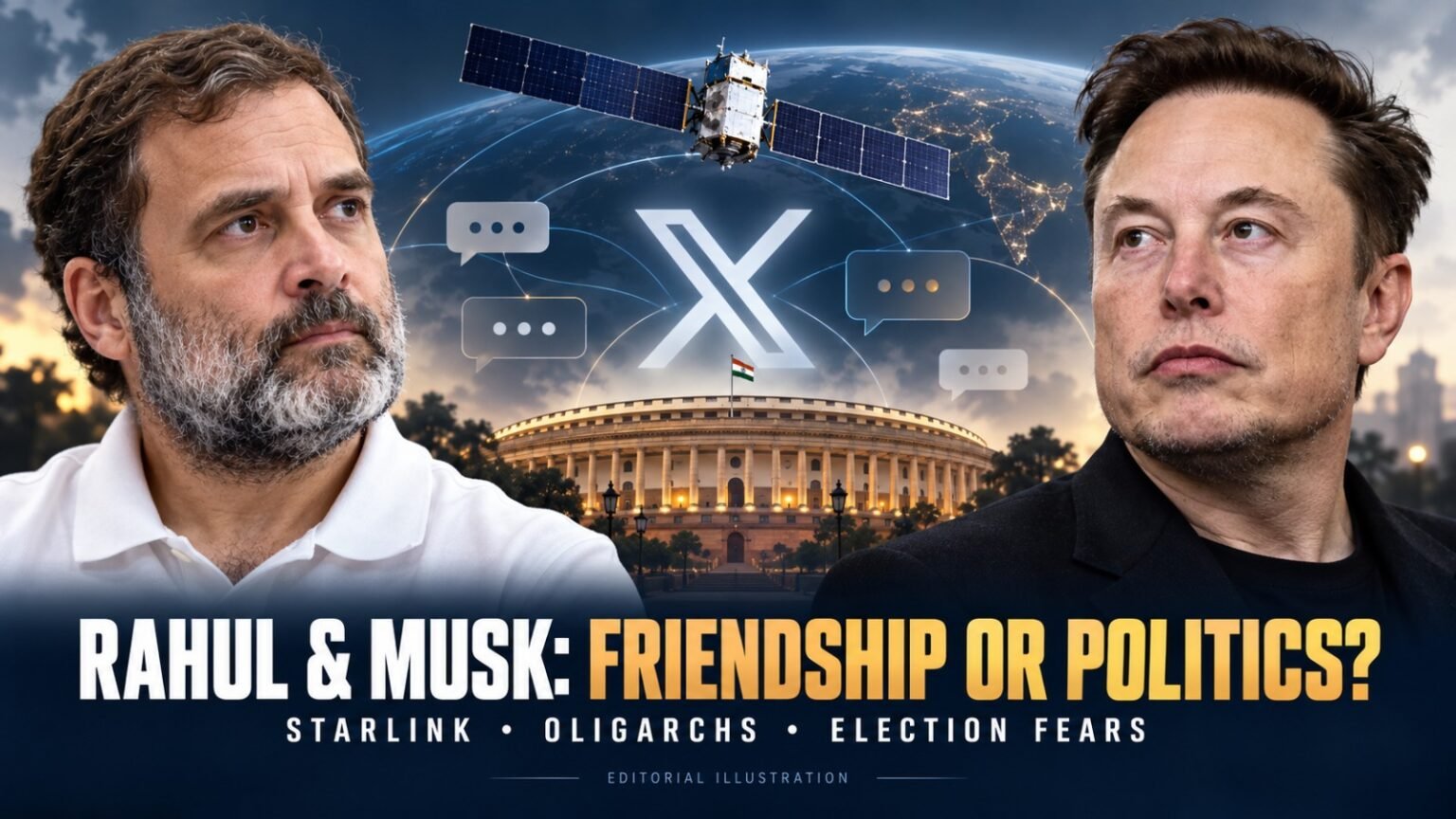
Rahul Gandhi – Elon Musk Tweet Row
A brief exchange between Rahul Gandhi and Elon Musk has turned a satellite-internet dispute into a debate about corporate influence, political consistency and elections. Musk accused powerful business interests of obstructing Starlink’s entry into India. Gandhi responded with a pointed welcome, and Musk thanked him.
But does this establish a friendship? Has Gandhi endorsed Starlink’s business demands? Could Musk use his technological influence against the BJP government?
The verified exchange establishes public agreement on a criticism, not a political alliance. The sources reviewed do not establish a plan to manipulate Indian elections. That distinction matters because concerns about platform power can be legitimate without every viral conspiracy being true.
The India Today report documents the BJP–Congress clash following the exchange. Understanding its significance requires separating what was said, what remains disputed and what observers are inferring. India Today
What happened between Rahul Gandhi and Elon Musk?
The controversy developed across 7–9 October 2026.
On 7 October, Musk alleged that unnamed influential business interests were blocking Starlink to protect their market dominance. His language presented the delay as harm to Indian consumers, especially people without adequate connectivity. newindianexpress.com
On 8 October, he escalated the argument by explicitly referring to Ambani and asking: “Is Ambani the real boss of India?” Musk also asserted that Starlink had spent years meeting Indian requirements and operated under licences in more than 165 countries. These were Musk’s assertions, not an independently established finding that every Indian approval requirement had been completed. The Wire
Gandhi replied: “Welcome to India, Elon. Wait till you discover the other guy.” indianexpress.com
Musk responded: “Thank you, Rahul. This is indeed troubling.” x.com
Those posts are the factual foundation of the supposed Rahul Gandhi–Elon Musk friendship. They show a friendly exchange. They do not demonstrate private coordination, campaign support, funding or a sustained political relationship.
Also read – Mumbai Airport Shutting Down: How the flights will function?
What did Musk mean by “Indian oligarchs”?
“Oligarch” is a politically loaded description of someone whose wealth is associated with disproportionate influence over public decisions. It is not a legal finding of wrongdoing.
Musk’s initial post referred to unnamed oligarchs and alleged that they were preserving a “monopolistic chokehold.” He subsequently named Ambani in his rhetorical question. The distinction is important: the initial allegation was broad, while the later post made one industrialist an explicit target. newindianexpress.com
Reporting identifies Reliance Jio and Bharti Airtel as dominant telecom businesses, associated with Mukesh Ambani and Sunil Mittal respectively. Their satellite ventures and Starlink are also competing for opportunities in India. However, market concentration and commercial rivalry alone do not prove that a particular company caused an improper regulatory delay. Reuters
Nor should Gandhi’s unnamed “other guy” be converted into a confirmed identification. The Wire interpreted the remark as an apparent reference to Gautam Adani; other interpretations have circulated. Gandhi did not name that person in the quoted response. Any identification must remain an interpretation. The Wire
The question worth asking is more specific than whether India has powerful billionaires: what evidence shows that a business influenced a particular approval decision, and was that influence improper?
Why is Starlink’s India launch still disputed?
The government’s account differs from Musk’s.
Its 8 October statement says three satellite-service operators have received telecom licences and are undergoing security assessments. Once an operator completes that process, it can seek spectrum assignment. The government says the applicants are broadly at the same regulatory stage and rejects allegations of discrimination. newindianexpress.com
Consequently, saying Starlink has “no licence” can obscure the distinction between an initial telecom licence and the clearances needed to begin commercial service.
Starlink’s representatives, meanwhile, say they have developed India-specific security arrangements and invested in local infrastructure, including 20 gateway sites. These are company statements about readiness; they are not a substitute for the regulator’s final assessment. newindianexpress.com
The disagreement is therefore not simply whether satellites can deliver internet. It concerns security compliance, spectrum access and the point at which an applicant is authorised to operate.
A credible examination should ask which requirement remains outstanding, how it is being assessed and whether comparable applicants receive comparable treatment.
The complication: Jio and Airtel are also Starlink partners
The idea of a simple battle between Musk and Indian telecom companies misses an important fact.
Airtel announced an agreement with SpaceX on 11 March 2025 to offer Starlink services, subject to SpaceX obtaining its authorisations. Jio announced its own agreement on 12 March. bharti.com
Companies can cooperate in distribution while competing over spectrum, pricing and their own satellite offerings. A partnership does not rule out disagreement. Equally, the partnerships make it misleading to present the relationship as permanent, uncomplicated hostility.
Commercial incentives can change. A firm might welcome selling a service while opposing particular regulatory terms. Establishing obstruction requires evidence about those actions, rather than assumptions based on who stands to gain.
Musk also has a direct business interest in securing market access. His criticism deserves examination, but his status as a technology entrepreneur does not make him a neutral adjudicator of the dispute.
Why has Rahul Gandhi suddenly started supporting Musk?
The strongest explanation supported by the exchange is that Gandhi saw an opportunity to reinforce his criticism of concentrated corporate influence. That is political analysis, not verified knowledge of his private motives.
Musk’s complaint offered an unusual advantage: criticism associated with Gandhi’s domestic political argument was now being voiced by an internationally prominent businessman.
However, Gandhi’s brief reply does not provide a complete position on Starlink. It does not specify whether he supports immediate approval, accepts the company’s compliance claims or would waive any security requirement.
Calling it an unconditional endorsement goes beyond the words available.
There is nevertheless a real consistency question. In March 2025, Congress spokesperson Jairam Ramesh questioned the Starlink partnerships, alleged political orchestration and raised concerns about who could control or interrupt connectivity. Those were Congress’s allegations and questions, not established findings about the deals. India News – The Indian Express
Gandhi can reasonably agree with a criticism of corporate influence while retaining security concerns. But readers are entitled to ask whether Congress still holds those concerns and what evidence would satisfy them.
A political party’s standard should not change merely because a businessman starts criticising its opponent.
What has the BJP said?
BJP leader Ram Madhav criticised Gandhi for championing Musk’s cause after earlier criticism of the government’s dealings with American leadership. Madhav defended the regulatory process and said spectrum decisions would be transparent and non-discriminatory.
His central political challenge was why Gandhi’s position appeared to have changed. indianexpress.com
That response gives the BJP a counterargument about consistency and sovereignty. It also leaves a separate question unanswered: whether the approval process is sufficiently transparent.
Gandhi’s motives do not determine whether Musk’s allegations are true. Musk’s commercial interest does not establish that the government is acting improperly. Each claim requires its own evidence.
Can Elon Musk manipulate Indian elections?
The phrase “manipulate elections” bundles together different claims.
| Claim | What the available evidence supports |
|---|---|
| Musk can draw attention to political allegations | His public interventions can shape discussion |
| X’s recommendations can influence political attitudes | Research supports effects in a specific US experiment |
| Musk has supported election campaigns financially | Documented in the United States |
| Starlink can remotely alter Indian EVM votes | No evidence established by the sources reviewed |
| Musk and Gandhi have an election-interference arrangement | No evidence established by the sources reviewed |
These distinctions prevent two errors: treating platform influence as imaginary, and treating that influence as proof of control over election results.
X’s algorithmic influence is a serious research question
A Nature study published in February 2026 examined a seven-week experiment involving US users of X in 2023.
Switching users from chronological to algorithmic feeds shifted some political opinions in a more conservative direction. Researchers also found changes in the accounts users followed. However, the experiment did not detect significant changes in self-reported party affiliation or affective polarisation. Nature
The findings show that feed design can affect political attitudes. They do not establish that Musk personally ordered those effects, that identical effects occur in India, or that X can guarantee an election result.
India-specific claims require India-specific evidence.
Political spending shows influence, not control
Reuters reported, using US campaign-finance filings, that Musk gave $259 million to groups supporting Donald Trump’s 2024 campaign. Reuters
That demonstrates substantial participation in American electoral politics. It does not prove he determined the outcome, and it does not establish equivalent funding or coordination in India.
The inference “Musk influenced US politics, therefore he can deliver an Indian election to Gandhi” skips the evidence needed for the second claim.
Starlink is not an established route into Indian voting machines
According to Election Commission technical descriptions, Indian EVMs are standalone devices without external internet, Wi-Fi or Bluetooth connectivity. Election Commission of India
The reviewed material provides no evidence that Starlink can remotely access those machines or change their recorded votes.
That does not require treating every aspect of election administration as beyond scrutiny. Voter registration, campaigning, counting procedures and equipment handling are separate subjects. Allegations concerning them should be investigated through their actual mechanisms.
An internet service is not, by itself, evidence of an electoral hacking capability.
How close are we to a credible conspiracy claim?
Based on the available evidence, there is a verified commercial dispute, a politically useful exchange and a legitimate broader concern about concentrated digital power.
There is no established evidentiary bridge connecting those facts to a coordinated Indian election-manipulation scheme.
Such a claim would need specific supporting material: authenticated communications, documented coordination, forensic evidence, credible disclosures or independently examined platform changes linked to a campaign.
Timing, friendliness and shared criticism are insufficient.
Readers should also distinguish opportunity from action. Someone having influence does not prove they used it covertly. Someone benefiting politically from a post does not prove they commissioned it.
The burden of proof becomes greater as the allegation becomes more serious.
How could the controversy affect the BJP government?
The following are possible political effects, not measured forecasts.
It could strengthen scrutiny of corporate influence
If Musk sustains his criticism, Gandhi could gain additional visibility for questions about business access and regulatory fairness.
For the government, a documented explanation of approval stages would be more persuasive than a dispute over personalities.
It could give the BJP a consistency argument
The BJP can highlight Congress’s earlier concerns and ask whether Gandhi now supports a different standard for Starlink.
If Congress fails to explain its position, the debate could shift from regulatory transparency to political opportunism.
It could increase pressure without changing election outcomes
International attention could make a technical licensing disagreement more politically costly. However, reputational pressure is different from demonstrated voter movement.
Assessing electoral impact would require polling, changes in issue salience and evidence from constituencies. Viral engagement alone does not measure votes gained or lost.
The commercial resolution could reduce the dispute
If the approval process reaches a documented conclusion, Musk’s incentive to sustain this particular confrontation could change.
That possibility is another reason to avoid declaring a permanent alliance from a moment of shared frustration.
What should this episode make readers question?
For Gandhi’s supporters: would Musk’s allegations seem equally credible if they targeted Congress?
For BJP supporters: does national security explain the outstanding requirements clearly enough, or is greater transparency necessary?
For Musk’s admirers: would the same claim be accepted from a less celebrated company seeking market access?
These questions challenge selective belief without pretending every allegation has equal evidentiary support.
Competition, security and transparency can all be legitimate public objectives. Readers need not choose between unconditional faith in the government and unconditional faith in a billionaire.
The Rahul Gandhi–Elon Musk tweet exchange is politically revealing because it exposes how quickly familiar loyalties shape interpretation. A friendly response becomes a friendship; a business dispute becomes a geopolitical plot; platform influence becomes supposed control over ballots.
The evidence currently supports a narrower account: Musk criticised India’s approval process, Gandhi amplified the criticism, and the BJP challenged his consistency.
What happens next should be judged through documents, regulatory decisions and independently verifiable actions. Public influence deserves scrutiny. Claims of secret electoral control require proof.