







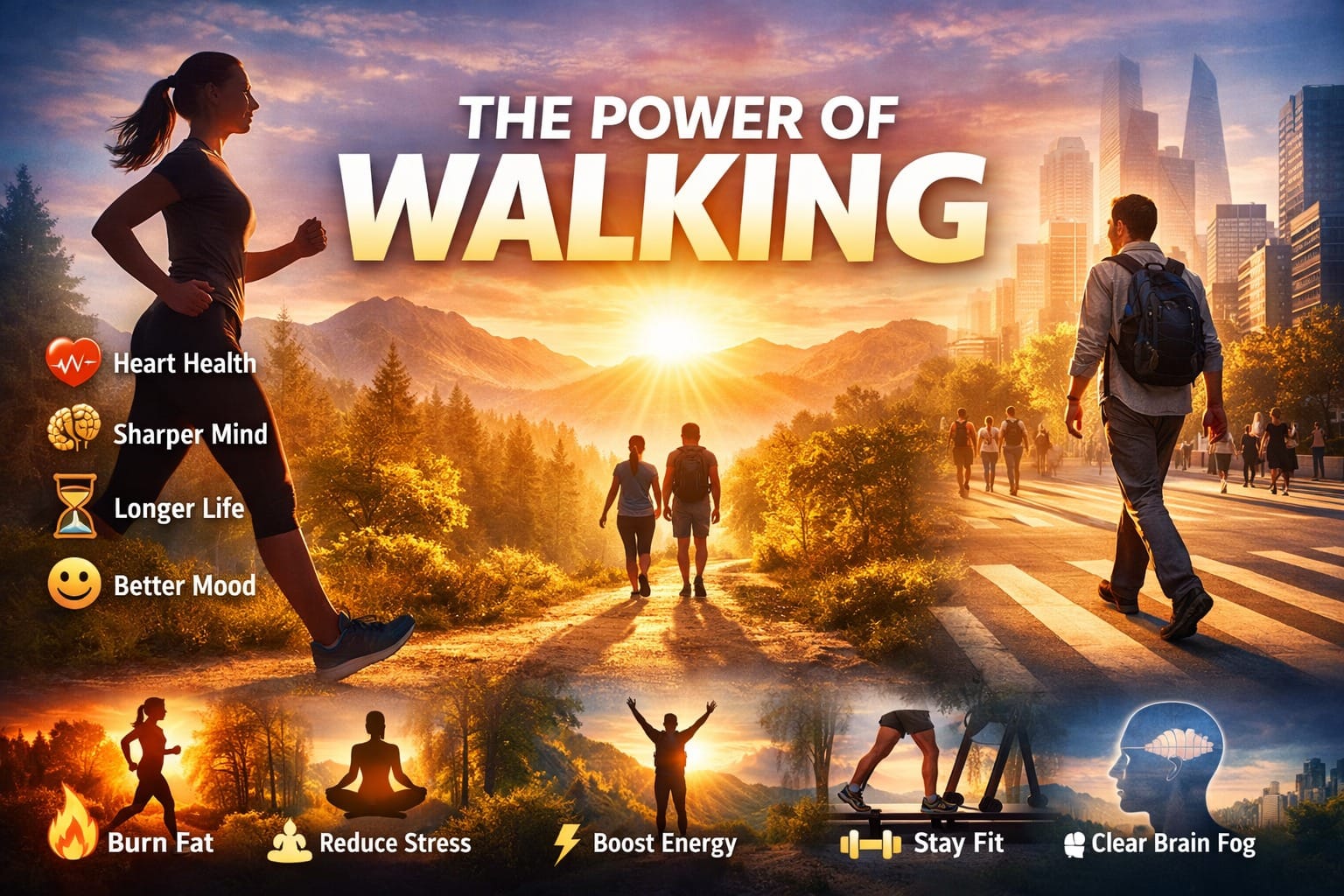
Walking is arguably the most natural human movement. Yet in a world obsessed with high-intensity workouts, gym memberships, and extreme fitness challenges, the humble act of walking remains one of the most powerful health interventions known to science.
Modern research consistently shows that walking is not merely exercise — it is a biological regulator, mental therapy, disease prevention tool, and longevity accelerator.
Studies across epidemiology, neurology, cardiology, and metabolic science confirm that walking:
- reduces mortality risk
- improves brain structure
- prevents chronic diseases
- enhances mood and creativity
- reshapes body composition
- increases lifespan
Even small step counts show measurable benefits, with research finding that walking above ~2,200 steps daily already reduces risk of early death, while around 9,000–10,500 steps provides the lowest mortality risk.
This article explores:
- types of walking exercises
- the science behind walking
- types of walking (including Japanese interval walking)
- 10k steps and longevity
- impact on diseases, mood, brain fog, and body structure
- examples of celebrities and athletes
- behavioral strategies to make walking addictive, not a task
Walking Exercises You Can Include in Your Daily Routine
Walking is not a single activity. It can be structured into multiple exercise formats that improve cardiovascular health, fat loss, muscle strength, posture, and mental well-being. Below are the most effective walking exercises supported by fitness science.
1. Brisk Walking
Brisk walking involves walking at a pace faster than normal, typically where speaking is possible but slightly challenging.
How to do
- Maintain upright posture
- Swing arms naturally
- Walk at 5–6 km/h pace
Benefits
- Improves cardiovascular endurance
- Helps in fat burning
- Strengthens lungs
- Reduces blood pressure
This is one of the simplest and most recommended walking workouts globally.
2. Interval Walking (Japanese Interval Walking Training)
This scientifically researched technique alternates between fast and slow walking phases.
How to do
- Walk fast for 3 minutes
- Walk slow for 3 minutes
- Repeat 5–6 times
Benefits
- Improves VO2 max
- Enhances glucose control
- Boosts endurance
- Supports weight loss
Studies show interval walking may outperform steady walking for metabolic health improvements.
3. Incline or Hill Walking
Walking uphill or on an inclined treadmill increases resistance and muscle engagement.
How to do
- Lean slightly forward
- Take shorter strides
- Engage core
Benefits
- Strengthens glutes and hamstrings
- Increases calorie burn
- Improves heart strength
- Builds leg endurance
4. Power Walking
Power walking is an exaggerated form of brisk walking with increased arm swing and stride length.
How to do
- Drive arms forcefully
- Increase pace
- Maintain tight core
Benefits
- Improves posture
- Builds speed
- Enhances hip mobility
- Burns more calories than normal walking
5. Weighted Walking (Rucking)
Weighted walking involves carrying light weight through a backpack or vest.
How to do
- Start with 2–5 kg weight
- Maintain posture
- Gradually increase load
Benefits
- Builds strength endurance
- Improves bone density
- Enhances fat loss
- Improves functional fitness
6. Backward Walking
Walking backward activates muscles and neural pathways differently from forward walking.
How to do
- Walk slowly in a safe space
- Focus on coordination
- Maintain balance
Benefits
- Strengthens knee joints
- Improves coordination
- Enhances brain activation
- Supports posture correction
7. Post-Meal Walking
Short walks after meals significantly impact metabolic health.
How to do
- Walk for 10–15 minutes after meals
- Maintain relaxed pace
Benefits
- Improves digestion
- Reduces blood sugar spikes
- Prevents bloating
- Enhances metabolism
This is one of the most evidence-backed metabolic walking strategies.
8. Mindful Walking (Walking Meditation)
Mindful walking focuses on awareness of breath, steps, and surroundings.
How to do
- Walk slowly
- Focus on breathing and movement
- Avoid phone distractions
Benefits
- Reduces stress and anxiety
- Improves emotional regulation
- Enhances mental clarity
- Reduces brain fog
9. Walking Lunges
Walking lunges combine walking with strength training.
How to do
- Step forward into a lunge
- Alternate legs
- Maintain upright posture
Benefits
- Builds leg strength
- Enhances balance
- Activates glutes and core
- Improves mobility
10. Nordic Walking (Pole Walking)
Nordic walking uses poles to engage upper body muscles.
How to do
- Use poles while walking
- Push poles backward with stride
Benefits
- Full-body workout
- Improves posture
- Increases calorie burn
- Reduces joint stress
How to Structure Walking Exercises Weekly
Beginner
- 20 minutes brisk walk daily
- Post-meal walk
- Weekend mindful walk
Intermediate
- 30 minutes brisk walking
- 2 interval sessions weekly
- 1 hill walk weekly
- Daily post-meal walk
Advanced
- Interval walking 3 times weekly
- Incline walking 2 times weekly
- Weighted walking 1–2 times weekly
- Daily post-meal walk
1. Why Walking Is a Biological Superpower
Human physiology evolved for movement. Sedentary lifestyles disrupt metabolism, hormones, cardiovascular health, and brain function.
Walking reactivates the systems evolution designed:
Core biological effects
- improves circulation
- enhances mitochondrial function
- regulates blood sugar
- strengthens heart muscle
- stimulates neurogenesis
- activates lymphatic detox
Research shows daily walking:
- lowers blood pressure, cholesterol, and glucose
- strengthens bones and joints
- improves immune function
- reduces depression and stress
- increases brain volume and cognitive health
In simple terms:
Walking is a full-body regulatory therapy.
2. The 10,000-Step Myth vs Science
The famous 10,000-step rule originated from a Japanese marketing campaign in the 1960s rather than strict medical evidence.
However, later studies validated many benefits of higher step counts.
Evidence-based insights
Research shows:
- benefits begin around 2,200 steps
- 4,000–4,500 steps deliver ~50% mortality benefit
- 9,000–10,500 steps linked to lowest cardiovascular risk
- 7,000 steps may already reduce mortality by ~50%
What matters more than steps
Science now emphasizes:
- consistency
- walking intensity
- frequency
- lifestyle integration
Conclusion:
10k steps are a good benchmark — not a magic number.
3. Types of Walking (Most People Don’t Know These)
Walking is not a single activity. It exists across multiple physiological intensities.
3.1 Leisure walking
- low intensity
- stress reduction
- digestion improvement
- mental relaxation
3.2 Brisk walking
- moderate intensity
- cardiovascular conditioning
- weight management
- metabolic health
3.3 Power walking
- higher pace
- fat burning
- muscle endurance
- aerobic fitness
3.4 Hiking / incline walking
- muscle activation
- bone density
- VO2 max improvement
3.5 Post-meal walking
- blood sugar regulation
- digestive improvement
- reduced insulin spikes
3.6 Mindful walking
- psychological reset
- reduced anxiety
- improved emotional regulation
3.7 Interval walking (Japanese method)
This deserves a separate section because of its strong scientific backing.
4. The Japanese Walking Technique (Interval Walking Training)
Developed by researchers at Shinshu University, interval walking involves alternating:
- 3 minutes brisk walking (~70% max HR)
- 3 minutes slow walking (~40% max HR)
- repeated for ~30 minutes
- performed 4+ times weekly
This method improves:
- aerobic fitness
- blood pressure
- muscle strength
- glucose control
- body weight
- cardiovascular health
Research shows it can outperform steady walking in improving:
- VO2 max
- metabolic markers
- blood sugar regulation
- muscle function
The philosophy:
Quality of steps > quantity of steps.
5. Walking and Lifespan: The Longevity Connection
Large population studies confirm walking is a longevity multiplier.
Research indicates:
- 6,000 steps improves cognition and lowers mortality
- 7,000 steps reduces death risk significantly
- 10,000 steps lowers heart disease risk
- 12,000 steps associated with optimal longevity
Mechanisms behind lifespan extension
Walking improves lifespan through:
- mitochondrial efficiency
- reduced inflammation
- improved metabolic flexibility
- vascular elasticity
- telomere preservation
- insulin sensitivity
In longevity science, walking is often considered the lowest-risk highest-reward intervention.
6. Walking and Body Structure Transformation
Walking is often underestimated for body recomposition.
Effects on physique
- reduces visceral fat
- improves posture
- strengthens glutes and core
- enhances bone density
- improves gait stability
- improves muscle endurance
Studies show 10k steps improve:
- body composition
- blood pressure
- lipid profile
Structural benefits
Walking also:
- improves joint lubrication
- reduces lower-back pain
- enhances spinal alignment
- strengthens connective tissue
7. Walking and Brain Health (The Brain Fog Killer)
Walking stimulates multiple neurological benefits.
Research shows walking:
- increases hippocampal volume
- enhances memory
- reduces dementia risk
- improves executive function
- boosts creativity
- reduces anxiety
Even moderate walking increases endorphins and neurotransmitters responsible for mood regulation.
Mechanisms behind brain benefits
- increased cerebral blood flow
- neurogenesis
- reduced inflammation
- improved glymphatic clearance
- dopamine and serotonin release
Walking is one of the most effective non-pharmaceutical tools against brain fog.
8. Walking and Mood: The Natural Antidepressant
Walking influences mood via multiple pathways:
- endorphin release
- cortisol reduction
- sunlight exposure
- social interaction
- sensory stimulation
- vagal nerve activation
Research links walking with reduced depression, stress, and anxiety symptoms.
Many psychologists now prescribe walking as:
behavioral activation therapy.
9. Walking and Metabolic Health
Walking improves:
- insulin sensitivity
- glucose control
- weight regulation
- lipid metabolism
- appetite regulation
Interval walking shows particular benefits for type-2 diabetes through improved glycemic control.
10. Why Walking Is the Most Sustainable Exercise
Walking wins because it is:
- low injury risk
- free
- accessible
- scalable
- age-independent
- socially adaptable
- habit-friendly
The best exercise is the one you can sustain — and walking leads that category.
11. Walking and Disease Prevention: A Medical Perspective
One of the strongest arguments for walking comes from clinical and epidemiological research showing its powerful disease-prevention capacity.
Walking is often called “exercise medicine” because it simultaneously improves multiple physiological systems.
11.1 Cardiovascular Disease
Walking is one of the most effective ways to reduce heart disease risk.
Research findings
Studies consistently show walking:
- lowers blood pressure
- improves cholesterol profile
- reduces arterial stiffness
- enhances endothelial function
- decreases inflammation
Walking 30 minutes daily can reduce coronary heart disease risk by up to 30–40%.
Mechanism
Walking improves heart health through:
- increased stroke volume
- improved oxygen transport
- vascular elasticity
- reduced plaque buildup
- improved autonomic balance
Cardiologists frequently prescribe brisk walking as first-line therapy for mild hypertension.
11.2 Diabetes and Insulin Resistance
Walking has remarkable metabolic effects.
Research highlights
Post-meal walking:
- reduces glucose spikes
- improves insulin sensitivity
- enhances glucose uptake
- reduces risk of type-2 diabetes
Even 10–15 minutes of walking after meals significantly improves glycemic control.
Interval walking training (Japanese method) demonstrates stronger improvements in HbA1c levels.
11.3 Obesity and Fat Distribution
Walking influences weight through multiple pathways.
Mechanisms
- increases daily energy expenditure
- reduces visceral fat
- regulates appetite hormones
- improves mitochondrial fat oxidation
- improves leptin sensitivity
Walking also improves body composition without triggering hunger spikes often associated with intense workouts.
11.4 Cancer Risk Reduction
Evidence suggests regular walking reduces risk of several cancers, including:
- breast cancer
- colon cancer
- endometrial cancer
Mechanisms include:
- reduced inflammation
- improved immune surveillance
- hormonal regulation
- improved insulin metabolism
Walking also improves recovery and quality of life in cancer survivors.
Also read – How Ai Personal Trainers are redefining Fitness
11.5 Dementia and Alzheimer’s Disease
Walking is one of the most protective lifestyle habits for brain aging.
Neurological benefits
- increased hippocampal volume
- enhanced neuroplasticity
- reduced amyloid accumulation
- improved cerebral perfusion
- reduced oxidative stress
Long-term studies show higher step counts correlate with lower dementia risk.
11.6 Joint Health and Musculoskeletal Disorders
Contrary to myths, walking supports joint health.
Benefits
- improves synovial fluid circulation
- strengthens supporting muscles
- improves bone density
- reduces arthritis symptoms
- enhances balance and fall prevention
Walking is often prescribed for rehabilitation after injury and surgery.
12. Walking and Brain Fog: The Cognitive Reset Button
Brain fog — characterized by fatigue, lack of clarity, and poor focus — is strongly influenced by inactivity.
Walking improves cognition through:
- enhanced oxygen delivery
- improved glucose metabolism
- increased BDNF (brain-derived neurotrophic factor)
- improved neurotransmitter balance
- improved sleep quality
Research also shows walking increases creative thinking and problem-solving ability.
Many breakthrough ideas in history were conceived during walks.
13. Walking and Emotional Regulation
Walking acts as a psychological regulator.
Emotional benefits
- reduces cortisol
- improves emotional processing
- enhances resilience
- reduces rumination
- improves self-reflection
- boosts confidence
Mindful walking is now used in:
- therapy
- trauma recovery
- stress management
- executive coaching
14. Celebrities, Athletes & Visionaries Who Believe in Walking
Walking has been embraced by high performers across domains.
14.1 Steve Jobs
Jobs conducted many important meetings while walking, believing movement enhanced creativity and decision-making.
14.2 Barack Obama
Known for walking meetings and daily walks for mental clarity and stress management.
14.3 Jennifer Aniston
Attributes walking to maintaining fitness and emotional balance.
14.4 Cristiano Ronaldo
Uses walking as active recovery between intense training sessions.
14.5 Novak Djokovic
Integrates nature walks and mindful walking for recovery and mental conditioning.
14.6 Mahatma Gandhi
One of history’s most iconic walkers, using walking as both philosophy and lifestyle.
14.7 Charles Darwin
Darwin’s “thinking path” walk contributed to development of evolutionary theory.
14.8 Haruki Murakami
The author credits walking with creativity and mental discipline.
15. Walking and Creativity: The Neuroscience
Research shows walking enhances creative output by up to 60% compared to sitting.
Why walking boosts creativity
- increases default mode network activity
- enhances divergent thinking
- reduces cognitive rigidity
- increases dopamine
- improves sensory integration
Walking essentially creates a mental state conducive to innovation.
16. Behavioral Science: Why Walking Fails for Many People
Despite benefits, walking habits fail due to psychological barriers.
Common obstacles
- boredom
- time perception
- lack of immediate reward
- absence of social reinforcement
- digital distraction
- unrealistic goals
Walking must be reframed from exercise → lifestyle ritual.
17. Making Walking Addictive: Behavior Design Strategies
To transform walking into a desirable habit, behavioral science suggests:
17.1 Habit stacking
Pair walking with:
- podcasts
- calls
- music
- audiobooks
- brainstorming
17.2 Gamification
- step challenges
- rewards
- streak tracking
- leaderboards
17.3 Social walking
- walking clubs
- family walks
- coworker walking meetings
17.4 Environmental design
- scenic routes
- nature exposure
- safe walkable infrastructure
17.5 Purpose-driven walking
- photography walks
- idea walks
- gratitude walks
- mindful walking
17.6 Identity shift
People sustain habits when identity changes:
“I am a walker” rather than “I should walk.”
18. Urban Design and Walking Culture
Cities with high longevity (Blue Zones) share one trait:
Walkable environments.
Examples
- Okinawa (Japan)
- Sardinia (Italy)
- Ikaria (Greece)
These regions naturally integrate walking into daily living.
19. Walking and Longevity Psychology
Walking increases lifespan not only biologically but behaviorally.
It promotes:
- social connection
- exposure to sunlight
- stress reduction
- cognitive engagement
- emotional balance
Longevity is rarely about one intervention — walking activates multiple longevity pathways simultaneously.
20. How to Promote Walking as a Lifestyle Movement
To make walking a must-include daily essential:
20.1 Workplace walking culture
- walking meetings
- standing breaks
- walking brainstorming sessions
20.2 Public health campaigns
- step challenges
- walking festivals
- community walking days
20.3 Digital integration
- wearable tech
- walking-based rewards
- fitness apps
20.4 Education
Teaching children walking as a lifestyle habit.
20.5 Media storytelling
Promoting walking as empowerment rather than exercise.
21. Future of Walking Science
Emerging research areas include:
- walking and mitochondrial aging
- interval walking and longevity biomarkers
- walking and gut microbiome
- walking and mental health recovery
- walking and immune system regulation
- walking as anti-aging therapy
Walking is increasingly being studied as a preventive healthcare intervention.
22. Final Conclusion: Walking as the Foundation of Human Health
Walking is not merely movement — it is a biological necessity.
It influences:
- lifespan
- disease risk
- brain function
- emotional health
- body composition
- creativity
- productivity
- social connection
In a world chasing complex wellness solutions, walking remains the simplest, most accessible, and most evidence-backed intervention.
The future of health may not lie in extreme workouts or advanced medical treatments — but in restoring the everyday act of walking.
Walking should not be seen as a task.
It should be viewed as:
- therapy
- meditation
- creativity tool
- longevity practice
- emotional reset
- lifestyle ritual
A daily walk is one of the most powerful investments in human health.