





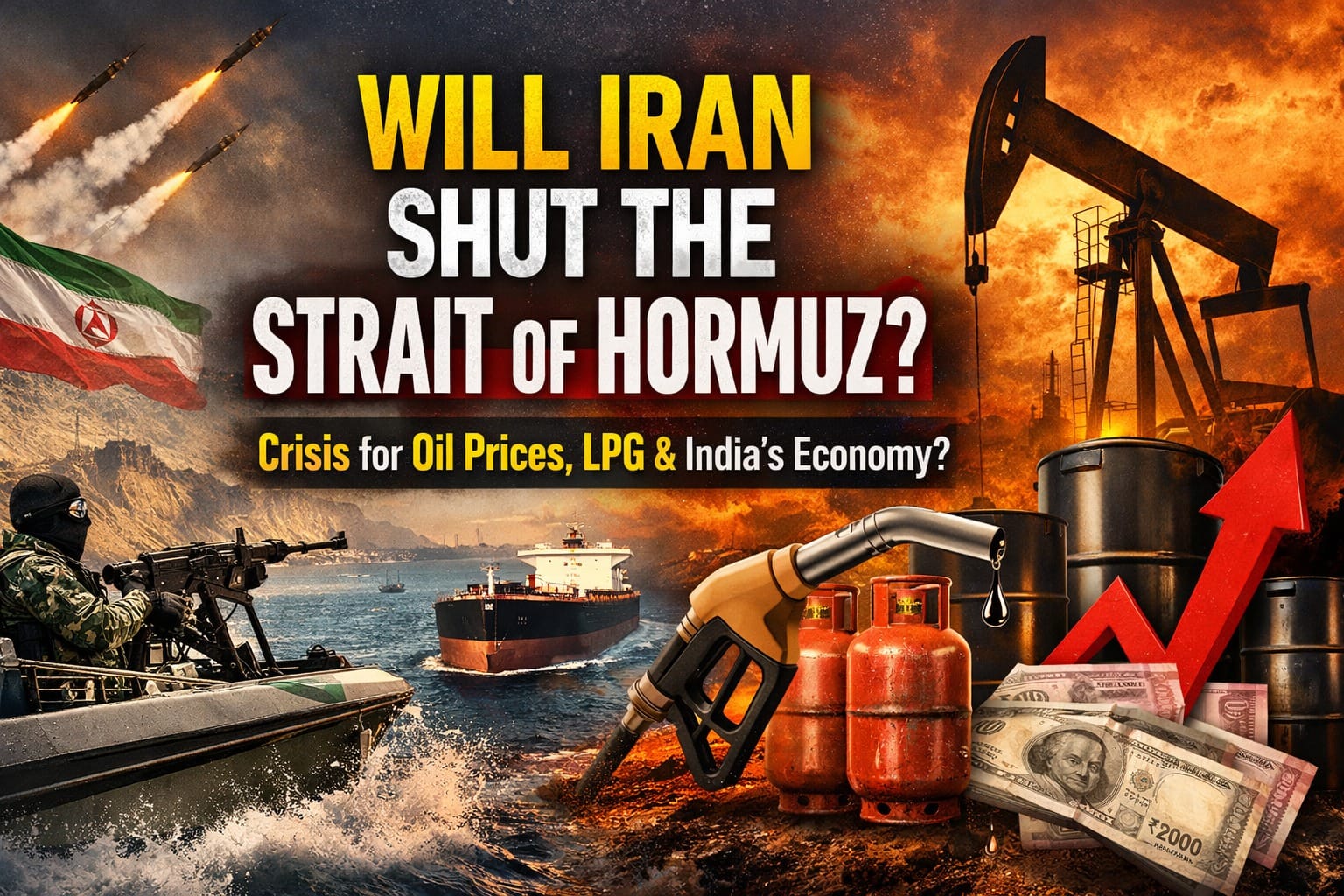
The Strait of Hormuz has suddenly become the most important place on Earth for energy markets — and possibly the global economy. As tensions escalate following the Israel–US military strikes on Iran in February 2026, Iran’s strategic leverage over this narrow waterway has triggered fears of blocked oil shipments, surging fuel prices, disrupted LPG supply, and a potential global inflation shock.
What Is the Strait of Hormuz and Why It Matters
The Strait of Hormuz is a narrow sea passage that links the Persian Gulf to the Gulf of Oman and the Arabian Sea, acting as a gateway for global energy supplies. It is bordered by Iran to the north and Oman to the south, and is roughly 104 miles (≈167 km) long, narrowing to about 21-33 km (≈13-21 miles) at its tightest point.
A Chokepoint for Global Energy
- About 20–25 % of the world’s crude oil and petroleum products flow through the Strait every day — roughly 20 million barrels per day — making it one of the most important energy chokepoints on Earth.
- It also carries a large portion of liquefied natural gas (LNG), especially from Qatar.
- Most oil exports from key producers — Saudi Arabia, the UAE, Kuwait, Iraq, and Iran itself — rely on this route for delivery to Asia, Europe, and beyond.
Because there is no alternative route at comparable scale, any disruption here can cause a massive supply shock to global oil and gas markets.
Why Iran’s Leverage Matters Now
Iran has long threatened to disrupt or close the Strait in times of crisis as a form of strategic leverage. The waterway’s geography — narrow and shallow — makes it vulnerable to physical blockage or threats from naval forces, mines, missiles, or fast boats operated by Iran’s Revolutionary Guard.
During the 2026 Middle East conflict, Iranian authorities reportedly issued warnings and broadcasts saying no ship was allowed to pass through the Strait, effectively making shipping companies and insurers avoid the passage.
This has led major oil tanker operators and trading houses to suspend transit in recent days — a de-facto closure — tightening supply fears.
Impact on War and Energy Markets
1. Oil Prices Surging
The immediate market reaction to the conflict and Hormuz disruption has been dramatic:
- Oil prices jumped roughly 10 % in the days after the conflict began, with Brent crude hitting multi-month highs.
- Analysts warn that if the Strait stays blocked, crude could spike to $100 per barrel or more — and some scenarios suggest even higher spikes in a severe cut-off.
- Short disruptions could push prices into a temporary inflation shock that ripples across energy and commodity markets.
Often these price swings come even without physical closure, because traders price in geopolitical risk and insurance costs rise, further tightening supply.
2. Fuel Prices and Daily Life
When crude oil prices rise:
- Petrol and diesel prices at the pump increase in importing countries.
- Higher crude costs feed into transportation, logistics, and manufacturing costs.
- LPG (liquefied petroleum gas) — crucial for cooking and heating — also sees price rises because a large share of seaborne LPG moves through the Strait.
India, for example, imports ~90 % of its crude oil, and around 50 % of that supply transits the Strait of Hormuz — making the country highly sensitive to any disruptions.
This means that a prolonged closure could lead to higher fuel bills, rising cooking gas (LPG) prices, and inflation that affects everyday consumers.
Impact on India and Other Economies
India’s Dependence and Strategic Reserves
While immediate disruption to India’s supply might be limited — authorities say India has 10–15 days’ crude and 5–7 days’ fuel stocks — a continued strait closure could deplete these buffers quickly.
The options India faces include:
- Pivoting back to Russian oil imports, which may be cheaper but politically sensitive due to U.S. and Western sanctions dynamics.
- Diversifying supply sources via longer routes, including the Red Sea and Suez Canal, but these are also threatened by geopolitical instability.
- Building up strategic petroleum reserves to cover a longer crisis.
A prolonged disruption could contribute to general inflation, higher energy costs for industries, and slower economic growth in India and across Asia.
Also read – Israel Attacks Iran: Full breakdown & joint operation with USA
Effects on Global Economy
1. Inflation and Growth Slowdown
Rising energy prices tend to:
- Raise production and transportation costs globally.
- Increase inflation, especially in energy-importing economies.
- Potentially delay central bank rate cuts due to inflationary pressures.
Global demand for energy remains robust, and bottlenecks like Hormuz disruptions can have outsized effects on growth expectations.
2. LNG and Gas Markets
It’s not just oil — liquefied natural gas (LNG) flows are also threatened, since a significant portion of gas exports from Qatar and other Gulf states transit Hormuz. A bottleneck here would raise LNG prices and pressure utilities and power producers worldwide.
Long-Term Scenarios: What Happens Next?
1. Strait Reopens Quickly
If the geopolitical conflict de-escalates, shipping could resume, and markets may calm — but oil prices will likely remain higher due to risk premiums.
2. Prolonged Disruption
Extended blockage could:
- Keep crude prices elevated near or above $100 per barrel.
- Trigger global inflation shocks.
- Make energy imports costlier and slow economic growth.
3. Wider Global Shifts
Countries might:
- Build alternative pipelines or expand existing ones (e.g., Saudi East-West Pipeline).
- Invest in strategic storage and renewables to reduce dependency on chokepoints.
- Re-evaluate maritime security strategies and alliances.
Conclusion: The Strait of Hormuz — A Global Energy Flashpoint
The Strait of Hormuz isn’t just a shipping lane — it is one of the most consequential chokepoints in global geopolitics and energy markets. Its narrow waters carry a substantial portion of the world’s oil and gas, meaning that any disruption — real or threatened — can send shockwaves through global fuel prices, inflation, economic growth and geopolitical relations.
In the current conflict, if Iran proceeds with blocking or discouraging passage through the Strait, markets will react immediately — pushing oil and LPG prices higher, increasing costs for importing nations like India, and potentially triggering inflation that affects everyday consumers across the world.
In short, the Strait of Hormuz shows how a narrow 33-kilometer waterway can hold the global economy hostage — and why its stability is crucial for peace and prosperity.