






India-Iran Relations Explained
India and Iran share a relationship that is often misunderstood through the lens of global politics. On the surface, it appears inconsistent — shaped by sanctions, diplomacy, and shifting alliances. But beneath that surface lies a far more stable reality:
India-Iran ties are not emotional or ideological — they are deeply strategic.
For over three decades, both nations have maintained a careful balance — cooperating where necessary, adapting where required, and never completely disengaging despite immense external pressure, particularly from the United States.
To understand this relationship, one must go beyond headlines and examine three core pillars:
- Energy security
- Geopolitical access
- Strategic autonomy
The Foundation: A Relationship Built on Geography and Necessity
India and Iran are not accidental partners.
They are bound by:
- Geography — Iran sits at the gateway of Central Asia and the Middle East
- Trade routes — connecting India to Afghanistan, Russia, and Europe
- Energy — Iran holds some of the world’s largest oil and gas reserves
Historically, even before modern diplomacy, Persian influence shaped Indian culture, language, and administration. But in the post-1990s world, this relationship became more strategic.
After the Cold War, both India and Iran found themselves navigating a new global order:
- India was opening its economy
- Iran was dealing with Western isolation
This created a natural convergence.
The 1990s: Shared Security Concerns and Afghanistan
The first major strategic alignment between India and Iran emerged in the 1990s — not over trade, but over security.
Both countries opposed the rise of the Taliban in Afghanistan, which was backed by Pakistan.
India and Iran, along with Russia, supported the Northern Alliance, effectively forming a quiet but powerful strategic grouping.
This cooperation did three things:
- Built trust between India and Iran
- Established a shared understanding of regional threats
- Laid the groundwork for future collaboration beyond security
This was the moment when India–Iran relations moved from historical goodwill to strategic alignment.
Early 2000s: Formal Strategic Partnership Begins
The relationship was formalized through two major diplomatic milestones:
Tehran Declaration (2001)
When Prime Minister Atal Bihari Vajpayee visited Iran, both nations agreed to:
- Expand cooperation in regional security
- Address terrorism
- Increase economic engagement
New Delhi Declaration (2003)
This elevated ties into a formal strategic partnership, emphasizing:
- Energy cooperation
- Infrastructure development
- Long-term geopolitical alignment
This phase marked a shift from reactive cooperation to proactive planning.
Energy: The Core of India–Iran Relations
If there is one area that defines India–Iran relations more than anything else, it is energy.
India’s reality is simple:
- It imports 85–90% of its crude oil needs
- Its economy is heavily dependent on stable energy supplies
Iran, on the other hand:
- Holds vast oil and gas reserves
- Needs consistent buyers
This created a natural and mutually beneficial partnership.
Why Iran Was a Preferred Oil Supplier for India
Iran was not just another supplier — it was one of the most strategically valuable energy partners India had.
Before sanctions disrupted trade:
- Iran supplied a significant portion of India’s crude oil
- At one point, it accounted for nearly one-fifth of India’s consumption
But the real advantage was not just supply — it was terms of trade.
The “Best Price” Advantage
Iran offered India something few other suppliers could:
- Extended credit periods (often up to 60 days or more)
- Flexible payment arrangements
- Competitive pricing
In a business where margins matter, these advantages were critical.
For Indian refiners, Iranian crude was not just affordable — it was financially efficient.
The Rupee-Rial Mechanism: A Strategic Innovation
One of the most fascinating aspects of India–Iran relations was how both countries adapted to global sanctions.
When banking restrictions made dollar payments difficult, India and Iran created a workaround:
The Rupee-Rial system
- India paid for oil in Indian Rupees
- Payments were routed through designated Indian banks
- Iran used these rupees to buy Indian goods
This system essentially turned oil trade into a barter-like economic loop
Why This Was Important
This mechanism:
- Allowed trade to continue despite sanctions
- Reduced dependency on the US dollar
- Boosted Indian exports to Iran
It was not just a workaround — it was a strategic financial innovation.
The Turning Point: US Sanctions and Their Impact
Everything changed in 2018–2019 when the United States reimposed sanctions on Iran.
India was suddenly forced into a difficult position:
- Continue buying Iranian oil and risk US penalties
- Or stop imports and protect its global economic interests
India chose the latter — but not without consequences.
Collapse of Oil Trade
The impact was dramatic:
- India’s oil imports from Iran dropped by over 90%
- Eventually fell to near zero by 2020
This was not just a trade disruption — it was a strategic setback.
Economic Impact
Before sanctions:
- Bilateral trade had reached over $17 billion, driven largely by oil
After sanctions:
- Trade shrank drastically
- Payment systems collapsed
- Investment slowed down
India’s Strategic Dilemma
India had to balance:
- Its partnership with the United States
- Its dependence on Iranian energy
This led to a policy of strategic neutrality:
- Comply with sanctions publicly
- Maintain engagement privately
India’s Silent Strategy: Not Breaking Ties
Despite the sharp decline in oil trade, India did not abandon Iran.
Instead, it shifted focus to:
- Infrastructure (Chabahar Port)
- Trade in non-sanctioned goods
- Diplomatic engagement
This is where India’s foreign policy becomes interesting:
India doesn’t cut ties — it recalibrates them.
Also read – Iran Strikes Tel Aviv Railways Stations
Beyond Oil: Trade and Economic Exchange
Even after sanctions, India–Iran trade did not stop entirely.
India continued to export:
- Agricultural products
- Pharmaceuticals
- Food items
In FY 2022–23:
- Bilateral trade stood at around $2.33 billion
While significantly lower than pre-sanctions levels, it shows:
The relationship remained active, not dormant.
The Deeper Reality: Why India Still Needs Iran
Even today, despite sanctions and global pressure, Iran remains important for India.
1. Energy Diversification
India cannot rely on a single region or supplier.
Iran provides:
- geographical proximity
- cost advantages
- supply diversification
2. Strategic Geography
Iran connects India to:
- Afghanistan
- Central Asia
- Russia and Europe
Without Iran, India’s access to these regions becomes limited.
3. Long-Term Vision
India’s foreign policy is not short-term.
It is based on:
- maintaining options
- preserving relationships
- preparing for future shifts
If energy defined the past of India-Iran relations, then connectivity and geopolitics define its future.
After the disruption of oil trade due to US sanctions, the relationship did not weaken — it shifted its centre of gravity.
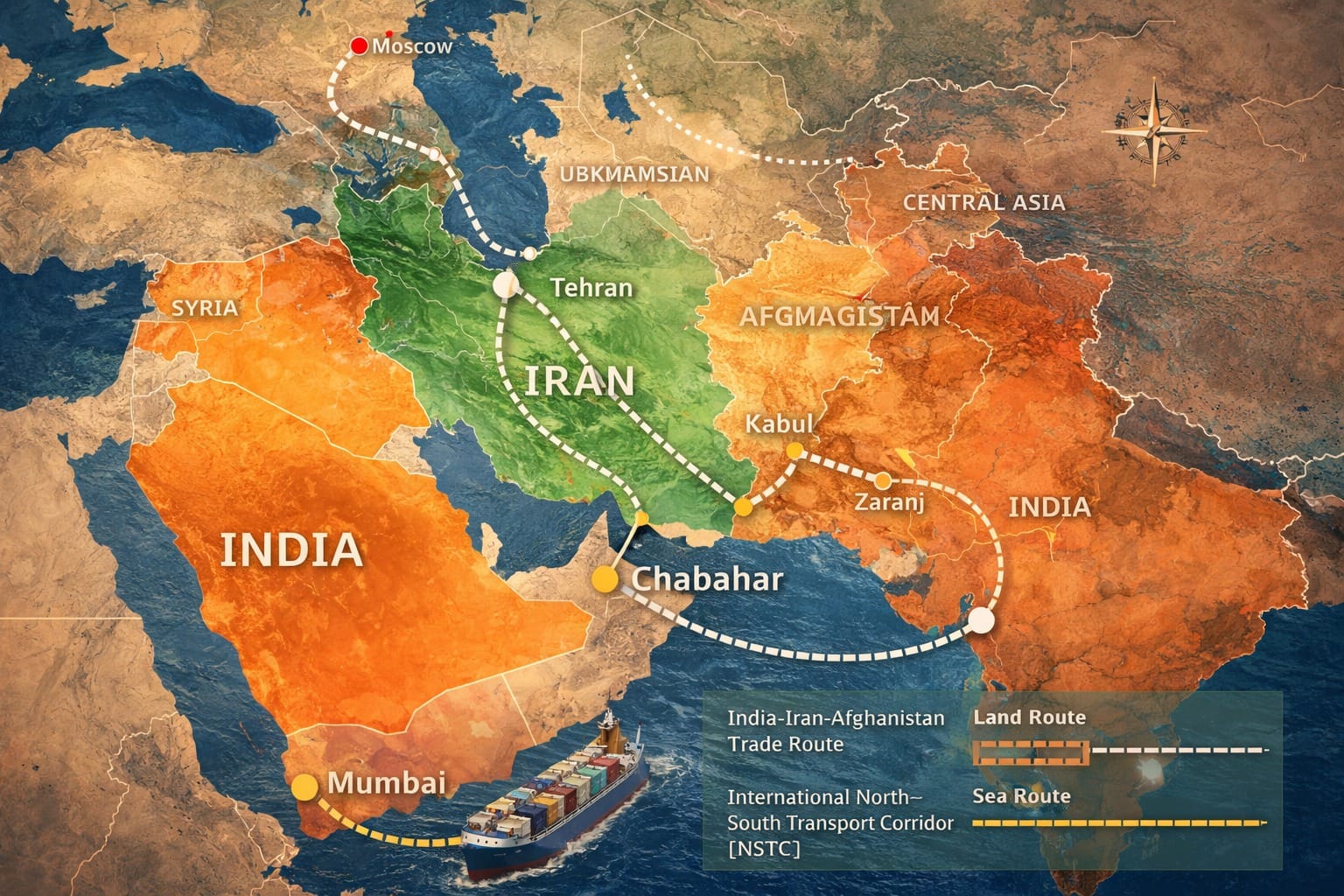
That shift is called: Chabahar.
But Chabahar is not just a port.
It is India’s answer to Pakistan, China, and geographic isolation.
Chabahar Port: Not Infrastructure, But Strategy
To understand why India is investing in Chabahar despite sanctions, delays, and global pressure, you need to understand one brutal geopolitical reality:
India is geographically blocked.
The Pakistan Problem: Why India Needed an Alternative Route
India cannot access:
- Afghanistan
- Central Asia
- Energy-rich regions beyond
…through land routes.
Why?
Because Pakistan denies India transit access.
This has been one of India’s biggest strategic disadvantages.
So India needed:
A route that bypasses Pakistan completely.
That route is:
→ Chabahar Port (Iran)
→ Connected to Afghanistan via road and rail
→ Further linked to Central Asia
Why Iran Was the Only Viable Option
There were no alternatives.
- Pakistan route → blocked
- China-controlled routes → strategic risk
- Sea-only trade → expensive and inefficient
Iran offered:
- Geographic proximity
- Political willingness
- Strategic alignment
So India invested.
Timeline of Chabahar: Slow but Strategic Progress
2001–2003: Conceptual Phase
After the Tehran and New Delhi Declarations, India began exploring:
- connectivity through Iran
- access to Afghanistan
At this stage, Chabahar was just an idea with strategic potential.
2016: The Breakthrough Agreement
The real turning point came in 2016.
India, Iran, and Afghanistan signed a trilateral agreement.
This was not just about trade — it was about:
- breaking Pakistan’s monopoly over land routes
- creating a new regional corridor
- strengthening India’s presence in the region
India committed:
- funding
- infrastructure development
- port operations
2018–2024: Operationalization Under Pressure
Despite US sanctions, India continued work.
This is critical.
While India reduced oil imports under US pressure, it refused to abandon Chabahar.
Why?
Because even the US understood:
Chabahar is strategically important for Afghanistan’s stability.
So it gave India a sanctions waiver for the port.
2024: Long-Term Commitment
India signed a 10-year agreement to operate Chabahar.
This signals something important:
India is not thinking in years —
It is thinking in decades.
Chabahar vs Gwadar: India vs China
To truly understand Chabahar, you need to see it in comparison.
Just 170 km away from Chabahar lies:
→ Gwadar Port (Pakistan)
→ Built and controlled by China
Gwadar (China–Pakistan)
- Part of China’s Belt and Road Initiative (BRI)
- Gives China access to the Arabian Sea
- Strengthens China–Pakistan alliance
Chabahar (India–Iran)
- India’s strategic counter
- Independent access to Central Asia
- Reduces China’s regional dominance
The Bigger Picture
This is not just about ports.
This is about:
- India vs China influence in Asia
- Control over trade routes
- Geopolitical positioning for the next 50 years
Chabahar is India saying:
“We will not be boxed in.”
Iran’s Perspective: Why It Needs India
This relationship is not one-sided.
Iran gains significantly from India.
1. Breaking Isolation
Due to sanctions, Iran is often cut off from:
- Western markets
- global finance
- foreign investments
India provides:
- a large, stable trading partner
- an alternative economic channel
2. Infrastructure Development
Chabahar helps Iran:
- develop its southeastern region
- increase trade flows
- become a regional transit hub
3. Strategic Balance
Iran does not want to depend only on:
- China
- Russia
India gives Iran a third strategic pillar.
India’s Strategic Autonomy: The Real Game
India’s foreign policy today is best described by one word:
Multi-alignment
India maintains relations with:
- USA
- Iran
- Russia
- Gulf nations
- Israel
This is not confusion —
It is strategy.
How India Balances Iran and the US
India:
- reduced oil imports from Iran (to comply with US)
- continued Chabahar project (to maintain Iran ties)
This shows:
India does not choose sides.
It chooses interests.
Why India Cannot Abandon Iran
Even if pressured, India cannot cut off Iran because:
- It needs long-term energy diversification
- It needs access to Central Asia
- It needs strategic depth
Iran’s Position on Kashmir and PoK
This is one of the most sensitive aspects of India-Iran relations.
Iran’s Public Statements
At times, Iran has:
- expressed concern about Muslim rights in Kashmir
- made statements that appear critical
But here’s the key point:
Iran has never taken a hard anti-India position like Pakistan.
Why Iran Stays Balanced
Iran understands:
- India is a major economic and strategic partner
- Taking a strong stance could damage relations
So Iran follows a carefully calibrated approach:
- Symbolic statements
- No aggressive diplomatic action
The Real Interpretation
Iran is:
- balancing religious sentiment
- with geopolitical realism
And in that balance, it chooses:
not to antagonize India
The Silent Understanding Between India and Iran
There is an unspoken agreement between both countries:
- Differences will exist
- But they will not define the relationship
This is why:
- Kashmir issue does not derail ties
- Sanctions do not end cooperation
- Global pressure does not break engagement
The Future: Where Are India–Iran Relations Headed?
This is where things get interesting.
Scenario 1: Sanctions Ease
If US-Iran tensions reduce:
- India will likely resume oil imports
- Trade could return to previous levels
- Energy partnership will strengthen again
Scenario 2: Continued Conflict
If tensions continue:
- India will deepen non-oil engagement
- Focus on infrastructure and trade
- Maintain diplomatic balance
Scenario 3: Rise of Alternative Trade Systems
India and Iran may expand:
- Rupee-based trade
- Non-dollar transactions
- regional financial systems
This reduces dependence on Western financial systems.
Scenario 4: Stronger Chabahar Corridor
Chabahar could become:
- India’s gateway to Eurasia
- a major logistics hub
- a counter to China’s Belt and Road
The Biggest Truth About India–Iran Relations
If you strip away headlines, politics, and global pressure, one truth remains:
India and Iran need each other — but on their own terms.
Why This Relationship Will Never Fully Break
Because it is based on:
- geography (cannot be changed)
- energy needs (cannot be ignored)
- strategic access (cannot be replaced)
Final Conclusion
India–Iran relations are not emotional alliances.
They are:
- calculated
- flexible
- long-term
From oil trade to Chabahar, from sanctions to strategy, both countries have shown an ability to:
adapt without abandoning each other.
And that is what makes this relationship powerful.
Final Thought
In a world where countries are forced to pick sides,
India and Iran represent something different:
A relationship that survives pressure, adapts to reality, and plays the long game.
Subscribe to our YouTube channel The Logic Stick for more video insights