







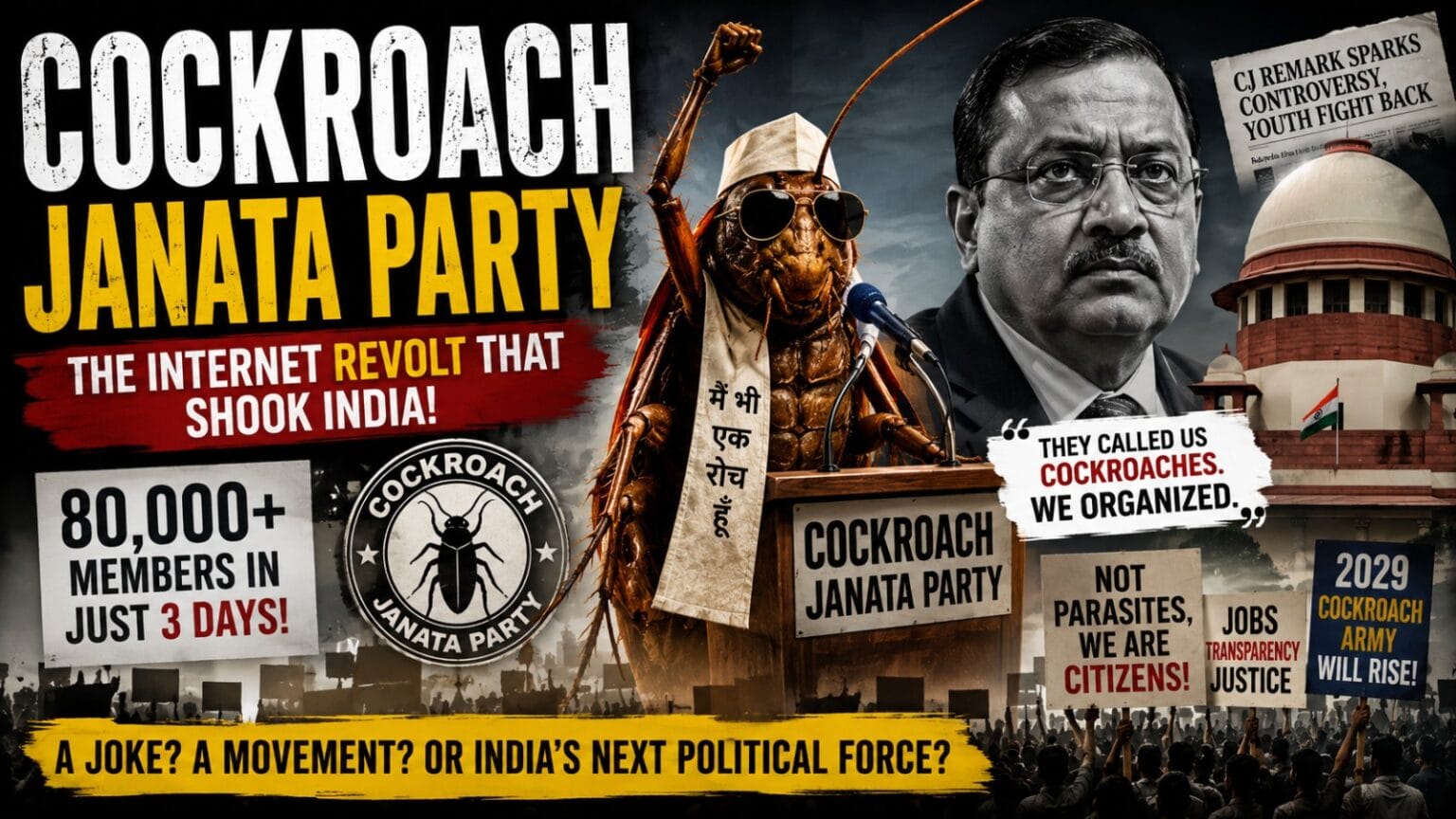
India’s internet has created many viral trends over the years, but few have exploded as rapidly as the Cockroach Janata Party (CJP). What started as a sarcastic online response to controversial remarks allegedly made by Chief Justice Surya Kant has now become one of the most talked-about digital political movements in India.
From memes and satire to manifestos and online memberships, the Cockroach Janata Party represents something much bigger than a joke. It reflects frustration among India’s youth, anger against institutions, distrust in politics, unemployment anxiety, and the rise of Gen Z internet activism.
Here’s everything you need to know about the Cockroach Janata Party, how it started, who created it, what the party wants, why it went viral, and whether it could become a real political force.
What Is the Cockroach Janata Party?
The Cockroach Janata Party (CJP) is a satirical political movement that emerged online in May 2026. It was launched as a humorous but politically charged response to remarks linked to Chief Justice Surya Kant, where unemployed youth were allegedly compared to “cockroaches” and “parasites attacking the system.”
Instead of rejecting the insult, internet users embraced it.
The idea quickly transformed into a parody political party with:
- A website
- A manifesto
- Membership forms
- Social media campaigns
- Satirical political posters
- Meme-based propaganda
Within days, the movement attracted tens of thousands of followers online.
Who Started the Cockroach Janata Party?
The Cockroach Janata Party was founded by Abhijeet Dipke, a political content creator and digital strategist. Multiple reports suggest he previously worked with the social media machinery of the Aam Aadmi Party (AAP).
Dipke positioned the movement as a response to the humiliation and alienation many young Indians feel in modern political and economic systems.
According to interviews and reports, the movement was designed to represent:
- unemployed youth,
- overworked digital workers,
- RTI activists,
- journalists,
- creators,
- meme culture communities,
- and people who feel “ignored by the system.”
Why Is It Called “Cockroach” Janata Party?
The name is symbolic.
Cockroaches are known for survival. They adapt, resist, and continue living despite hostile conditions. The movement uses the cockroach as a metaphor for ordinary citizens who continue surviving despite unemployment, inflation, pressure, and political neglect.
The party slogan reportedly became:
“They tried to step on us. We came back.”
The name also intentionally mocks elitist attitudes toward unemployed youth and digitally active citizens.
How Did the Cockroach Janata Party Start?
The movement began shortly after courtroom remarks allegedly made by Chief Justice Surya Kant went viral online.
According to multiple media reports, he allegedly referred to certain unemployed youth entering journalism, law, activism, or RTI-related work as “cockroaches” and “parasites.”
Social media reacted instantly.
Within 48 hours:
- meme pages amplified the controversy,
- users began creating parody political posters,
- AI-generated political branding spread online,
- and Abhijeet Dipke officially launched the Cockroach Janata Party website and campaign.
The internet transformed outrage into satire.
Also read - Everything you need to know about the Ebola VirusWhy Did the Cockroach Janata Party Go Viral?
1. Gen Z Political Humor
The party speaks the language of the internet:
- memes,
- sarcasm,
- self-deprecating humor,
- digital rebellion,
- ironic nationalism,
- and anti-establishment jokes.
Unlike traditional political parties, CJP uses humor as its primary communication tool.
2. Unemployment Frustration
India’s youth unemployment issue has become a major concern.
Many young Indians feel:
- overqualified,
- underpaid,
- digitally exhausted,
- and disconnected from traditional politics.
The Cockroach Janata Party tapped directly into that frustration.
Also read – NEEt-UG Paper Leak Explained
3. Anti-System Sentiment
The movement resonates with people who distrust:
- political parties,
- bureaucracies,
- media systems,
- educational institutions,
- and corporate influence.
The satire became a form of collective venting.
4. Meme Culture as Politics
This may be India’s clearest example yet of “meme politics.”
The movement turned:
- jokes into campaigns,
- hashtags into political symbols,
- and satire into community identity.
What Is the Cockroach Janata Party Manifesto?
The manifesto mixes humor with genuine criticism of society and governance.
According to reports, the movement focuses on:
1. Youth Unemployment
The party highlights joblessness and economic insecurity among educated youth.
2. Exam Scams & Education Pressure
The group reportedly supports students affected by NEET controversies and examination irregularities.
3. Digital Labor Recognition
The movement mocks the idea that online work or internet activism is “not real work.”
4. Transparency & Accountability
Through satire, the party criticizes corruption, bureaucracy, and institutional opacity.
5. Mental Burnout & Internet Culture
Many membership jokes revolve around:
- doomscrolling,
- internet addiction,
- burnout,
- and emotional exhaustion.
The Viral Membership Rules
One major reason for the party’s popularity is its intentionally absurd membership criteria.
Reports suggest applicants qualify if they are:
- “Unemployed by force, choice, or principle”
- “Chronically online”
- “Emotionally exhausted by the system”
- “Talented at ranting online”
The satire made young people feel seen.
What Is the National Parasitic Front (NPF)?
Soon after the rise of the Cockroach Janata Party, another parody political movement appeared online: the National Parasitic Front (NPF).
The NPF positioned itself as the “opposition” to the Cockroach Janata Party.
This created an entire ecosystem of:
- fake political debates,
- parody campaigns,
- meme manifestos,
- and internet political roleplay.
It reflects how deeply internet humor now overlaps with political expression in India.
Is the Cockroach Janata Party a Real Political Party?
As of now, the Cockroach Janata Party is primarily:
- a digital satire movement,
- a meme-political community,
- and an online protest culture phenomenon.
It is not officially recognized as a mainstream electoral political party.
However, its popularity raises a serious question:
Can meme-based digital communities evolve into real political movements?
Globally, internet culture has already influenced:
- elections,
- activism,
- protests,
- and ideological movements.
India may now be entering that phase too.
What Does the Cockroach Janata Party Represent?
The movement symbolizes:
Digital Political Identity
Young Indians increasingly express politics through memes rather than speeches.
Distrust of Institutions
Many users feel disconnected from traditional political systems.
The Rise of Internet Activism
Online humor is now becoming a tool for mobilization.
Emotional Exhaustion of Youth
The party reflects burnout, unemployment stress, and identity crises among educated young people.
Is This a Threat to Traditional Politics?
Not directly — at least not yet.
But the Cockroach Janata Party reveals something important:
Traditional political communication is losing cultural relevance among younger audiences.
Gen Z responds more to:
- authenticity,
- humor,
- relatability,
- and internet-native language.
If mainstream parties fail to adapt, meme movements could become increasingly influential.
Could the Cockroach Janata Party Become Real?
That depends on three things:
1. Leadership Structure
Right now, it functions more as a decentralized internet movement.
2. Offline Organization
Going viral online is easier than building real political machinery.
3. Longevity
Most meme movements disappear quickly unless they evolve into structured activism.
Still, many serious political movements in history began as satire or fringe communities.
Why the Cockroach Symbol Works So Well
Ironically, the cockroach is one of the strongest survival symbols in nature.
Cockroaches are known for:
- adaptability,
- resilience,
- persistence,
- and surviving hostile environments.
That symbolism unintentionally strengthened the movement’s identity.
Final Thoughts
The Cockroach Janata Party may look ridiculous on the surface, but beneath the memes lies a serious social signal.
It represents:
- economic anxiety,
- political disillusionment,
- internet-native activism,
- and a generation using humor to express frustration.
Whether the movement survives or fades away, it has already proven one thing:
In modern India, politics is no longer limited to rallies, TV debates, or parliament speeches.
Sometimes, it begins with a meme. Sometimes, it begins with an insult.
And sometimes, the internet turns that insult into an entire political movement.
Subscribe to our YouTube Channel The Logic Stick for more video insights