







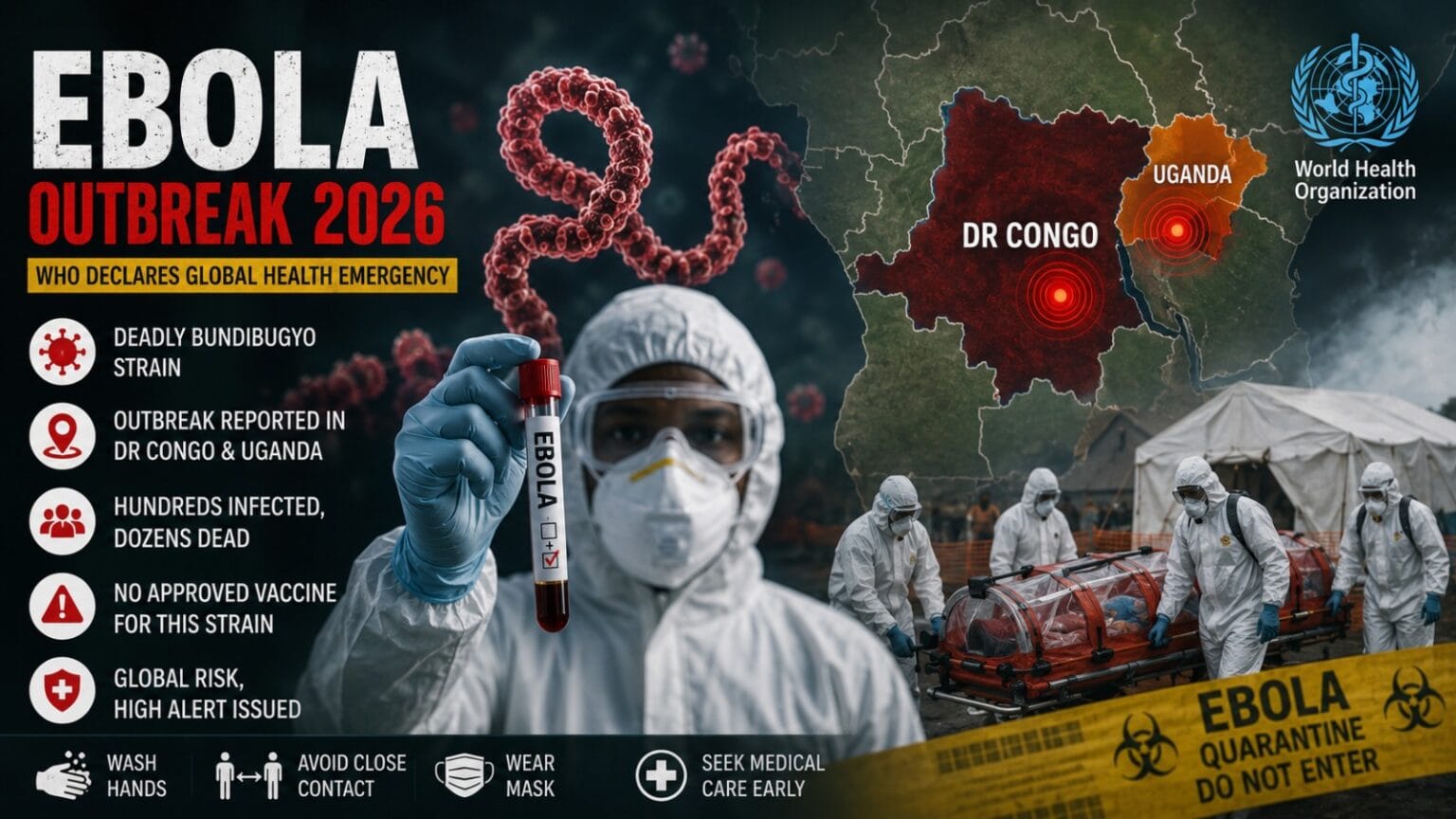
The World Health Organization (WHO) has officially declared the ongoing Ebola outbreak in the Democratic Republic of Congo (DRC) and Uganda a “Public Health Emergency of International Concern” (PHEIC), raising global concern over the rapid spread of the deadly virus in Central Africa. The declaration came after dozens of deaths, hundreds of suspected infections, and fears that the outbreak could spread across borders.
Health officials say the outbreak is particularly alarming because it involves the rare Bundibugyo strain of the Ebola virus — a strain for which there are currently no approved vaccines or virus-specific treatments.
As fears of another major global health emergency rise, here is everything you need to know about Ebola, including:
- What Ebola is
- How it spreads
- Symptoms and stages
- Death rates
- The 2026 Congo-Uganda outbreak
- Why WHO declared an emergency
- Whether Ebola can become a pandemic
- Treatment options
- Vaccines
- Prevention methods
- Global risks and future concerns
What Is Ebola?
Ebola Virus Disease (EVD), commonly known as Ebola, is a severe and often fatal viral illness that affects humans and some animals.
The disease is caused by viruses from the Ebolavirus genus, which belongs to the Filoviridae family. Ebola was first identified in 1976 near the Ebola River in what is now the Democratic Republic of Congo.
Ebola is considered one of the world’s deadliest infectious diseases because:
- It spreads rapidly through bodily fluids
- It causes severe internal and external bleeding
- It has a high fatality rate
- Outbreaks can overwhelm healthcare systems quickly
Why WHO Declared the Ebola Outbreak a Global Health Emergency in 2026
On May 17, 2026, the WHO declared the Ebola outbreak in Congo and Uganda a Public Health Emergency of International Concern (PHEIC).
The decision was taken because:
- The outbreak had spread across borders
- Cases were confirmed in Uganda’s capital Kampala
- Hundreds of suspected cases were emerging
- Healthcare worker deaths were reported
- The virus was spreading in conflict zones
- The true scale of the outbreak remained uncertain
According to WHO:
- More than 246 suspected cases were reported
- Around 80 suspected deaths had occurred
- Multiple health zones in Congo were affected
- Uganda confirmed imported cases linked to Congo
WHO warned that the outbreak carries:
- High regional spread risk
- Major healthcare challenges
- Serious humanitarian concerns
What Is the Bundibugyo Ebola Virus?
The current outbreak is caused by the Bundibugyo strain of Ebola virus disease (BVD).
This strain is especially concerning because:
- No approved vaccine exists specifically for it
- No virus-specific therapeutics are approved
- It is rarer than the Zaire strain
- Outbreak data is limited compared to other Ebola variants
The Bundibugyo strain was first identified in Uganda in 2007.
Unlike the Ebola-Zaire strain — which caused the massive West African outbreak — the Bundibugyo strain has fewer medical countermeasures available.
Ebola Symptoms Explained
Ebola symptoms usually begin suddenly after an incubation period of 2 to 21 days.
Early Symptoms of Ebola
Initial symptoms often resemble flu or malaria:
- Fever
- Fatigue
- Weakness
- Muscle pain
- Headache
- Sore throat
Advanced Symptoms
As the disease progresses:
- Vomiting
- Diarrhea
- Severe dehydration
- Organ failure
- Internal bleeding
- Bleeding from eyes, nose, gums, or stool
- Shock
In severe cases:
- Multiple organs fail
- Blood clotting systems collapse
- Patients die from shock or internal bleeding
WHO says fatality rates can range from 25% to 90%, depending on the strain and healthcare access.
How Ebola Spreads
Ebola does NOT spread like COVID-19 through normal airborne transmission.
The virus spreads through:
- Blood
- Vomit
- Saliva
- Sweat
- Urine
- Breast milk
- Semen
- Contact with infected bodily fluids
- Contaminated medical equipment
- Unsafe burial practices
People become infectious only after symptoms begin.
Healthcare workers are especially vulnerable because:
- They directly handle infected patients
- They are exposed to bodily fluids
- Protective equipment shortages increase risk
WHO reported healthcare worker deaths during the current outbreak.
Can Ebola Spread Through Air?
This is one of the biggest questions people ask.
Current scientific evidence shows Ebola is not naturally airborne like COVID-19 or influenza.
However:
- Droplets from bodily fluids can infect nearby individuals
- Hospital procedures can increase exposure risk
- Poor infection control worsens transmission
This is why strict isolation protocols are essential during outbreaks.
Ebola Death Rate: How Dangerous Is It?
Ebola is among the deadliest viruses known to infect humans.
Fatality rates vary by strain:
| Ebola Strain | Approximate Fatality Rate |
|---|---|
| Zaire Ebola | 60–90% |
| Sudan Ebola | 40–60% |
| Bundibugyo Ebola | 25–50% |
| Reston Ebola | Rarely causes human illness |
The current Bundibugyo outbreak has an estimated mortality range between 25% and 50%.
Death risk increases when:
- Treatment is delayed
- Healthcare systems collapse
- Rural areas lack medical access
- Malnutrition is widespread
Why the 2026 Ebola Outbreak Is So Concerning
Several factors make this outbreak unusually dangerous:
1. Cross-Border Spread
Cases have already appeared in:
- Congo
- Uganda
- Kampala
- Potentially Goma and other major cities
Cross-border movement increases transmission risk.
2. Conflict Zones
Parts of eastern Congo are affected by:
- Armed conflict
- Rebel activity
- Displacement
- Weak healthcare systems
These conditions make:
- Contact tracing difficult
- Quarantine enforcement harder
- Healthcare delivery dangerous
Previous Ebola outbreaks in conflict zones were significantly harder to control.
3. No Approved Vaccine for This Strain
Unlike earlier outbreaks involving Ebola-Zaire:
- No approved Bundibugyo vaccine exists
- Experimental countermeasures are limited
- Treatment remains largely supportive care
This significantly increases global concern.
Ebola Treatment: Is There a Cure?
There is currently no universal cure for all Ebola strains.
Treatment mainly involves supportive care:
- IV fluids
- Electrolyte replacement
- Oxygen support
- Blood pressure management
- Infection control
- Organ support
Early medical care dramatically improves survival chances.
For the Zaire strain:
- Some monoclonal antibody treatments exist
- Certain vaccines have shown effectiveness
But for Bundibugyo:
- No fully approved virus-specific treatment exists yet
Ebola Vaccines Explained
The rVSV-ZEBOV vaccine has shown success against the Ebola-Zaire strain.
However:
- It is not specifically approved for Bundibugyo Ebola
- Research is ongoing for broader Ebola vaccines
- Experimental approaches may be used in emergencies
WHO and Africa CDC are currently evaluating emergency strategies for vaccine deployment.
Also read
Also read - PM Modi Receives Royal Order of the Pole Star How Ebola Outbreaks Are Controlled
Public health authorities usually rely on:
Isolation
Confirmed patients are isolated immediately.
Contact Tracing
Anyone exposed to infected individuals is monitored.
Protective Equipment
Healthcare workers use PPE kits.
Safe Burials
Traditional burial practices can spread Ebola.
Travel Monitoring
Authorities monitor high-risk travellers.
WHO currently advises against complete border closures because:
- People may cross secretly
- Tracking becomes harder
- Surveillance weakens
Can Ebola Become a Pandemic?
WHO says the current outbreak does NOT yet meet pandemic criteria.
However, experts remain concerned because:
- Urban transmission has occurred
- Cross-border cases exist
- Healthcare infrastructure is weak
- Detection delays are possible
Ebola spreads less easily than COVID-19 because:
- It requires close bodily-fluid contact
- People are contagious only after symptoms start
But localized outbreaks can still become devastating.
History of Major Ebola Outbreaks
1976 – First Ebola Outbreak
First identified in Congo and Sudan.
2014–2016 West Africa Outbreak
Largest Ebola outbreak in history:
- Over 28,000 cases
- More than 11,000 deaths
- Spread across Guinea, Liberia, and Sierra Leone
2018–2020 Congo Outbreak
Second-largest outbreak:
- Over 2,000 cases
- Major conflict-zone transmission
- WHO declared global emergency
2026 Congo-Uganda Outbreak
Current outbreak involving Bundibugyo strain.
Why Ebola Keeps Emerging in Africa
Experts believe outbreaks are linked to:
- Human contact with infected wildlife
- Deforestation
- Bushmeat consumption
- Population movement
- Weak healthcare infrastructure
Fruit bats are considered likely natural hosts of Ebola viruses.
Climate change and habitat disruption may also increase future outbreak risk.
Ebola vs COVID-19: Key Differences
| Feature | Ebola | COVID-19 |
|---|---|---|
| Transmission | Bodily fluids | Airborne droplets |
| Fatality Rate | Very high | Lower overall |
| Contagious Before Symptoms | Rare | Common |
| Speed of Spread | Slower | Very fast |
| Vaccine Availability | Limited | Widely available |
| Pandemic Potential | Lower | Very high |
Despite lower pandemic potential, Ebola’s fatality rate makes it far more deadly for infected individuals.
Global Health Agencies Responding to the Outbreak
Organizations responding include:
- WHO
- Africa CDC
- CDC (United States)
- Local African governments
- International aid agencies
The U.S. CDC has activated emergency response measures and is assisting potentially exposed individuals.
Is India at Risk From Ebola?
Indian health experts say there is currently:
- No major reason for panic
- No evidence of widespread international transmission
However:
- Surveillance systems remain active
- Airports may increase monitoring
- International travel advisories could change
Experts emphasize vigilance rather than panic.
Why the WHO Declaration Matters
A Public Health Emergency of International Concern (PHEIC) is WHO’s highest alert level for disease outbreaks.
The declaration helps:
- Mobilize international funding
- Accelerate emergency response
- Improve surveillance
- Coordinate international cooperation
- Increase vaccine research urgency
WHO uses this declaration only during serious international health threats.
Conclusion
The 2026 Ebola outbreak in Congo and Uganda has become one of the world’s biggest public health concerns after WHO declared it a global health emergency. The outbreak is especially alarming because it involves the rare Bundibugyo Ebola strain, which currently lacks approved vaccines and virus-specific treatments.
Although Ebola is less contagious than airborne diseases like COVID-19, its extremely high fatality rate and the risk of regional spread make it one of the deadliest infectious diseases on Earth.
The coming weeks will be critical as:
- Health workers attempt to contain transmission
- Contact tracing expands
- International agencies coordinate response efforts
- Researchers explore vaccine and treatment options
For now, global health authorities are urging vigilance, rapid containment, and international cooperation to prevent the outbreak from escalating further.
Subscribe to our YouTube Channel The Logic Stick for more video insights