







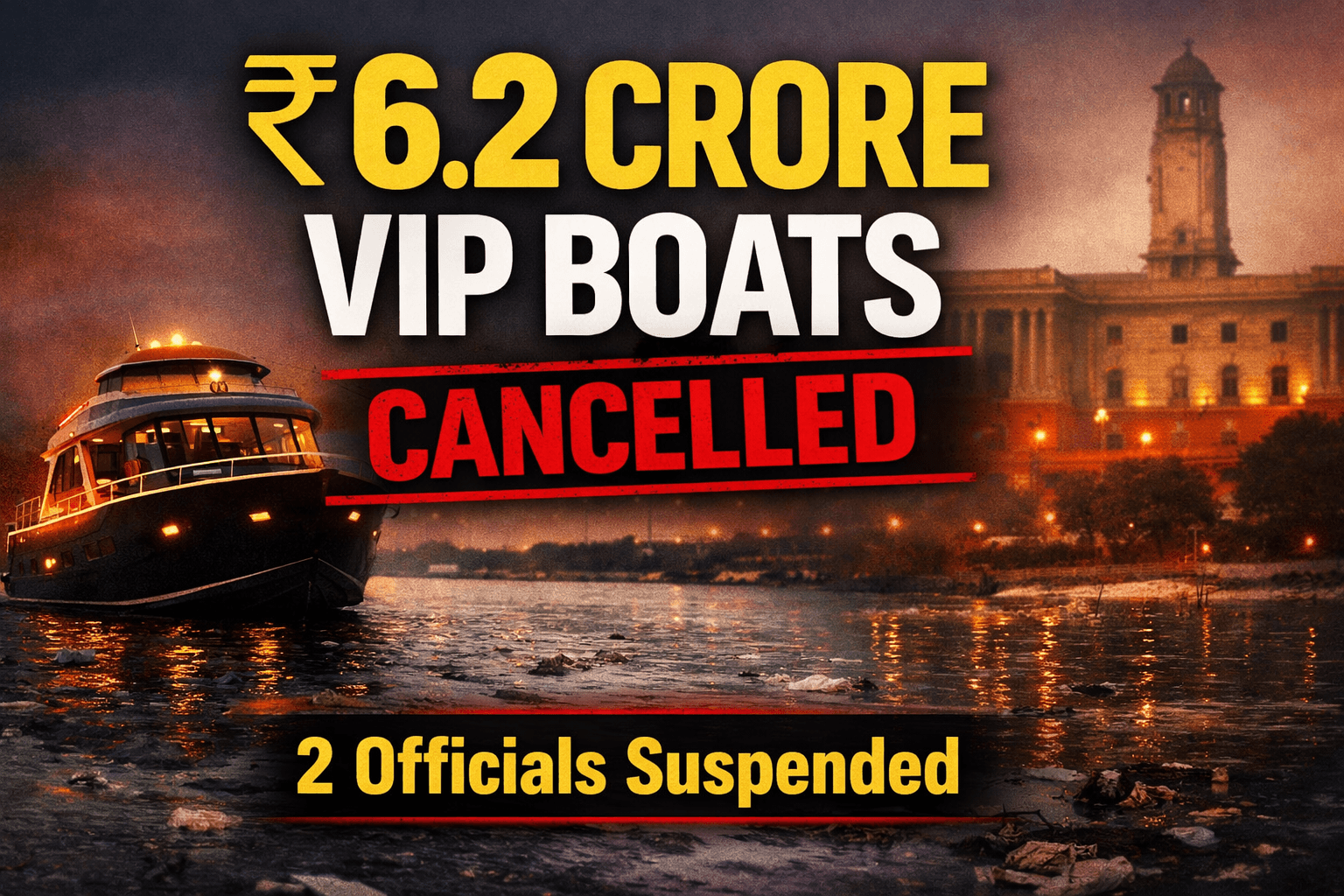
Delhi scraps ₹6.2 crore VIP boats plan amid Yamuna controversy, probe ordered into tender process
In a move that has triggered widespread attention and debate, the Delhi government has scrapped a ₹6.2 crore proposal to procure two air-conditioned VIP boats for Yamuna inspections and suspended two officials linked to the project. The decision comes after the plan drew sharp scrutiny over its cost, purpose, and timing—especially in a city battling severe environmental and civic challenges.
The controversy, which escalated quickly after media reports surfaced, has now turned into a case study of governance optics, administrative accountability, and public expectations in urban India.
What Was the ₹6.2 Crore VIP Boats Plan?
At the centre of the controversy was a tender issued by the Irrigation and Flood Control (I&FC) Department for the procurement of two high-end boats, each costing approximately ₹3.1 crore.
These boats were designed with:
- Air-conditioned enclosed cabins
- Facilities suitable for VIP/VVIP movement
- Usage for official inspections along the Yamuna River
While departments often require mobility tools for inspections, the luxury-like specifications and high cost became the biggest point of contention.
Read more on the Iran Israel War here.
Why Did the Plan Trigger an Uproar?
The backlash was not just about the money—it was about priorities.
1. Optics vs Reality
Delhi continues to struggle with:
- Severe Yamuna pollution
- Urban flooding risks
- Water management inefficiencies
In this context, spending ₹6.2 crore on VIP-style boats appeared disconnected from ground realities.
2. “VIP” Tag Became the Flashpoint
The moment the boats were described as VIP/VVIP inspection vessels, the narrative shifted. It raised questions about:
- Who the project was really meant for
- Whether comfort was prioritized over functionality
3. Lack of Justification in Public Domain
There was no strong publicly communicated explanation of why such high-spec boats were necessary for inspections.
Delhi Government’s Action: Scrap, Suspend, Investigate
Following the controversy, the Delhi government acted swiftly:
- The entire ₹6.2 crore procurement plan was scrapped
- Two officials (including an executive engineer and an assistant engineer) were suspended
- An inquiry was ordered into the tender process
This indicates that the issue was not just political optics but also administrative accountability.
Minister’s Stand: Only Essential Boats Going Forward
Delhi minister Parvesh Verma, who oversees the I&FC Department, clarified that:
- Future procurements will be limited to essential operational requirements
- Boats, if required, will be used for:
- Pollution monitoring
- River surveillance
- Flood management activities
This distinction is crucial—it signals a shift from VIP-oriented design to functional necessity.
The Real Issue: Governance Priorities in a Crisis City
Delhi’s Yamuna is not just a river—it is one of the city’s biggest environmental challenges.
Ground Reality of Yamuna
- High levels of toxic pollutants
- Massive untreated sewage inflow
- Frequent political promises but limited visible improvement
In such a scenario, citizens expect:
- Investment in cleaning and restoration
- Strengthening of monitoring systems
- Real, measurable environmental outcomes
Not high-cost VIP infrastructure.
How Media Triggered the Turning Point
The project gained traction after it was highlighted in media reports. Within a day:
- The issue gained public attention
- Questions were raised on governance priorities
- The government responded with cancellation and inquiry
This shows how media scrutiny continues to act as a powerful accountability tool in governance.
Suspension of Officials: Symbolism or Structural Change?
The suspension of two officials sends a clear message—but raises deeper questions:
What It Signals
- The government is willing to take disciplinary action
- Procurement decisions will be scrutinized
What Still Needs Clarity
- How did the proposal get approved initially?
- Were there systemic gaps in oversight?
- Will procurement processes be reformed?
Because real accountability is not just punishment—it’s prevention of future lapses.
The Bigger Pattern: When Bureaucracy Meets Public Perception
This controversy reflects a common governance gap:
| Administrative View | Public View |
|---|---|
| Boats needed for inspection | Why luxury boats? |
| Departmental requirement | Misuse of taxpayer money |
| Technical justification | Poor prioritization |
The lesson: perception matters as much as policy.
Could the Plan Have Been Salvaged?
Interestingly, the idea of boats itself was not flawed.
What could have worked:
- Basic, cost-effective boats
- Focus on pollution tracking equipment
- Clear communication of functional necessity
But once the “VIP” narrative took over, the project became politically unsalvageable.
Impact on Delhi’s Bureaucracy
This incident is likely to create ripple effects:
- Increased caution in drafting tenders
- Stronger justification required for high-cost proposals
- Greater awareness of public and media scrutiny
In short, future decisions may become slower—but more defensible.
Political Fallout: Damage Control or Governance Reset?
Politically, the government has attempted to flip the narrative:
Negative Side
- Why was the project approved in the first place?
Positive Spin
- Swift action taken
- Officials held accountable
- Public sentiment respected
Whether this works depends on what follows—especially real Yamuna clean-up progress.
Why This Story Matters Beyond Delhi
This is not just a Delhi story—it reflects a national pattern.
Across India:
- Citizens are more aware than ever
- Social media amplifies scrutiny instantly
- Governance decisions are judged in real time
The expectation is simple:
Every rupee spent must justify itself publicly.
Conclusion: A Governance Wake-Up Call
The scrapping of the ₹6.2 crore VIP boats plan is not just an administrative rollback—it is a signal moment in urban governance.
It highlights:
- The power of public scrutiny
- The importance of perception in policy
- The need for alignment between spending and citizen priorities
Most importantly, it sends a clear message:
In today’s India, governance is no longer judged behind closed doors—it is judged in the public eye.
And in that space, every decision must stand not just on logic, but on legitimacy.