







West Bengal Illegal Immigration
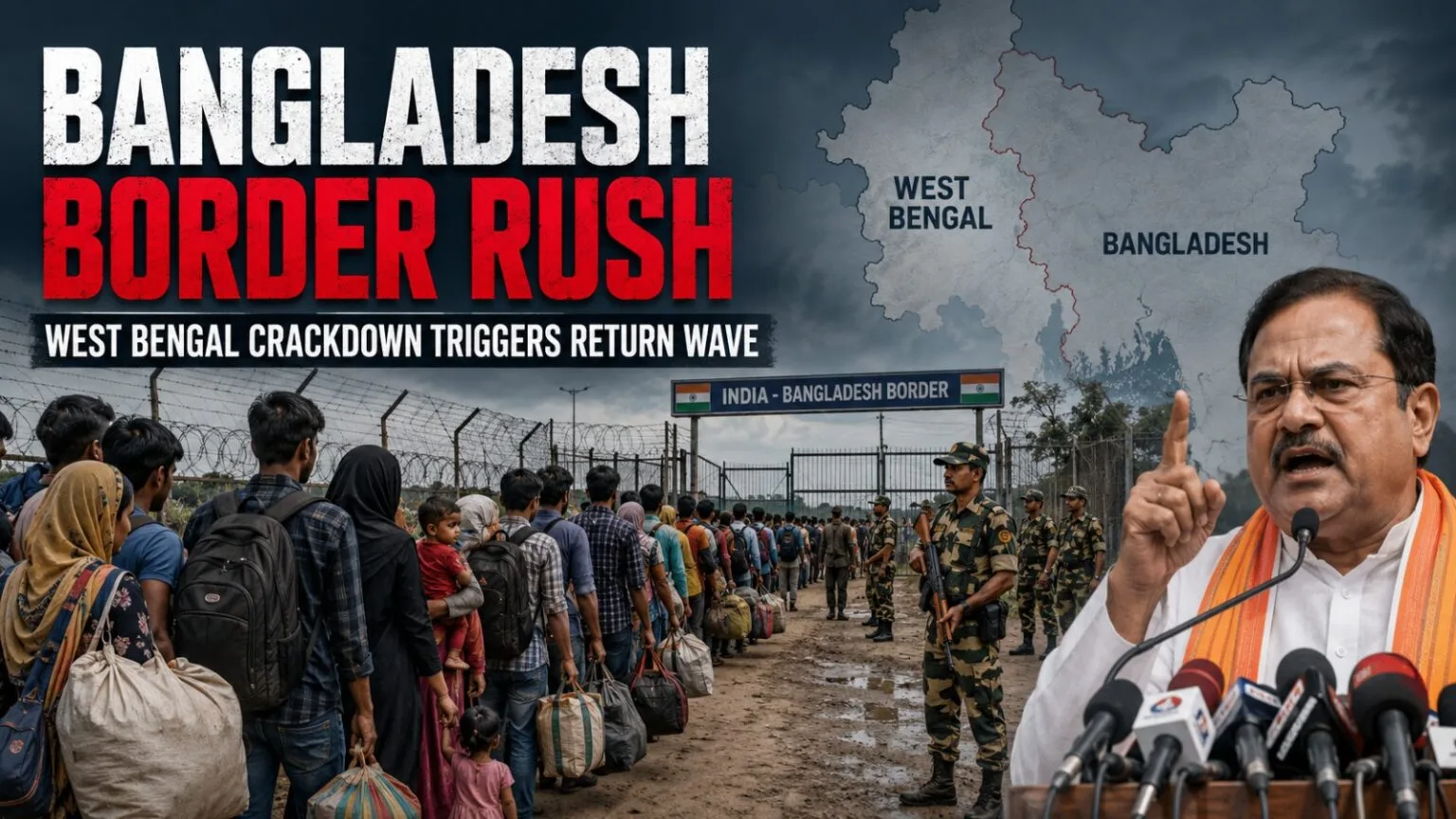
The West Bengal illegal immigration crackdown has triggered a dramatic scene along the India-Bangladesh border, with hundreds of undocumented Bangladeshis reportedly trying to return home through the Bithari-Hakimpur border exit in North 24 Parganas. The sudden movement came after the state government intensified its “detect-delete-deport” approach against alleged illegal immigrants, and after West Bengal Chief Minister Suvendu Adhikari issued a sharp warning asking suspected infiltrators to leave or face government action.
According to reports, men, women and children gathered near the border after the first holding centres for detained or imprisoned illegal immigrants were opened in Malda and Murshidabad. Border Security Force personnel reportedly detained those attempting to cross so that verification and handover procedures could be followed with Bangladesh’s border authorities.
This development has turned into a major political, legal and humanitarian debate. For the government, it is being projected as a border security and national identity issue. For critics and rights observers, the concern is whether due process, identity verification and humane treatment will be ensured before deportation.
What Happened at the West Bengal-Bangladesh Border?
The immediate trigger was the opening of holding centres in West Bengal and the state government’s push to identify, detain and deport undocumented foreign nationals. Reports from the Bithari-Hakimpur border in North 24 Parganas described hundreds of Bangladeshis without valid documents gathering to return to Bangladesh.
Many of those attempting to leave were reportedly working in Kolkata and surrounding areas as domestic workers, masons, hotel workers, fishery workers and construction labourers. Some told reporters they had entered India through border points such as Ghojadanga or Swarupnagar in earlier years and decided to return after fearing detention in the new holding centres.
One of the most important aspects of the situation is that this is not simply a border incident. It reflects a larger shift in West Bengal’s immigration enforcement policy under the new state administration. The phrase “detect-delete-deport” suggests a three-step approach: identify undocumented migrants, remove them from official systems where applicable, and then repatriate or deport them after verification.
Suvendu Adhikari’s Warning: “Leave or Face Action”
Chief Minister Suvendu Adhikari reportedly told suspected illegal infiltrators to leave quickly or the government would take action. He also directed officials to speed up the repatriation process for detainees.
His statement has become the political centre of the controversy because of its aggressive tone and timing. Supporters argue that the message is necessary to discourage illegal immigration and protect state resources. Opponents are likely to question whether such warnings could create panic among vulnerable communities, including people whose citizenship or documentation status may require careful legal examination.
Adhikari also argued that it made little sense to keep illegal immigrants in jails at public expense, saying that repatriation should be expedited where the law allows.
What Are Holding Centres and Why Are They Important?
Holding centres are temporary facilities where foreign nationals suspected of illegal stay may be kept while their nationality, identity and deportation papers are processed. In West Bengal, the first two such centres were reportedly opened in Malda and Murshidabad.
The state government reportedly issued directions to district magistrates to arrange facilities for illegal immigrants awaiting deportation. Within 48 hours of the circular, suspected Bangladeshi nationals intercepted in Malda and Murshidabad were moved to these facilities.
Legally, the idea of detention or holding centres is not new in India. The Ministry of Home Affairs has previously stated that detection and deportation of illegal foreigners is a continuous statutory process, and that foreign nationals may have to remain in holding or detention centres until nationality verification and travel documents are completed.
Also read – Twisha Sharma Case Full Updates
The Legal Background: Can States Deport Illegal Immigrants?
India’s immigration enforcement has historically been governed by laws such as the Foreigners Act, 1946 and the Passport (Entry into India) Act, 1920. The Ministry of Home Affairs has previously said that the power to deport illegally staying foreign nationals has been entrusted to state governments under Article 258(1) of the Constitution, while Union Territories also discharge such functions under Article 239(1).
However, deportation is not as simple as picking up a person and sending them across the border. The person’s nationality usually needs to be verified by the country of origin. Travel documents may have to be issued. Border agencies must coordinate. The receiving country’s authorities must also accept the person.
This is why the role of BSF and Border Guard Bangladesh becomes crucial. A BSF officer cited in reports said that once suspected infiltrators are detained, their identities and backgrounds are verified through questioning, fingerprints and photographs before BSF contacts BGB for repatriation.
Why This Is Politically Sensitive in West Bengal
The West Bengal illegal immigration crackdown is politically sensitive because the state shares a long and porous border with Bangladesh. Migration, citizenship, border security and refugee identity have been major election issues in the state for decades.
For the BJP-led government, the crackdown is likely to be framed as a promise being fulfilled: stronger border control, removal of illegal immigrants and protection of national security. The government’s messaging also links the issue with public resources, law and order, and demographic concerns.
For opposition parties and civil society groups, the concern may centre around due process, possible wrongful targeting, treatment of poor migrants, and the risk of genuine Indian citizens being harassed if they lack proper documents.
This is where the debate becomes complex. Illegal immigration is a legitimate state concern, but enforcement must still follow legal safeguards. The real test for the government will be whether every case is verified carefully and whether holding centres are operated with transparency and humane conditions.
Humanitarian Concerns: Workers, Families and Fear
Reports suggest that many of those attempting to return to Bangladesh were low-income workers employed in households, hotels, construction sites and fisheries.
This raises a difficult question: how should a state enforce immigration law when many undocumented people are deeply embedded in informal labour markets?
For the workers, the fear is detention. For employers, there may be sudden labour disruptions. For border officials, there is the burden of verification. For the government, the challenge is to enforce the law without creating chaos or humanitarian distress.
Some migrants reportedly said they were returning voluntarily to avoid being placed in holding centres. But when such returns happen in an atmosphere of fear, the line between “voluntary return” and “forced exit” can become politically and legally contested.
Why Bangladesh Repatriation Is Not Automatic
Even if a person claims to be Bangladeshi, deportation requires confirmation. Bangladesh’s authorities must verify and accept the person as their national. This is why BSF-BGB coordination matters.
If nationality cannot be established, the process can become prolonged. This is also why holding centres exist: they are meant to house foreign nationals while verification and documentation are pending. The Ministry of Home Affairs has previously stated that illegal foreigners whose nationality needs to be verified may have to await deportation until travel documents are issued.
This means the success of West Bengal’s crackdown will depend not only on state policing, but also on diplomatic and border-level cooperation between India and Bangladesh.
The CAA Angle: Who Is Protected and Who Is Not?
Reports around the new policy also mention the Citizenship Amendment Act context. Earlier coverage said the state government had indicated that migrants not covered under the CAA framework would face deportation action.
This is important because the CAA creates a pathway to Indian citizenship for certain persecuted religious minorities from neighbouring countries under specified conditions. However, it does not apply equally to all undocumented migrants. Those outside its ambit may still face action under immigration laws.
This is likely to remain one of the most debated parts of the crackdown because it connects immigration enforcement with religion, refugee protection and citizenship politics.
What This Means for West Bengal
The immediate impact is visible at the border: panic, queues and attempted return by undocumented migrants. But the longer-term impact could be much bigger.
First, the government may expand holding centres across districts if the crackdown continues. Second, informal labour markets may face disruption if large numbers of undocumented workers leave or are detained. Third, border policing could become stricter in districts such as North 24 Parganas, Malda and Murshidabad. Fourth, the issue may dominate West Bengal politics, especially because immigration has always been a high-emotion topic in the state.
The crackdown may also send a signal to other states with undocumented migrant populations. If West Bengal’s model becomes politically popular, similar enforcement drives could be seen elsewhere.
The Bigger Question: Security vs Due Process
The West Bengal illegal immigration crackdown sits at the intersection of security, politics, law and human rights.
From a security perspective, no country can ignore illegal immigration. A state has the right to know who is living within its borders, especially in sensitive border regions. From a governance perspective, undocumented populations create challenges for law enforcement, welfare delivery, employment regulation and national security.
But from a constitutional and humanitarian perspective, every suspected case must be handled carefully. Wrongful identification can destroy lives. Poor migrants may not have papers even when they have long histories in a place. Families can be separated. Children can be caught in the middle. Holding centres must therefore be monitored, transparent and legally accountable.
The key issue is not whether immigration laws should be enforced. The key issue is how they are enforced.
Conclusion
The scenes at the Bithari-Hakimpur border show that West Bengal’s new immigration policy has already had a strong psychological and administrative impact. Hundreds of undocumented Bangladeshis reportedly trying to return home after Suvendu Adhikari’s warning marks a turning point in the state’s approach to illegal immigration.
For the government, this is a crackdown on illegal infiltration. For affected migrants, it is a moment of fear and uncertainty. For the public, it raises a larger debate about border security, citizenship, labour, legality and human dignity.
The coming weeks will show whether the West Bengal illegal immigration crackdown becomes a structured legal enforcement model or a politically charged campaign that triggers deeper social and humanitarian concerns.
Subscribe to our YouTube Channel The Logic Stick for more video insights