







Breakthrough Whale and Dolphin Disease Detection Tech Brings Faster Field Testing for Deadly Cetacean Infections
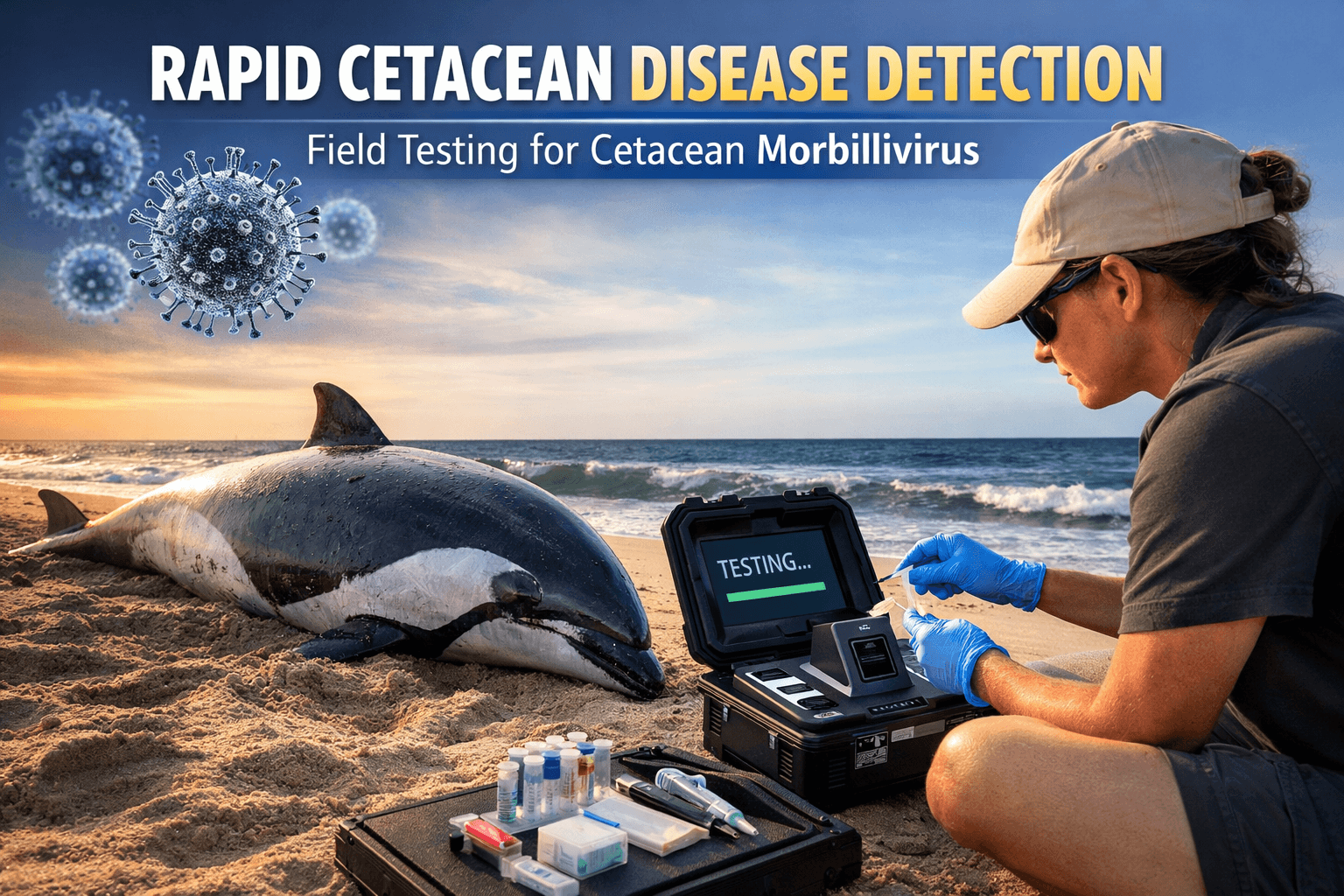
A new portable disease-detection system developed and validated by researchers at the University of Hawaiʻi at Mānoa could change how scientists respond to illness outbreaks in whales and dolphins. The tool is designed to detect Cetacean Morbillivirus (CeMV) in the field, including on beaches and in remote coastal locations, and can produce results in about an hour. That is a major shift from older workflows that often depended on sending samples to specialized laboratories and waiting weeks or even months for answers.
The core importance of this breakthrough is speed. When marine mammals strand in groups, responders often have only a narrow window to understand whether trauma, toxins, or infectious disease may be involved. A faster test does not solve every mystery, but it can help scientists and wildlife officials make better real-time decisions about triage, sampling, biosecurity, and broader surveillance. According to the University of Hawaiʻi, the portable unit was validated as a field-deployable molecular diagnostic tool for CeMV by the UH Health and Stranding Lab working with international collaborators.
Cetacean Morbillivirus is one of the most serious infectious threats known in dolphins and some whales. Scientific reviews describe CeMV as a distinct morbillivirus affecting cetaceans and link it to major epizootics, including outbreaks in the Mediterranean, the United States, and Australia. Research has documented that some of these outbreaks killed thousands of dolphins, especially striped dolphins in the Mediterranean in the early 1990s.
That broader history is what makes the Hawaiʻi development so important. The university article says the new system is meant for use in “oceans, beaches and remote locations,” and that it was designed for hot, humid environments where traditional lab infrastructure may not be available nearby. Kristi West, director of the UH Health and Stranding Lab, said it is the first application of a field-deployable system for rapid testing for whales and dolphins. That claim comes from the research team itself, so it is best presented as their characterization rather than as an independently verified global first in every possible diagnostic category.
The original version of the article also needed one important correction in wording. The technology is not a general detector for every whale and dolphin disease. Based on the available sources, it is specifically a portable molecular test developed for Cetacean Morbillivirus. The PubMed record for the study describes it as a portable reverse transcription-insulated isothermal PCR (RT-iiPCR) assay targeting a conserved segment of the virus’s phosphoprotein gene. In other words, this is a focused molecular diagnostic innovation aimed at one high-priority pathogen, not an all-purpose disease scanner.
That distinction matters for accuracy. A headline can still be strong and readable, but the body of the story should make clear that the breakthrough is about rapid field detection of CeMV, a virus already recognized as a recurring driver of unusual mortality events in cetaceans. The study abstract on PubMed says surveillance remains uneven in places where laboratory capacity is limited, and that the researchers developed the portable assay to improve that gap in disease detection.
The University of Hawaiʻi report states that the tool delivers results in roughly one hour and was tested across multiple divergent strains from Hawaiʻi, Europe and Brazil. It also says the test proved effective even in archived tissues up to 28 years old. Those are notable claims because they suggest the assay may be useful both for current field investigations and retrospective disease surveillance using preserved samples.
Another point that needed tightening from the earlier draft is the phrase that CeMV has caused the deaths of “thousands of marine animals globally.” The safer, more precise version is this: CeMV has been linked to major mortality events in cetaceans, with scientific literature documenting outbreaks that killed thousands of dolphins in some regions. That wording is better supported by the peer-reviewed material surfaced through PubMed and PMC than a blanket global estimate across all marine animals.
Why does rapid field testing matter so much? In a stranding event, every hour counts. When samples must be shipped to distant labs, warm temperatures, decomposition, and logistical delays can degrade sample quality and slow public-agency decisions. A rapid field-ready assay does not replace full necropsy, pathology, histology, sequencing, or toxicology. But it can give responders an early signal about whether a dangerous infectious agent may be present. That can shape how carcasses are handled, how nearby animals are monitored, and what further testing is prioritized. This interpretation follows directly from the university’s emphasis on faster decision-making during mass strandings and the study abstract’s focus on surveillance where capacity is limited.
The University of Hawaiʻi article also highlights the international dimension of the project. Researchers in Honolulu hosted a training workshop with Professor Wei-Cheng Yang from National Taiwan University’s Veterinary School. Participants included staff from the Taiwanese Cetacean Society, NOAA Fisheries, the U.S. Geological Survey’s National Wildlife Health Center, Hawaiʻi’s Department of Land and Natural Resources, and biologists from Guam and Saipan. That matters because a diagnostic tool becomes far more valuable when responders in multiple regions know how to use it consistently.
The workshop details offer a clearer picture of how the system may be applied in practice. According to the university, participants ran tests on known positive and negative samples involving diseases affecting dolphins and nēnē, the Hawaiian goose. The article also notes that the Taiwanese team shared lessons from a recent mass stranding of 11 pygmy killer whales, seven of which were successfully released. These details show that the project is not just about lab validation; it is also about operational readiness and knowledge transfer across the Pacific.
Read more on journalist getting kidnapped in Iraq.
It is also worth correcting another subtle overstatement from the earlier draft. The new test does not automatically mean outbreaks can now be prevented. A fast diagnostic can improve surveillance and response, but prevention depends on many variables: the stage of the outbreak, the condition of the animals, transmission dynamics, and whether responders can access enough samples early enough. The best evidence-supported phrasing is that the tool may help with earlier detection and therefore could improve the odds of identifying outbreaks before they become larger. The university itself uses cautious language, saying the system is essential for detecting outbreaks early and potentially preventing larger epidemics.
From an SEO and reader-interest perspective, the real story here is not hype but utility. Marine mammal strandings often capture public attention, yet the scientific challenge behind them is much harder than it looks. Diseases in free-ranging wildlife are notoriously difficult to track because samples are scarce, strandings are unpredictable, and remote coastlines are hard to service quickly. A portable test that shortens the gap between sampling and diagnosis could therefore become a meaningful advance in marine wildlife health monitoring. That conclusion is supported by the university report and by the study abstract’s framing of uneven surveillance in low-capacity settings.
There is also a bigger conservation context. Peer-reviewed literature describes CeMV as one of the most significant viral threats in cetaceans, with extensive geographic distribution and repeated emergence across species and regions. That does not mean every stranding or dolphin death is caused by morbillivirus. Many strandings involve trauma, fisheries interactions, toxic exposures, starvation, or other disease processes. But having a rapid CeMV assay gives marine health teams a better chance of separating one major infectious threat from other possible causes.
Funding and collaboration details further underline the seriousness of the initiative. The University of Hawaiʻi says the project is supported by the U.S. Pacific Fleet Environmental Readiness Division and a joint zoonotic disease grant involving the state of Hawaiʻi’s Department of Land and Natural Resources, with collaborators from Taiwan, the Philippines, Spain, and Brazil. That kind of multinational support suggests the technology is being viewed not as a narrow local experiment but as a potentially scalable surveillance tool.
Researchers at the University of Hawaiʻi at Mānoa and their partners have validated a portable molecular test for Cetacean Morbillivirus that can be used in field settings and can return results in about an hour. It was tested across different viral strains and archived tissues, and the team is actively training responders to use it more widely. The technology does not diagnose every disease in whales and dolphins, and it does not guarantee outbreak prevention. But it appears to be an important step toward faster, more practical marine mammal disease surveillance.
For conservationists, veterinarians, and marine rescue teams, that could make a real difference. In wildlife health, speed often determines whether an event is merely documented after the fact or understood in time to inform action. This new Hawaiʻi-led tool seems built for exactly that challenge.