







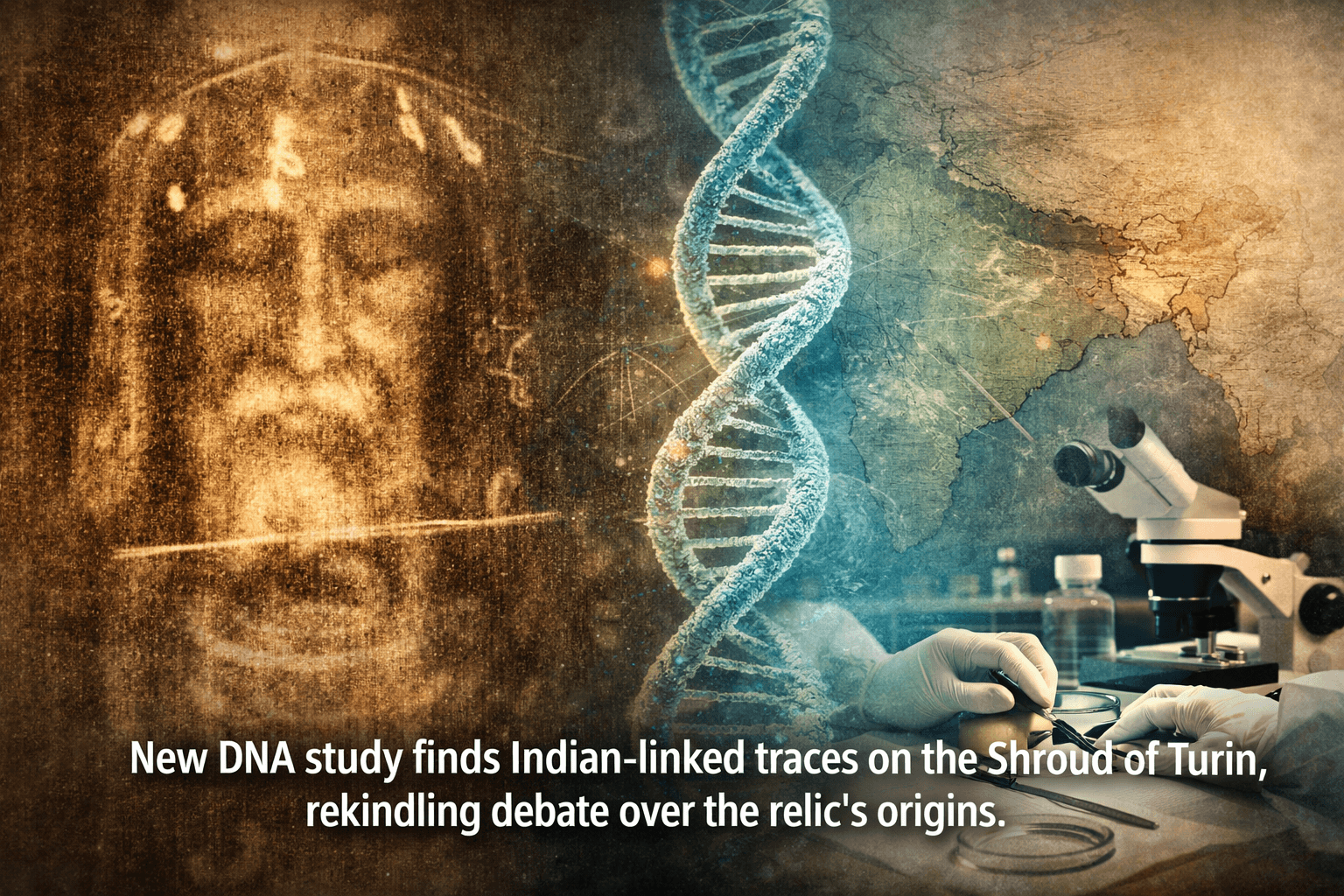
Shroud of Turin DNA Study Finds Indian-Linked Traces as Scientists Urge Caution.
A fresh wave of headlines has pushed the Shroud of Turin back into the global spotlight after a new DNA study reported human genetic traces linked in part to Indian lineages. That finding is intriguing, but it has also been widely overstated. The corrected picture is more careful: the new research does not prove that the Shroud of Turin was made in India, nor does it overturn the best-known radiocarbon dating results that placed the cloth in the medieval period. What it does show is that samples taken from the shroud carry a complex mixture of human, microbial, plant and animal DNA, consistent with centuries of handling, storage, movement and contamination.
The Shroud of Turin is a linen cloth associated by many believers with the burial of Jesus. It is housed in Turin, Italy, and has been the subject of scientific, religious and historical debate for decades. The cloth’s first secure historical appearance is in France in the mid-14th century, and it is now kept at the Cathedral of Saint John the Baptist in Turin.
The new study driving the latest discussion was posted on bioRxiv, which means it is a preprint and has not yet completed peer review. According to reports on the study, the research team led by Gianni Barcaccia at the University of Padova re-examined material collected from the shroud in 1978. The study found a broad mix of DNA from multiple sources, including several human mitochondrial lineages, microbes associated with skin and storage environments, and traces from plants and animals.
That broad mix is the first important correction to the more sensational versions of this story. The study does not identify one clean, original human genetic profile from the cloth. In fact, the researchers themselves say the opposite: the mixed DNA signatures indicate contact with multiple individuals and make it impossible to isolate any single “original” DNA source from the shroud. One lineage reportedly matched the 1978 collector, which strongly suggests that at least part of the genetic signal comes from modern handling during sampling and preservation.
The most widely repeated claim from the new reporting is that nearly 40% of the human DNA found on the cloth is linked to Indian lineages. That is the part that generated headlines about a possible Indian origin. But the proper interpretation is narrower. The study’s authors and subsequent reports frame this as a possibility, not a conclusion. The Indian-linked traces may reflect one of several scenarios: the yarn or textile may have had links to trade networks reaching India, the cloth may have been handled by people of Indian ancestry over the centuries, or the DNA may simply reflect accumulated contamination from many historical contacts. None of those possibilities, on their own, proves where the cloth was woven.
That distinction matters because the new DNA work is about traces on the cloth, not a direct dating of the main linen itself. The most cited age estimate for the Shroud of Turin still comes from the 1988 radiocarbon dating carried out by laboratories at Arizona, Oxford and Zurich. Their results, published in Nature, concluded that the linen dated to AD 1260–1390, which the paper described as conclusive evidence that the cloth was medieval.
This is the second major fact-check point. The new DNA study does not invalidate that radiocarbon result. There have been later statistical critiques and continuing debate over whether the tested sample perfectly represented the whole cloth, but there has been no accepted scientific reversal of the medieval radiocarbon range. Even reviews that revisit the data do not amount to a definitive re-dating of the shroud to the time of Jesus.
So where does that leave the story? The most defensible reading is that the shroud contains biological evidence of a long and messy material history. According to reporting on the new paper, the researchers found DNA associated with Western Eurasian, Near Eastern and Indian-linked human lineages. They also detected bacteria commonly associated with human skin, along with fungi, archaea and other microbes that can survive dry or salty environments. In addition, they found plant and animal traces, including DNA linked to domesticated species and cultivated plants. Taken together, that points less to one neat origin story and more to a cloth that has been touched, stored, moved, repaired and exposed repeatedly across different environments.
Some articles have gone further and suggested that the shroud may have been “crafted in India.” That wording goes beyond what the available evidence supports. At most, the current reporting suggests that Indian-linked DNA raises the possibility of trade links, movement through the Mediterranean and perhaps long-distance textile exchange. Ancient and medieval trade routes did connect the Mediterranean world with South Asia, so that idea is historically plausible in a broad sense. But plausible is not the same as proven, and the present DNA data do not pin down the place of manufacture.
There is another reason for caution: the shroud has an extremely complicated conservation history. It has been displayed publicly, handled by clergy, researchers and conservators, damaged and repaired over the centuries, and stored in varying environments. The current official cathedral description emphasizes the cloth’s dimensions and preservation, while other historical records note repairs after fire damage. The more a relic has been exposed over time, the harder it becomes to treat surface DNA as a pure window into its first origin.
Read more on India’s Second Semi Conductor Plant.
Historically, the shroud’s documented trail also matters. The cloth’s first certain appearance is generally placed in Lirey, France, around the 1350s. That timing aligns closely with the 1260–1390 radiocarbon range published in Nature. This does not settle every question about the shroud, but it does explain why many historians and scientists still see the medieval-origin case as the strongest overall fit with the documentary record.
At the same time, believers and some researchers continue to argue that the shroud deserves further study. That debate has persisted for decades because the artifact sits at the intersection of science, faith and historical imagination. The image on the cloth, its religious significance and the unresolved arguments around testing methods all keep the subject alive. The new DNA paper adds another layer to that debate, but it does not settle it.
The more accurate conclusion is that the study contributes useful evidence about the cloth’s exposure history and contamination profile. It suggests the shroud interacted with multiple people and environments, and it raises the possibility of broader geographic connections, including Indian-linked genetic traces. But it cannot establish the cloth’s original place of manufacture or its age by itself.
For readers trying to separate fact from hype, the core facts are these. First, a new preprint DNA study reported mixed biological traces from the shroud, including human lineages with some Indian-linked signatures. Second, the researchers say the DNA is too mixed to identify a single original source. Third, the study has not yet been peer reviewed. Fourth, the widely cited 1988 radiocarbon dating that placed the linen in AD 1260–1390 still stands as the best-known direct age test of the cloth, even though aspects of that test continue to be debated.
That means the most responsible headline is not that the Shroud of Turin “has Indian origins,” but that a new DNA analysis found Indian-linked traces and reopened questions about the relic’s long journey. This is a story about complexity, not certainty. The shroud may preserve evidence of travel, trade, handling and contamination across centuries. What it does not yet provide is definitive proof of an Indian origin or a decisive scientific victory over the medieval dating evidence.
In the end, the Shroud of Turin remains what it has been for generations: one of the world’s most debated religious artifacts. The new DNA research makes the story richer, but not simpler. It gives scholars more material to investigate, while reminding readers that genetic traces found on a famous cloth are not the same thing as a final answer about where that cloth came from or whom it once touched. Until further peer-reviewed analysis and stronger corroborating evidence appear, the Indian-origin claim should be treated as an interesting hypothesis, not an established fact.