






India Census Controversy 2026: Why the Delayed Population Count Could Reshape Welfare, Representation and Caste Politics
India has finally begun its long-delayed national census, launching what is widely seen as the largest population-counting exercise in human history. The new count started on April 1, 2026, after the 2021 census was postponed because of the COVID-19 pandemic and other logistical hurdles. More than 3 million government workers are expected to take part over the course of the exercise, which will run into 2027 and combine traditional door-to-door enumeration with digital self-enumeration for the first time.
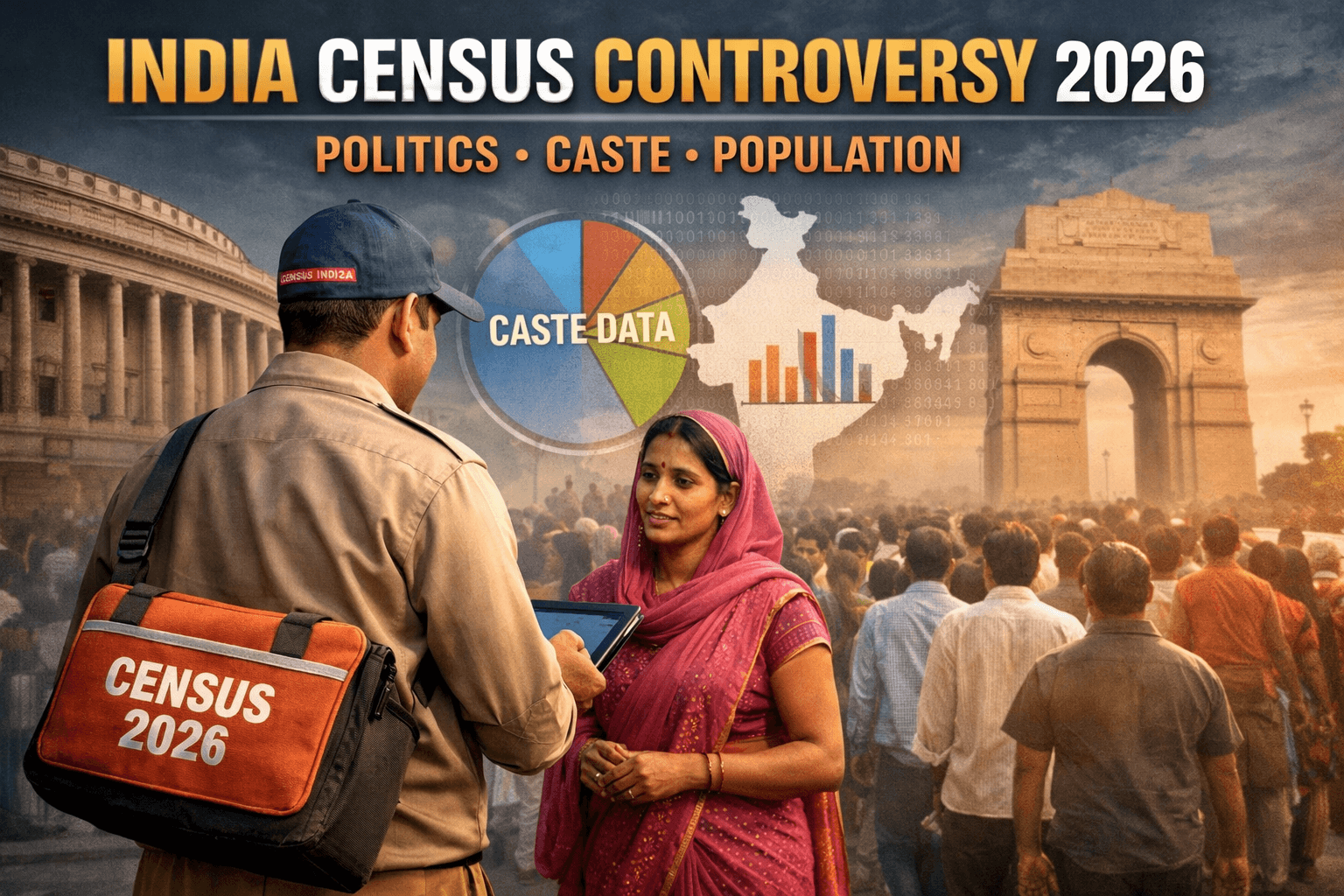
This is not just a statistical exercise. The India Census Controversy 2026 sits at the center of a much bigger national debate about caste, welfare, political power, women’s representation, and the future shape of India’s democracy. The census will influence how the government plans public services, how benefits are distributed, and potentially how parliamentary and assembly constituencies are adjusted in the years ahead.
India’s previous census was conducted in 2011, when the country’s population stood at about 1.21 billion. Since then, India has crossed 1.4 billion people and overtook China in 2023 to become the world’s most populous country, according to United Nations estimates. That makes the new count especially important: policymakers have been working for years with aging demographic baselines while India has undergone major economic, migration, and urban changes.
The government says Census 2027, as the exercise is officially being referred to, will take place in two phases. Phase I covers house listing and housing conditions, while Phase II will collect population-level social and economic details. The Press Information Bureau said the census will, for the first time, be conducted digitally and will also offer a self-enumeration facility through a secure web-based system available in 16 languages. Enumerators will use mobile apps, and digital mapping tools will help manage fieldwork.
That modernization sounds straightforward on paper, but the politics surrounding the census are anything but simple.
The main reason the India Census Controversy 2026 has become so intense is the issue of caste. India has long counted Scheduled Castes and Scheduled Tribes in its post-Independence censuses because those categories are central to affirmative-action policies and welfare entitlements. But a broader caste count across the population has remained deeply contested. According to AP and Al Jazeera, the last attempt to gather detailed caste information through a census dates back to 1931 under British rule, while post-1951 Indian censuses largely avoided a full caste enumeration beyond SCs and STs.
This is where fact-checking matters. Some reports loosely state that India “recorded castes in 2011,” but that requires context. In 2011, the government conducted the Socio Economic and Caste Census (SECC), a separate exercise coordinated outside the regular Census of India framework. The SECC gathered socio-economic and caste-related data, but the caste component was not fully released publicly because of concerns over data quality and classification. So while India did attempt caste data collection in 2011, it was not the same as saying the regular decennial census had fully and cleanly resumed a nationwide caste count.
That distinction helps explain why the current census has become so politically charged. Supporters of a fuller caste count argue that India cannot design fair welfare systems, reservation policies, or development interventions without updated data on the actual size and condition of different caste groups. Critics, however, say caste enumeration can sharpen identity politics, deepen social divisions, and encourage competitive demands for quotas and benefits. Reuters reported that supporters stress the need for accurate data on those who deserve government assistance, while critics argue caste has no place in a country that wants to project itself as a major modern power.
The political timing matters too. Reuters reported in April 2025 that India’s cabinet had approved including caste details in the delayed census, with the issue carrying particular significance ahead of key state politics, including Bihar, where caste plays an outsized electoral role. Information Minister Ashwini Vaishnaw said at the time that bringing caste into the official census would create more transparency than relying on state-level surveys conducted with differing methods.
In other words, the controversy is not only about whether caste should be counted. It is also about who gets to count it, how the data are classified, and how that information may be used later.
The census matters enormously because population data underpins welfare delivery. Government planning for housing, food support, infrastructure, education, and public health depends on reliable household and demographic information. AP noted that census data could reshape welfare programs and public policy across the country. Al Jazeera likewise noted that census figures feed the distribution of government welfare programmes and a wide range of state policy decisions.
The delay from 2021 to 2026 also created a serious information gap. India has changed rapidly over the last 15 years: cities have expanded, migration patterns have shifted, and household living conditions have evolved. The lack of a fresh census means governments, researchers, and planners have often been forced to rely on projections rather than updated official counts. Al Jazeera highlighted that the delay left India without current demographic information at a time of rapid economic and political change.
Another reason the India Census Controversy 2026 matters is representation. Census data can eventually shape delimitation, the process through which constituencies are redrawn or parliamentary and assembly seats are adjusted to reflect population changes. AP reported that the new count could lead to a redrawing of India’s political map and possibly an increase in seats in the Lok Sabha and state legislatures. That matters because seat changes can alter the balance of political influence among states.
This also intersects with women’s political representation. India’s 2023 women’s reservation law provides for reserving one-third of seats in the Lok Sabha and state assemblies for women, but the law’s implementation is linked to a post-enactment census and subsequent delimitation. PRS Legislative Research notes that the reservation becomes effective after the census conducted after the law’s commencement is published, and delimitation is then to be undertaken on that basis. So the census is not just a demographic exercise; it is one of the triggers for a major structural change in representative politics.
The digital shift is another major theme. The government has said self-enumeration will be available online, respondents can enter their details before the enumerator’s visit, and enumerators themselves will use smartphone apps for data collection. The official PIB release also says security provisions have been put in place and that self-enumeration will be available in 16 languages.
This is a big administrative leap, but it comes with questions. Digital systems can improve speed, monitoring, and standardization, but India’s uneven levels of digital access and literacy could still pose challenges. The government appears to have anticipated that concern by keeping door-to-door enumeration in place even while offering self-enumeration as an additional option rather than a replacement.
For many observers, the controversy around the census reflects an old Indian tension: whether social inequalities are best addressed by naming them more precisely or by trying to move beyond identity categories in public policy. The caste question sits at the heart of that tension. One side sees data as the path to justice. The other sees it as the risk of entrenching old fault lines even further. Reuters, AP, and Al Jazeera all point to this same divide, even if they frame it differently.
There is also a federal dimension to the debate. Faster-growing states may eventually argue for representation more closely aligned to current population. Slower-growing states, especially those that have invested heavily in family planning and social development, worry that a population-linked redistribution of seats could reduce their relative clout. While the exact political outcomes will depend on later decisions, the census is the foundational dataset that will inform those future battles.
So why has this population count become so controversial? Because it arrives at the intersection of nearly every sensitive question in Indian public life: who is counted, which identities matter, who receives benefits, how representation is distributed, and what kind of nation India wants to present itself as becoming.
The facts are clear on the broad outline. India’s census was due in 2021 but was delayed. It began on April 1, 2026. It is being conducted in two phases. It is digital for the first time. It includes a politically sensitive caste component. It will influence welfare planning and may shape future delimitation and women’s representation. And it is happening in a country that now has more than 1.4 billion people and no recent full census benchmark since 2011.
That is why the India Census Controversy 2026 is not merely about counting people. It is about counting power, identity, need, and legitimacy in the world’s largest democracy.