





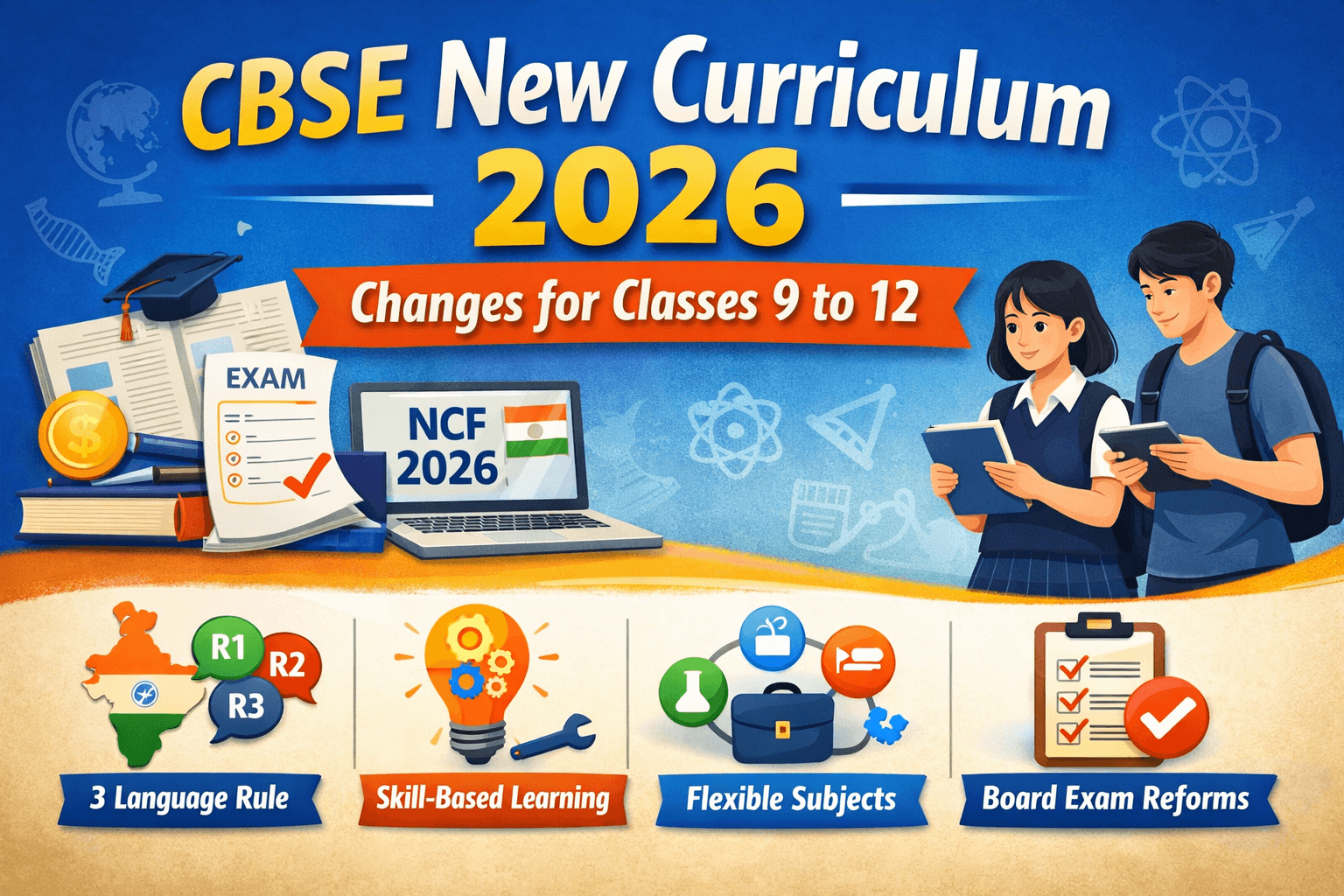
CBSE New Curriculum 2026 brings phased changes for Classes 9 to 12 with focus on languages, skills, flexibility and competency-based learning
The CBSE New Curriculum 2026 marks an important shift in India’s school education system, especially for students in Classes 9 to 12. The Central Board of Secondary Education has released the curriculum for the 2026–27 academic session for Classes XI and XII on April 1, 2026, and for Classes IX and X on April 2, 2026. CBSE has also made it clear that the new framework is aligned with the National Curriculum Framework for School Education (NCF-SE) 2023, with a strong focus on competency-based education, experiential learning, flexibility and holistic development.
For students, parents and schools, the biggest takeaway is this: the reforms are real, but they are also phased. The most visible structural changes are beginning with Class IX in 2026–27, while the revised Class X curriculum is slated to follow in 2027–28. That means not every headline about sweeping change applies equally to every class right away.
This matters because a lot of online summaries have mixed official policy, early reporting and broad NEP-era expectations into one list. A careful reading of the current CBSE release shows that the board is indeed changing how students learn and how schools organise studies, but the rollout is being done step by step rather than all at once.
What is the CBSE New Curriculum 2026?
At its core, the CBSE New Curriculum 2026 is part of a larger transition toward the goals laid out in NEP 2020 and NCF-SE 2023. CBSE says the curriculum is designed to move learning away from narrow memorisation and toward understanding, application, inquiry and real-life connection. In the official circular announcing the curriculum release, the board says the new framework focuses on competency-based education, experiential learning, flexibility and holistic development of learners.
That language is not just symbolic. Subject documents released for the new session show a clear academic direction. For example, the new Class IX Mathematics introduction says the syllabus has been redesigned to prioritise deep conceptual understanding, logical reasoning, problem-solving, visualisation and mathematical modelling. The Class IX Science curriculum similarly stresses observation, questioning, hypothesis testing, evidence-based thinking and decision-making. In Social Science, the board explicitly talks about inquiry, interpretation, analysis, democratic values and connecting learning with lived realities.
In simple terms, the curriculum is being repositioned to make students think more, connect more and apply more.
The biggest confirmed change is in Class 9
One of the most important points often missed in quick summaries is that Class IX is where the new NCF-based scheme of studies is beginning from 2026–27. CBSE’s official circular says that the board is implementing the scheme of studies recommended in NCF-2023 in Class IX from this year, which is why the secondary curriculum release for Classes IX and X was handled separately.
Reports based on the new curriculum documents indicate that the revised Class 10 curriculum will be implemented from 2027–28, which means Class 9 students are the first cohort to directly enter the restructured secondary framework this year.
This phased approach is important for schools because it affects textbooks, subject combinations, teaching style and planning. It also means families should not assume that every feature discussed under the “new curriculum” will immediately look identical across Classes 9, 10, 11 and 12 in the same academic year.
Three-language structure is now central in secondary classes
One of the most talked-about changes under the CBSE New Curriculum 2026 is the clearer emphasis on the three-language structure in secondary school. Search snippets from CBSE’s new secondary curriculum indicate that students in Classes IX and X will study three languages, and reporting around the rollout explains that these are being organised as R1, R2 and R3 under the new framework.
Economic Times reported that students will now need to pass all three languages by the time they are in Classes 9 and 10, marking a stricter and more structured implementation of multilingual learning under the new curriculum framework. The same reporting notes that the third language becomes mandatory earlier in the school journey, feeding into the structure students carry into secondary grades.
This does not simply mean “more language burden.” The official and reported intent is to promote multilingual proficiency, linguistic diversity, cognitive growth and stronger communication skills. For students, however, it also means language choices will matter more strategically than before.
New subject architecture goes beyond old textbook silos
The restructured secondary curriculum also shows that CBSE is rethinking education through broader learning areas rather than only through traditional subject silos. Reporting on the new Class 9 curriculum says the framework is organised into eight broad areas: languages, mathematics, science, social science, art education, physical education and well-being, vocational education, and interdisciplinary areas.
That broader architecture can already be seen in individual subject documents. Social Science now places heavier emphasis on ethical reasoning, citizenship, constitutional values and evidence-based analysis. Mathematics puts stronger weight on conceptual understanding and modelling. Science is framed around inquiry and real-life issues such as health and the environment.
Another notable change signalled in the secondary curriculum is the introduction of “Individual in Society” in Class IX from 2026–27, while “Environmental Education” is set to be implemented in Class X from 2027–28. That suggests the new framework is trying to give greater curricular space to social awareness and environmental understanding, rather than leaving them as peripheral topics.
What changes for Classes 11 and 12?
For Classes XI and XII, CBSE has already released the 2026–27 curriculum, but the current material does not suggest one dramatic single-format overhaul comparable to the secondary-stage restructuring in Class IX this year. Instead, the senior secondary curriculum continues to reflect an emphasis on subject continuity, flexibility within subject groups, skill education and multidisciplinary thinking.
CBSE’s senior secondary framework allows students to take a minimum of five subjects, with room for an additional sixth subject, and permits combinations drawn from languages, academic electives and skill subjects. The board’s curriculum materials also continue to emphasise ICT, practical learning and employability-oriented courses across multiple streams.
In subjects like Physics, Biology and Accountancy, the newly published 2026–27 curriculum documents continue to foreground conceptual competence, problem solving, links with real-world applications and, in some cases, stronger integration of technology and contemporary knowledge areas.
So for Classes 11 and 12, the story is less about a sudden one-line rule change and more about a curriculum that continues to evolve in the direction of application, interdisciplinarity and career relevance.
Class 10 board exam reform is real, but it is separate from the curriculum release
Another major area of confusion online is the link between curriculum reform and board exam reform. These are related, but they are not the same thing.
CBSE has already moved ahead with the policy of two board examinations for Class X from 2026. Official documents show that the board notified this earlier, and a February 2026 clarification states that it is mandatory for all students to appear in the first board examination. The second examination is not an alternative first attempt for everyone; it is meant for improvement in up to three main subjects and for eligible compartment cases under the board’s rules. Students who miss three or more subjects in the first examination are not allowed to use the second exam as a substitute route and are placed in the “Essential Repeat” category.
That means any summary claiming that Class 10 students can casually choose either of two full board attempts without conditions is inaccurate. The two-exam policy is real, but the rules are specific and structured.
Read more on Randy George position being taken.
What the reforms actually mean for students and parents
The CBSE New Curriculum 2026 is best understood not as one sudden rewrite of everything, but as a serious educational transition now becoming visible in official school practice. The confirmed direction is clear: less rote dependence, more conceptual understanding; less rigidity, more flexibility; less isolation of subjects, more real-world connection.
For students in Class 9, this year is especially important because they are entering the first phase of the new secondary structure. For Class 10, board examination reform is already in effect from 2026, with defined rules for improvement and second attempts. For Classes 11 and 12, the newly released curriculum continues the board’s shift toward broader competencies, skill orientation and flexible subject architecture.
For parents, the practical message is simple: focus less on memorisation-heavy preparation and more on helping students build understanding, language strength, analytical thinking and consistency across subjects. For schools, the challenge will be implementation. CBSE itself has asked heads of institutions to sensitise teachers and organise special parent-teacher meetings so that the curriculum changes are understood and implemented effectively from the start of the academic session.
Conclusion
The CBSE New Curriculum 2026 does bring meaningful changes for Classes 9 to 12, but the most accurate way to describe it is as a phased reform rather than a one-day revolution. The biggest structural shift begins with Class IX in 2026–27, backed by a new NCF-aligned scheme of studies, a stronger three-language structure, broader curricular areas and a clear move toward competency-based learning. Class X follows in the next phase, while Classes XI and XII continue under newly released curricula that reinforce flexibility, skills and application-oriented learning.
In other words, CBSE is not just changing chapters. It is gradually changing the logic of school education itself.