







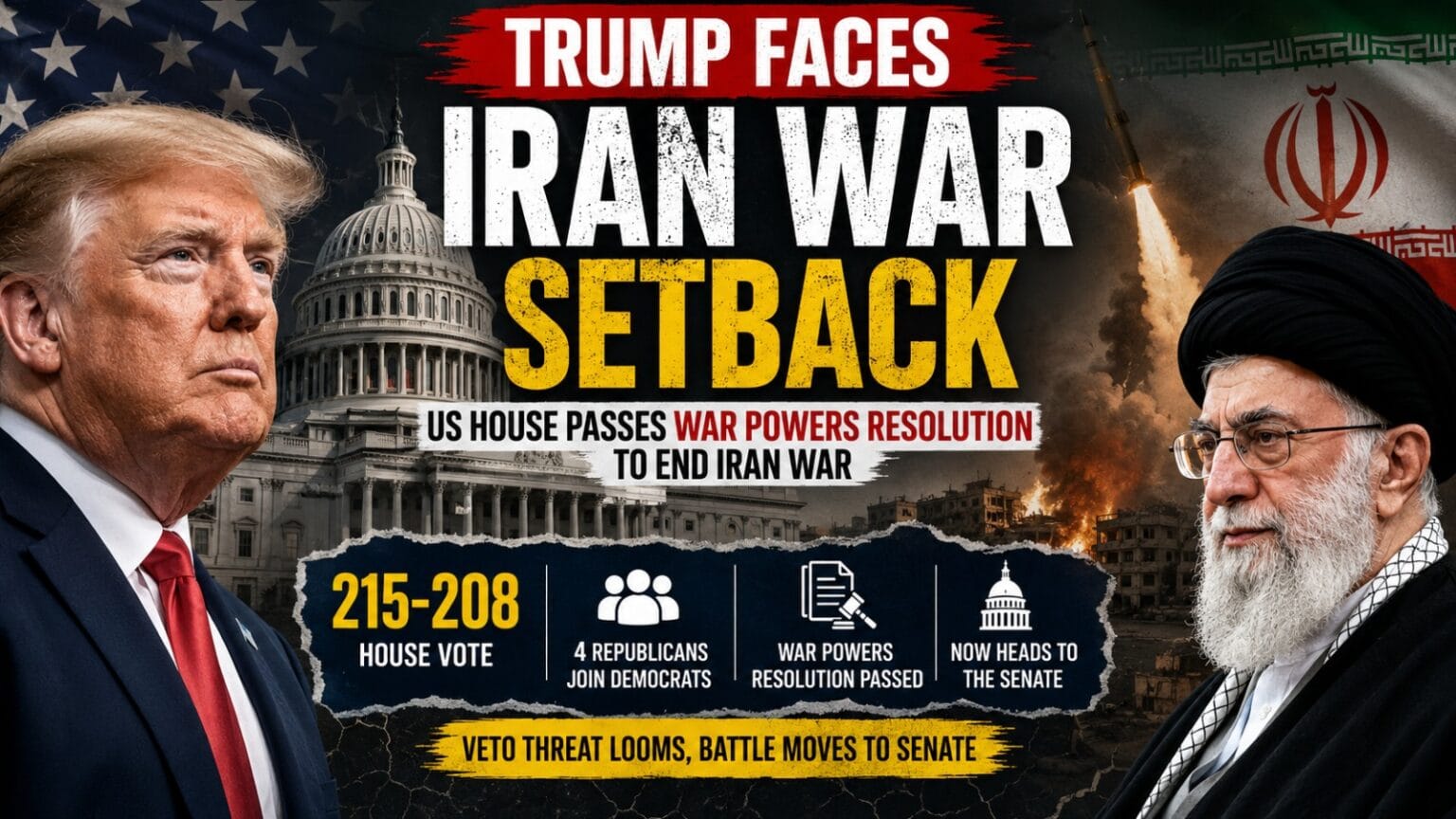
In a major political blow to US President Donald Trump, the US House of Representatives has passed a War Powers Resolution aimed at ending American military involvement in the Iran war. The resolution passed by a narrow 215–208 vote, with four Republicans joining Democrats to support the measure. The move now sends the resolution to the Senate, although Trump is expected to veto it if it reaches his desk.
The vote is important because it marks the first time the Republican-controlled House has approved a measure seeking to force Trump to wind down military operations against Iran since the conflict began around three months ago. NDTV, citing AFP, described the resolution as largely symbolic but politically significant because it challenges Trump’s authority to continue military action without congressional approval.
The development comes at a sensitive moment. The Trump administration has insisted that the war against Iran is already over, while lawmakers argue that the US military posture and involvement still require congressional oversight. This has revived one of Washington’s oldest constitutional debates: who has the power to take America to war — the president or Congress?
What Exactly Happened?
On Wednesday, June 3, 2026, the US House of Representatives approved a resolution ordering the withdrawal of American troops from the Iran war. The measure passed 215–208, with four members of Trump’s Republican Party crossing the aisle to vote with Democrats.
The resolution was introduced under the War Powers framework, which is designed to limit a president’s ability to continue military operations without approval from Congress. The measure now heads to the Senate, where its future remains uncertain. Even if the Senate passes it, Trump can veto the resolution. Overriding that veto would require a two-thirds majority in both chambers of Congress, which is currently unlikely.
Still, the vote sends a strong political message. For Trump, the challenge is not only legal but also political. A handful of Republicans publicly breaking with him on war powers suggests growing discomfort within his own party over the Iran conflict.
Why Is This a Setback for Trump?
This is a setback for Trump because the House vote challenges his authority as commander-in-chief and signals that even some Republicans are uncomfortable with the continuation of military action against Iran.
The vote does not immediately end the war. But politically, it shows that Trump’s Iran strategy is facing resistance inside Congress. According to Reuters, the resolution mandates withdrawal of US troops from Iran unless Congress authorizes military action.
Democrats framed the vote as a message from the American people. The House Foreign Affairs Committee Democrats called it a “loud and unambiguous message” to Trump that it was time to end what they described as an unpopular and illegal war of choice.
For a president who often projects strength through military decisiveness, a congressional vote to limit his war powers is a visible political embarrassment. It also gives Democrats and anti-war Republicans a fresh platform to question the legality, cost and purpose of the Iran campaign.
What Is the War Powers Resolution?
The War Powers Resolution of 1973 was created after the Vietnam War to prevent US presidents from engaging in prolonged military conflicts without Congress. Under this law, the president must notify Congress within 48 hours of introducing US forces into hostilities. The president can continue military action for 60 days without congressional authorization, followed by a 30-day withdrawal period.
The purpose of the law is simple: the president can respond quickly to emergencies, but long-term war requires congressional approval.
In the Iran case, the dispute is over whether Trump’s military actions still count as ongoing hostilities. The administration says the war is already over or that hostilities have effectively ended. Critics argue that continued military presence, operations, threats and regional escalation mean Congress still has a constitutional role to play.
Why Did Congress Act Now?
Congress acted because frustration over the Iran war has been building for months. Lawmakers have questioned whether the administration had proper legal authorization for military action. There is also concern that continued involvement could drag the United States deeper into a wider Middle East conflict.
According to AP, the vote marked a bipartisan rebuke of Trump’s handling of the war and came amid public discontent over rising gas prices and broader economic pressure linked to the conflict.
The timing is also important because US-Iran tensions remain fragile despite talk of ceasefire and negotiations. The House vote gives Congress a way to reassert its authority before the conflict expands again.
What Role Did Republicans Play?
The resolution passed because four Republicans joined Democrats. That matters because the House is Republican-controlled. Without Republican defectors, the measure would likely have failed.
This does not mean Trump has lost control of his party. Most Republicans still opposed the resolution. But the fact that even a small number of GOP lawmakers backed it is politically meaningful. It shows that war powers, foreign intervention and the cost of military conflict remain sensitive issues within the Republican base.
Some Republicans have long argued that presidents from both parties have stretched war powers too far. For them, the Iran vote is not only about Trump. It is about restoring Congress’s constitutional role in authorizing war.
Is the Resolution Legally Binding?
The resolution is not immediately binding in a practical sense because it still needs Senate approval and could face Trump’s veto. NDTV noted that the measure is largely symbolic for now because the president can veto it if it clears the Senate.
However, symbolic does not mean meaningless.
A House-approved War Powers Resolution creates political pressure, shapes public debate, and strengthens legal and constitutional arguments against unauthorized military action. It also forces the Senate to take a position.
If the Senate passes a similar measure, Trump would face a direct institutional challenge from Congress. If he vetoes it, Democrats and anti-war Republicans can argue that he is ignoring constitutional limits on presidential power.
Also read – Russia’s Cancer Vaccine: Everything you need to know
What Is Trump’s Position?
The Trump administration has insisted that the war against Iran is already over. This is a key part of the White House’s argument. If the war is over, then, in the administration’s view, the War Powers Resolution may no longer apply in the same way.
But critics say the administration is trying to have it both ways: claiming the war is over legally while maintaining military leverage and pressure in the region.
The White House has argued that military action was necessary to stop Iran from developing nuclear weapons and to protect US interests. Supporters of Trump’s position believe Congress limiting his military authority could weaken America’s bargaining power with Tehran.
What Is the Iran War About?
The current Iran conflict reportedly began around three months ago after US-Israeli military action against Iran. Since then, tensions have involved strikes, ceasefire claims, missile threats, oil market concerns and broader regional instability. AP reported that the war began with joint US-Israel strikes on February 28, 2026, and that a ceasefire was declared in April, though tensions have remained high.
Iran is central to multiple regional flashpoints, including Israel’s security concerns, the nuclear program dispute, Hezbollah in Lebanon, shipping routes in the Strait of Hormuz, and broader US influence in the Middle East.
That is why any US-Iran conflict has global consequences. It affects oil prices, shipping routes, regional alliances, military deployments and domestic politics in the United States.
Why the Strait of Hormuz Matters
One of the biggest fears around any Iran conflict is disruption in the Strait of Hormuz, one of the world’s most important oil transit routes. AP reported that concerns persist over international security and Iran’s disruption of shipping through this crucial passage.
If the conflict escalates around the Strait of Hormuz, global oil prices could rise sharply. That would affect fuel prices, inflation and political pressure on governments worldwide.
This is one reason some lawmakers want to limit Trump’s military options. They fear that one wrong move could trigger a broader economic and military crisis.
Why This Matters for US-Iran Diplomacy
The House vote comes while diplomatic talks around Iran are reportedly still in play. According to NDTV’s earlier live coverage, Iran was reviewing a proposed agreement with the United States to halt the war, while Trump had said talks were continuing.
A War Powers Resolution could affect these negotiations in two ways.
On one hand, it could signal to Iran that Trump faces domestic pressure and may not have unlimited room to escalate militarily. This could encourage diplomacy.
On the other hand, Trump’s supporters may argue that congressional restrictions weaken US leverage by making Iran believe Washington is divided.
This is the core strategic debate: does limiting war powers prevent escalation, or does it reduce America’s negotiating strength?
Why Democrats Supported the Resolution
Democrats supported the resolution because they argue Trump did not have congressional authorization for the war. They also say the war is unpopular, costly and constitutionally questionable.
For Democrats, the vote allows them to position themselves as defenders of congressional authority and critics of unchecked executive power. It also gives them a strong political issue ahead of future elections, especially if the Iran conflict continues to affect gas prices, inflation or military risk.
The Democratic argument is simple: no president should be allowed to conduct a prolonged war without Congress.
Why Most Republicans Opposed It
Most Republicans opposed the resolution because they support Trump’s authority to act against Iran. Many believe Iran remains a serious security threat and that limiting presidential power during a crisis could endanger US interests.
Trump-aligned Republicans may also see the resolution as a political move by Democrats to weaken the president. They argue that the commander-in-chief must have flexibility, especially in a volatile region.
This divide reflects a broader Republican split between traditional hawks, Trump loyalists, and anti-intervention conservatives who want fewer foreign wars.
Could This End the Iran War?
Not immediately.
The resolution still needs Senate approval. Even if it passes the Senate, Trump can veto it. Overriding a presidential veto would require a two-thirds vote in both the House and Senate, which appears unlikely at the moment.
However, the vote could still influence policy. It increases pressure on the White House to clarify the legal basis for military operations. It may push the administration toward diplomacy. It could also make lawmakers more willing to block funding, demand briefings, or attach restrictions to future defense bills.
So, while the resolution may not end the war immediately, it could slow escalation and reshape the political conversation.
What Happens Next?
The resolution now goes to the Senate. If the Senate takes it up and passes it, the measure will reach Trump’s desk. At that point, Trump is expected to veto it. If he does, Congress would need a two-thirds majority to override him.
The more immediate question is whether the Senate vote creates more bipartisan pressure. Al Jazeera reported in May that the Senate had already advanced a War Powers Resolution aimed at preventing Trump from using military force against Iran without congressional authorization, with some Republicans joining Democrats.
That suggests the House vote is not isolated. There is a broader congressional effort to curb Trump’s Iran war powers.
Why This Matters Globally
The House vote matters far beyond Washington. It affects Iran, Israel, Lebanon, oil markets, Europe, India and the wider Middle East.
For Iran, the vote shows that Trump is facing domestic political pressure. For Israel, it may raise questions about how much military backing the US can guarantee if Congress pushes back. For global markets, it may be seen as a possible step toward de-escalation. For America’s allies, it shows that US foreign policy remains divided between presidential power and congressional oversight.
For countries like India, the Iran war matters because any disruption in West Asia can affect oil prices, shipping costs, trade routes and diaspora safety.
Bigger Picture: A Constitutional Fight Over War
This is not only about Iran. It is about the long-running struggle between the White House and Congress over who controls war-making power.
The US Constitution gives Congress the power to declare war, while the president is commander-in-chief. Over decades, presidents have expanded their ability to use military force without formal declarations of war. The War Powers Resolution was designed to correct that imbalance, but presidents from both parties have often challenged or bypassed its limits.
Trump’s Iran conflict has brought this debate back to the centre of American politics. The House vote is a reminder that even in a deeply polarised Congress, war powers can still create unusual alliances.
Political Impact on Trump
Politically, the vote gives Trump’s opponents a clear talking point: even members of his own party are questioning his Iran war policy.
The impact may grow if the conflict continues, if US troops face casualties, if oil prices rise, or if negotiations with Iran fail. At the same time, Trump could use the vote to rally his base by claiming that Congress is undermining national security.
That means the war powers fight could become a major campaign issue, especially if the Iran conflict remains unresolved.
Conclusion
The US House passing a War Powers Resolution to end the Iran war is a serious political setback for Donald Trump. The resolution may be largely symbolic for now, but it sends a clear message: Congress is no longer willing to give the president unlimited space on Iran.
The measure challenges Trump’s authority, exposes Republican unease, strengthens Democratic criticism, and places the Senate under pressure to act. It also raises deeper questions about America’s role in the Middle East, the future of US-Iran diplomacy, and the constitutional balance between presidential power and congressional oversight.
For now, the resolution may not immediately end the Iran war. But it has changed the political battlefield.
The Trump Iran war setback is not just about one vote. It is about whether the United States continues to allow presidents to wage war first and seek approval later.
Subscribe to our YouTube Channel The Logic Stick for more video insights