







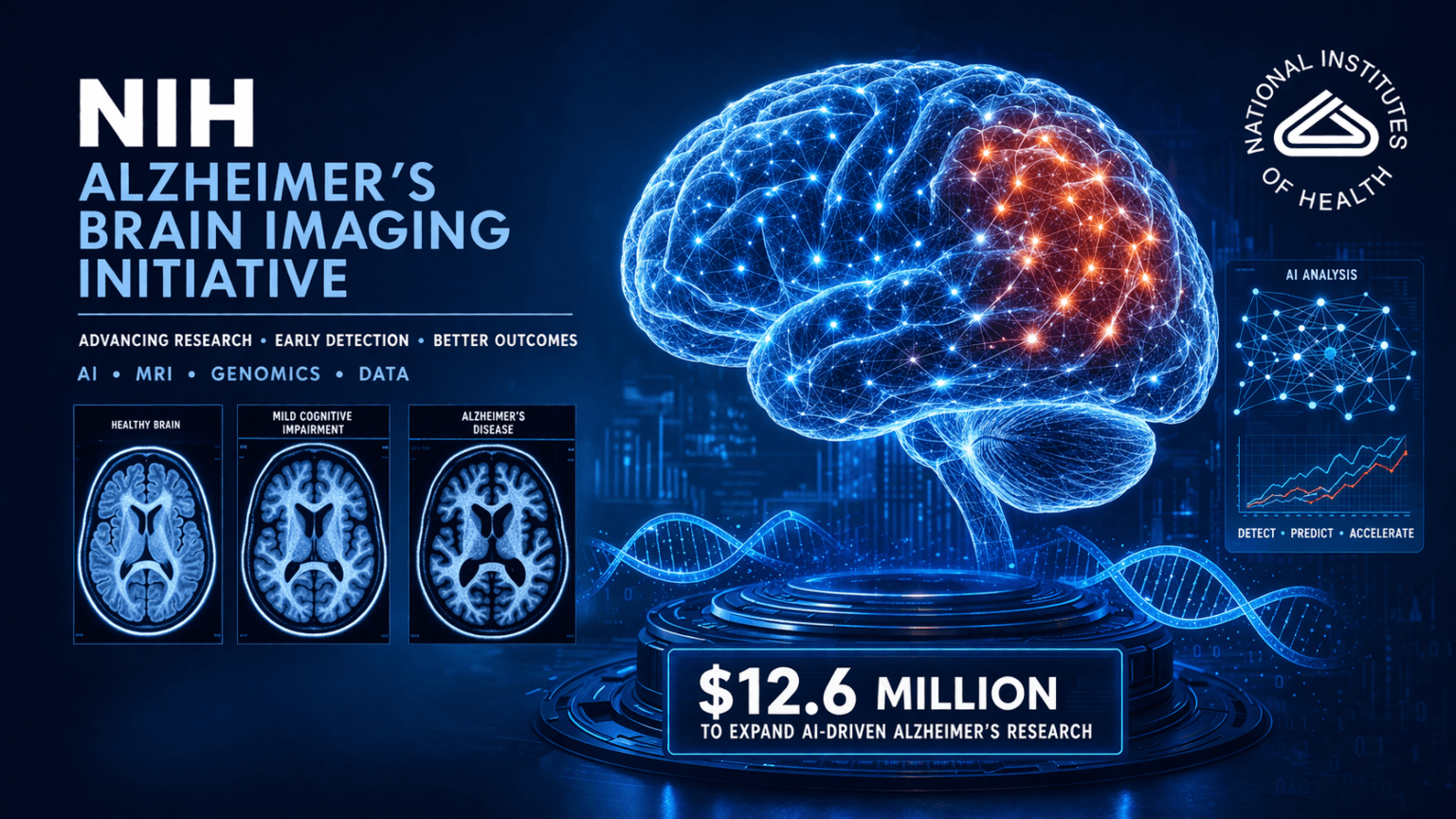
NIH Expands Alzheimer’s Brain Imaging Initiative with $12.6 Million Funding Boost
The National Institutes of Health (NIH) has awarded $12.6 million to expand a major research effort focused on Alzheimer’s disease, with a strong emphasis on brain imaging and artificial intelligence (AI). The funding supports the next phase of the Artificial Intelligence for Alzheimer’s Disease (AI4AD2) initiative, aimed at improving early detection, understanding disease progression, and advancing precision treatment strategies.
This initiative reflects a broader global push to integrate neuroimaging, genomics, and AI-driven analytics to tackle one of the most complex neurodegenerative diseases affecting millions worldwide.
What the $12.6 Million NIH Grant Actually Funds
The $12.6 million funding is allocated to continue and expand the AI4AD program, which was originally launched to apply AI techniques to Alzheimer’s-related data.
The AI4AD2 phase will focus on:
- Integrating brain imaging data (MRI and PET scans) with genetic and clinical datasets
- Improving AI models for disease prediction and classification
- Enhancing understanding of biological pathways involved in Alzheimer’s
- Supporting collaborative research across multiple institutions
Unlike some exaggerated claims circulating online, the funding is not for a single breakthrough cure, but rather for data-driven research infrastructure and model development.
Clarifying the Scope of the AI4AD Initiative
The AI4AD initiative is part of NIH-supported efforts to use machine learning and data science in Alzheimer’s research. It does not operate in isolation but complements existing programs such as:
- Alzheimer’s Disease Neuroimaging Initiative (ADNI)
- National Alzheimer’s Coordinating Center (NACC)
- Other NIH-funded longitudinal studies
The AI4AD2 expansion builds upon earlier work by:
- Refining AI models
- Expanding datasets
- Improving cross-cohort analysis
Key Research Goals of AI4AD2
1. Identifying Alzheimer’s Disease Subtypes
Researchers aim to use AI to classify Alzheimer’s into distinct biological or clinical subtypes.
This is important because:
- Alzheimer’s presents differently across patients
- Treatment response may vary significantly
- Personalized medicine depends on accurate classification
There is no confirmed universal subtype classification yet, but this initiative aims to move closer to that goal.
2. Integrating Genomic and Imaging Data
The project will combine genomic data with brain imaging datasets to better understand genetic influences on Alzheimer’s.
While reports mention large datasets, it is important to clarify:
- The research uses aggregated datasets from multiple cohorts
- Numbers like “tens of thousands of participants” refer to combined datasets, not a single controlled study
This integration may help identify:
- Genetic risk factors
- Disease progression markers
- Potential therapeutic targets
3. Expanding Data Diversity
A key focus of the initiative is improving representation in Alzheimer’s research.
Historically, many studies have been biased toward Western populations. The expansion includes:
- Data from underrepresented populations
- Greater inclusion across ethnic and geographic groups
However, it is important to note:
- This is an ongoing effort, not a completed dataset overhaul
- Representation gaps still exist in global research
4. Supporting AI-Based Drug Discovery Tools
The initiative will also support computational tools that assist in identifying potential drug targets.
Claims around platforms like PreSiBO should be interpreted carefully:
- These tools are research-stage systems
- They assist in hypothesis generation, not direct drug approval
- Clinical validation is still required
Role of Brain Imaging in Alzheimer’s Research
Brain imaging remains one of the most critical tools in Alzheimer’s research.
Techniques like MRI and PET scans help researchers:
- Detect structural brain changes
- Observe patterns of neurodegeneration
- Identify biomarkers such as amyloid plaques and tau proteins
However, it is important to clarify:
- Imaging alone cannot definitively diagnose Alzheimer’s
- Diagnosis typically involves a combination of clinical assessment, imaging, and biomarkers
The Role of AI: What Is Real vs Hype
Artificial intelligence is a powerful tool, but its capabilities are often overstated.
What AI Can Do:
- Analyze large datasets quickly
- Detect patterns in imaging and genetics
- Support predictive modeling
What AI Cannot Yet Do:
- Replace clinical diagnosis entirely
- Guarantee early detection in all patients
- Provide immediate cures or treatments
Earlier reports citing “90% accuracy” in AI detection should be interpreted cautiously:
- Accuracy varies depending on dataset and methodology
- Many models are still in experimental or validation phases
- Real-world clinical performance may differ
Read more on the Google Gemma-4 Launch.
Collaboration and Research Structure
The AI4AD2 initiative involves:
- Multiple research institutions
- Interdisciplinary teams including neurologists, radiologists, and AI experts
- Shared datasets and collaborative analysis frameworks
This collaborative approach is essential due to the complex and multifactorial nature of Alzheimer’s disease.
Why This Funding Matters
The NIH’s $12.6 million investment is significant, but its impact lies in long-term research advancement, not immediate clinical outcomes.
Key Benefits:
- Strengthens AI-driven research infrastructure
- Encourages data sharing across institutions
- Supports development of more accurate predictive models
- Improves understanding of disease variability
Current Challenges in Alzheimer’s Research
Despite advancements, several challenges remain:
1. Late Diagnosis
Most patients are diagnosed after symptoms appear, when brain damage has already progressed.
2. No Definitive Cure
Existing treatments only manage symptoms or slow progression.
3. Complex Disease Mechanisms
Alzheimer’s involves multiple biological pathways, including:
- Amyloid accumulation
- Tau pathology
- Neuroinflammation
4. Data Limitations
Even large datasets can have gaps in:
- Diversity
- Long-term tracking
- Standardization
Global Context: Why This Matters Beyond the U.S.
Alzheimer’s disease is a growing global concern.
- Millions of people worldwide are affected
- Aging populations in countries like India are increasing the burden
- Early detection and scalable diagnostic tools are urgently needed
The AI4AD2 initiative contributes to global research by:
- Promoting collaborative data sharing
- Encouraging inclusion of diverse populations
- Supporting scalable AI solutions
What This Means for Patients
While the initiative is still in the research phase, potential long-term benefits include:
- Earlier and more accurate diagnosis
- Better risk prediction
- More personalized treatment approaches
- Improved clinical trial design
However, patients should understand:
- These advancements will take time to translate into clinical practice
- Immediate changes in treatment protocols are unlikely
Future Outlook
The future of Alzheimer’s research lies in multi-disciplinary integration, combining:
- AI and machine learning
- Brain imaging technologies
- Genomics and biomarker research
The NIH’s continued investment signals confidence in this approach.
If successful, these efforts could lead to:
- Earlier detection methods
- More targeted therapies
- Improved patient outcomes
Conclusion
The NIH’s $12.6 million funding to expand the Alzheimer’s brain imaging initiative represents a meaningful step forward in research—but not a breakthrough cure.
The AI4AD2 program aims to harness artificial intelligence, brain imaging, and genetic data to better understand Alzheimer’s disease and improve diagnostic and treatment strategies over time.
While expectations should remain realistic, the initiative strengthens the foundation for future discoveries that could transform how Alzheimer’s is detected and managed globally.