






India-Iran Diplomatic Contact Amid Trump’s 48-Hour Threat: Why the Jaishankar-Araghchi Call Matters
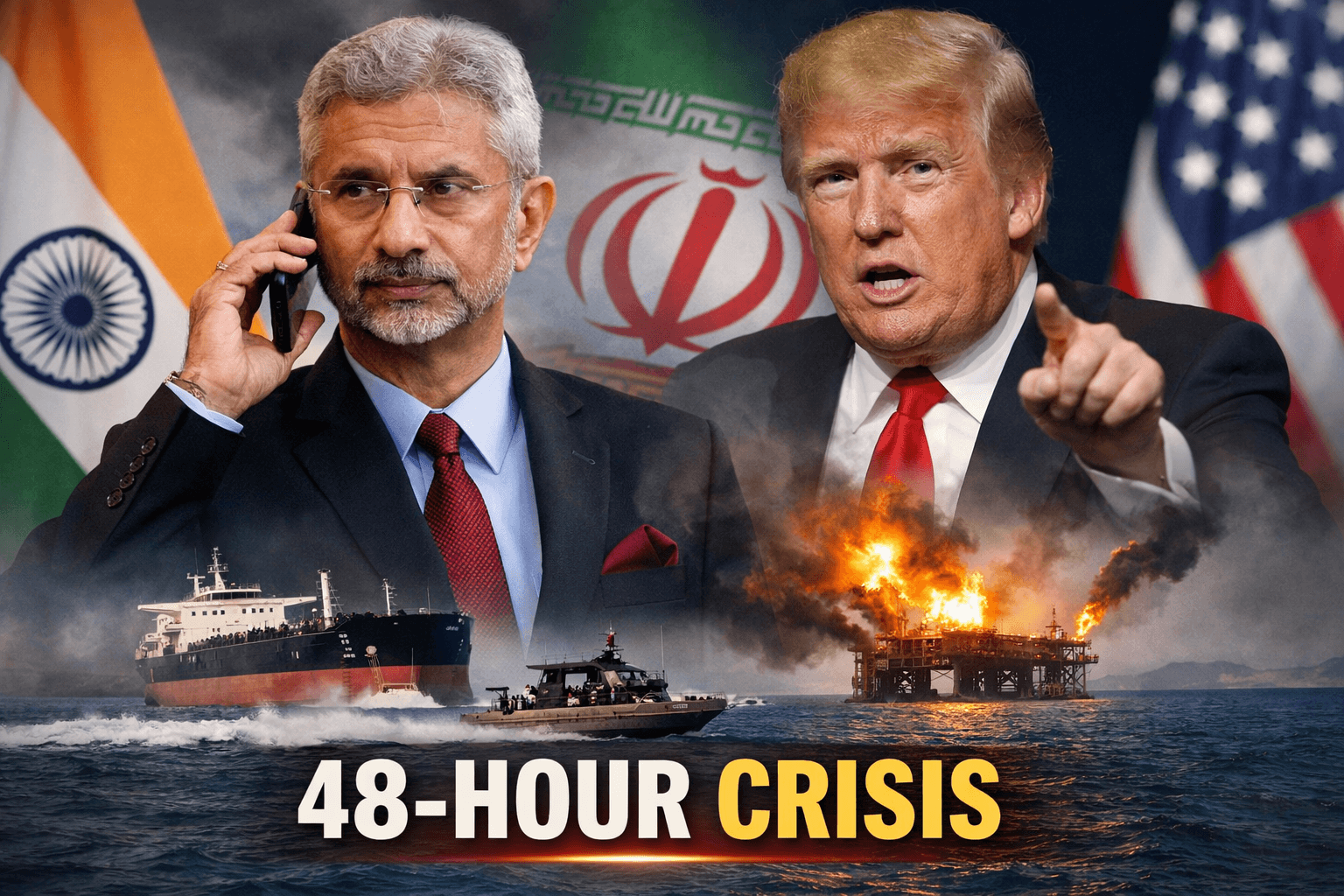
India’s External Affairs Minister S. Jaishankar received a phone call from Iranian Foreign Minister Abbas Araghchi on Sunday, April 5, 2026, as tensions around Iran, the United States and the Strait of Hormuz intensified sharply. The development came just as U.S. President Donald Trump escalated pressure on Tehran with a 48-hour warning linked to the reopening of the strategically vital waterway.
The call itself was brief in public description, but its timing made it significant. Jaishankar said on X that he had “received a call” from Araghchi and that they “discussed the present situation.” Iran’s embassy in India separately said the two foreign ministers discussed bilateral relations as well as regional and international developments. Those are the only publicly confirmed details of the conversation so far.
That matters because any interpretation beyond those confirmed statements would be speculation. There is, at this stage, no official public readout showing that India offered mediation, conveyed a formal warning, took a side, or proposed a specific diplomatic formula. What is clear is that New Delhi is staying in active contact with key actors as the regional crisis deepens.
What exactly happened
According to The Times of India, Jaishankar received the call from Araghchi on April 5. The report added that the Iranian embassy confirmed the contact and said the ministers discussed bilateral relations along with the regional and international situation. The same report also noted that Jaishankar had been in touch with other Middle Eastern leaders, including senior officials from the UAE and Qatar, though no detailed readouts of those conversations were released.
The Economic Times reported the same core development and placed it directly in the context of mounting tensions around the Strait of Hormuz, a route critical to global oil shipments and to India’s own energy security. That framing is important because India’s interest in this crisis is not abstract. Any disruption in the Gulf can quickly affect crude supply, freight costs and wider inflation risks.
Trump’s 48-hour threat: what is confirmed
A key correction to the earlier draft is this: the current reporting identifies Trump as U.S. President Donald Trump, not “former U.S. President Donald Trump.” Reuters and Associated Press both reported that Trump publicly warned Iran that the United States would target Iranian infrastructure if the Strait of Hormuz was not reopened within the stated time window. Reuters quoted Trump threatening action against power plants and bridges, while AP described the move as a 48-hour ultimatum tied to the strait.
Reuters reported on April 5 that Trump said the U.S. would target Iran’s infrastructure on Tuesday if the strait remained blocked, and also quoted him signaling that a deal might still be possible. That combination of coercive rhetoric and an opening for negotiations has shaped the diplomatic environment around the crisis.
Why the Strait of Hormuz is central to the story
The Strait of Hormuz is among the world’s most strategically important oil transit chokepoints. Reuters described it as a “key global oil transit route,” while AP called it a “critical” route whose disruption has raised fears over fuel prices and wider economic instability. For India, which depends heavily on imported crude, events in and around Hormuz are directly tied to energy security and macroeconomic stability.
That is why the Jaishankar-Araghchi call should be viewed less as a symbolic exchange and more as part of India’s crisis-monitoring diplomacy. India does not need to publicly declare mediation for the call to matter. In situations like this, maintaining direct channels with major regional players is itself a strategic act. That inference is supported by the timing and by India’s documented concern over developments in West Asia and Hormuz.
What India has officially said and what it has not
The verified public Indian position from the material available is narrow and careful. Jaishankar confirmed the call and said only that the “present situation” was discussed. There has been no official public statement in the cited reporting announcing a new Indian initiative, warning, or intervention plan.
That restraint is typical of high-stakes diplomacy. Publicly, New Delhi appears to be avoiding dramatic language while staying engaged with all relevant sides. This matters because India has relations across the region and has to protect multiple interests at once: energy supplies, shipping, regional stability, and the safety of Indian nationals and business links across West Asia. The energy-security part of that picture is directly supported by the Economic Times reporting on India’s stakes in the Strait of Hormuz.
Delhi High Court Decision on OpenAI vs ANI.
Why this call matters for India
The biggest reason is energy. A large share of India’s crude imports is exposed to Gulf shipping routes, and any long disruption in Hormuz can feed into higher landed costs, inflation pressure and policy complications for one of the world’s fastest-growing major economies. Reuters and AP both tied the crisis to global oil disruption concerns, and Indian reporting explicitly linked the situation to India’s strategic and economic interests.
The second reason is geopolitical balance. India has expanded strategic ties with the United States in recent years, while also maintaining working relations with Iran. In moments of crisis, that combination makes communication especially important. Even when India does not publicly frame itself as a mediator, it often seeks to preserve room for dialogue and avoid being boxed into zero-sum regional positioning. This is an inference from India’s pattern of engagement and the current round of calls, not a formally announced policy shift.
The third reason is regional spillover. If the Hormuz crisis worsens, the effects will not remain limited to Iran and the U.S. Shipping insurance, tanker routes, commodity prices and investor sentiment could all be affected. Reuters reported that U.S. intelligence assessed Iran was unlikely to ease its chokehold soon, underscoring how fragile the situation remains.
Separating confirmed facts from exaggeration
A number of claims circulating around the crisis deserve caution. It is confirmed that Trump issued the infrastructure threat and linked it to reopening the strait. It is confirmed that Jaishankar and Araghchi spoke. It is confirmed that Iran’s embassy said bilateral, regional and international developments were discussed.
What is not confirmed in the cited reporting is that India has launched formal mediation, that the Jaishankar-Araghchi call produced any breakthrough, or that New Delhi publicly endorsed either Washington’s coercive stance or Tehran’s response. Those additions would go beyond the available evidence. A publishable article has to keep that line clear.
The wider diplomatic picture
The call also fits into a broader pattern of urgent diplomatic contacts triggered by the worsening West Asia crisis. The Times of India report noted Jaishankar’s conversations with leaders from the UAE and Qatar before he disclosed the Iran call. That suggests India is working through multiple channels as tensions mount.
Meanwhile, Reuters reported that Trump paired his threat with remarks suggesting a deal was still possible. That is a crucial detail because it means the crisis has not yet moved entirely beyond diplomacy. Pressure and negotiations are unfolding at the same time. In that environment, every line of communication — including India-Iran contact — carries more weight than it might in calmer circumstances.
What happens next
In the immediate term, the most important variable is whether the standoff over the Strait of Hormuz eases or deepens. If the shipping route remains restricted, markets are likely to stay nervous and governments dependent on Gulf energy will continue contingency planning. Reuters reported that U.S. intelligence did not expect Iran to ease quickly, which points to the risk of a prolonged confrontation rather than a fast resolution.
For India, that means diplomacy, monitoring and risk management will all remain active. The Jaishankar-Araghchi conversation does not by itself change the regional equation, but it does show that India is keeping senior-level channels open with Tehran while the crisis is unfolding in real time. That is likely to remain a core part of New Delhi’s approach.
Conclusion
The confirmed facts are straightforward but important. On April 5, 2026, External Affairs Minister S. Jaishankar received a call from Iranian Foreign Minister Abbas Araghchi. Jaishankar said they discussed the present situation, and Iran’s embassy said the conversation covered bilateral relations and wider regional and international developments. The call took place as President Donald Trump publicly threatened strikes on Iranian infrastructure if the Strait of Hormuz was not reopened within 48 hours.
That makes this diplomatic contact notable not because it produced an announced breakthrough, but because it reflects India’s careful, high-level engagement at a moment when the Gulf crisis has direct implications for oil flows, shipping stability and global markets. In a fast-moving confrontation shaped by both threats and backchannel diplomacy, India’s decision to stay in touch with Iran is itself a development worth watching.