







Trump Budget Military Spending Plan Signals Historic Pentagon Surge and Sharp Domestic Cuts
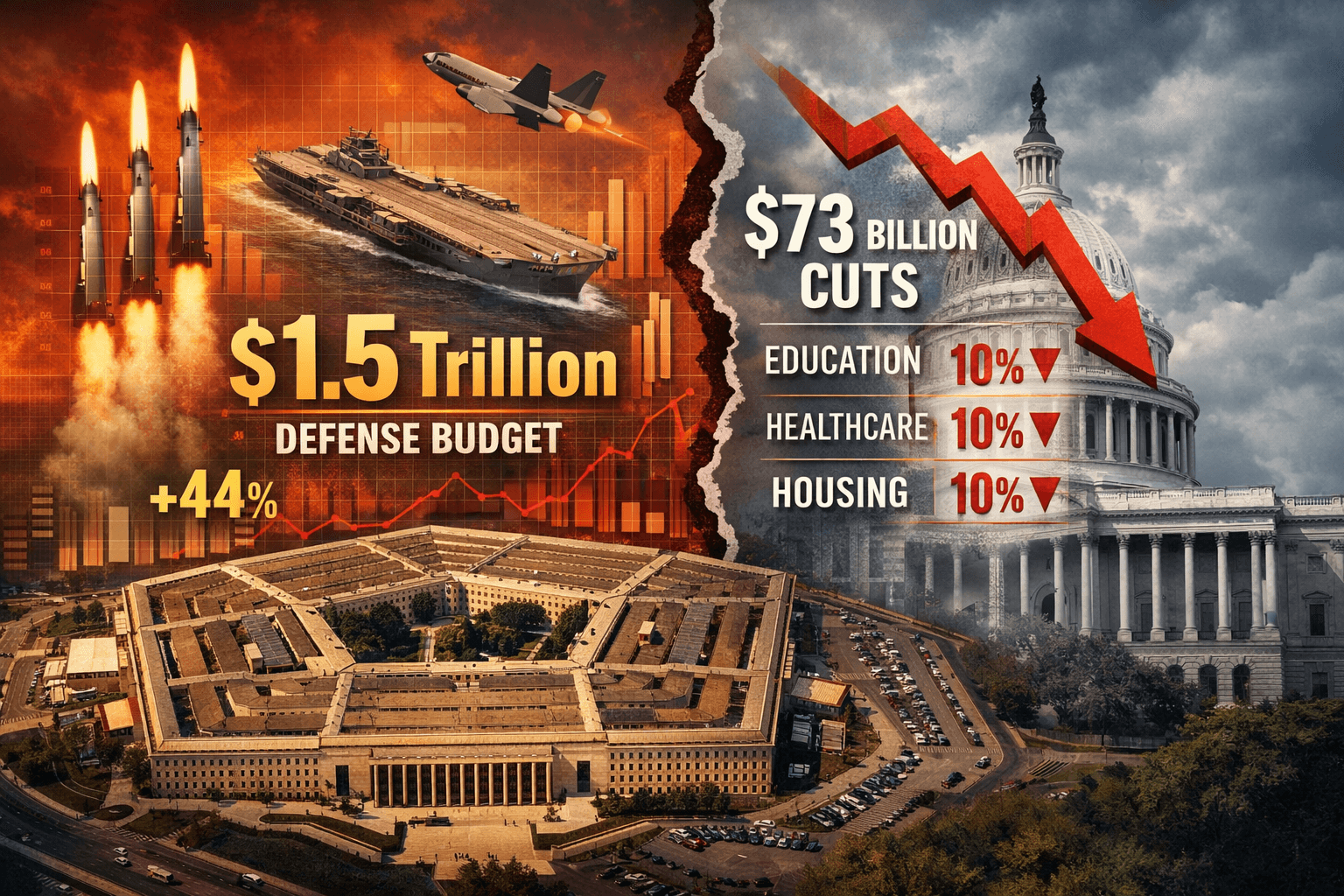
President Donald Trump’s latest federal budget proposal has triggered a fierce debate over Washington’s priorities, fiscal discipline, and the future direction of U.S. power. At the heart of the plan is a dramatic rise in defense spending: the White House’s fiscal 2027 budget requests $1.5 trillion in total national defense resources, which the administration describes as a 44% increase over the prior topline. The same proposal also calls for a 10% cut in non-defense discretionary spending, setting up a direct political fight over whether America should spend more on military strength while cutting back elsewhere.
The budget document says the administration is seeking $1.1 trillion in base discretionary budget authority specifically for the military, along with a request for $350 billion in additional mandatory resources for defense priorities such as munitions and the industrial base. The White House frames this as part of a broader “peace through strength” strategy, arguing that the United States must maintain what it calls the world’s most powerful military in a more dangerous global environment.
That makes the Trump budget military spending plan far more than a routine federal proposal. It is a statement of political philosophy. It tells Congress, financial markets, allies, and adversaries alike that this administration wants national defense to dominate the federal agenda. Even before lawmakers begin rewriting the plan, the message is unmistakable: Trump wants the U.S. government to spend far more on military power, even as it scales back domestic programs.
A closer reading of the White House budget shows that the proposed defense expansion is not just symbolic. The administration is seeking major funding for missile defense, shipbuilding, military pay, critical minerals, and space-related national security programs. The budget specifically calls for stronger funding for the Golden Dome missile defense effort, a substantial maritime push, and support for the defense industrial base. It also proposes military pay raises ranging from 5% to 7%, depending on rank.
One of the most notable elements in the proposal is the shipbuilding push. The budget requests $65.8 billion in shipbuilding funding and says that money would support the procurement of 18 battle-force ships and 16 non-battle-force ships. The administration argues that contested waters and strategic competition require a faster and larger naval buildup. The same section also mentions continued emphasis on submarines, sealift, logistics vessels, and repair capacity, tying naval expansion directly to long-term deterrence and warfighting readiness.
The administration is also tying this defense buildup to the broader geopolitical climate. Reuters reported that the budget was unveiled as the United States remained engaged in conflict with Iran, with thousands of service members deployed and the White House confronting a difficult public mood shaped by war risk and rising energy costs. That context matters. The timing of the proposal suggests the administration is using the international security environment to justify a budget that would have been politically explosive under normal circumstances.
Still, the scale of the increase is what has made this proposal so controversial. Reuters reported that the request would take defense spending to $1.5 trillion from about $1 trillion in 2026. The White House itself says the increase approaches the scale of U.S. pre-World War II military buildups. That kind of comparison is designed to underline urgency, but it also invites sharper scrutiny. When an administration asks for a defense surge of this size, lawmakers and voters naturally ask what gets cut, how it will be paid for, and whether the Pentagon can effectively absorb that much money.
That brings the domestic side of the budget into focus. The budget document says the administration proposes a 10% cut compared to 2026 non-defense levels. Reuters similarly reported a $73 billion reduction in non-defense discretionary spending. In practical terms, that means the White House is trying to create a sharp contrast: more resources for military expansion, less for the civilian side of government.
The cuts are spread across a range of departments and priorities. The budget says the Department of Agriculture would receive $20.8 billion, a 19% decrease from the 2026 enacted level. Housing and Urban Development would receive $73.5 billion, a 13% decrease. NASA would fall to $18.8 billion, a 23% decrease. The administration also says it wants to continue the Department of Education’s “path to elimination,” language that underscores just how aggressively the White House is framing the domestic side of this plan.
Read more on GTA online weekly update.
Those proposed reductions are not just accounting changes. They would affect housing policy, science and space programs, education administration, agriculture-related functions, and other domestic priorities if Congress accepted them in full. Critics argue that the budget is trying to shrink civilian government capacity in order to free political and fiscal space for defense and security spending. Supporters, by contrast, say the proposal cuts what they view as wasteful or ideologically driven programs while protecting core national interests.
The budget fight is also shaped by a deeper fiscal contradiction. Trump returned to office promising restraint, efficiency, and deficit discipline. Yet Reuters notes that the federal deficit is still projected by the Congressional Budget Office to reach $1.853 trillion in the current fiscal year, compared with $1.775 trillion the year before, while the national debt has climbed to roughly $39.016 trillion. In that environment, a massive military expansion raises immediate questions about whether this is a strategy of fiscal control or simply a reshuffling of spending priorities with even bigger topline risks.
The White House argues that the answer lies in how the money is allocated. Its case is that strong national defense, domestic production of critical minerals, stronger shipyards, and expanded military readiness are productive uses of federal dollars, especially at a time of conflict and strategic rivalry. The administration also says it is targeting non-defense areas that it considers inefficient, politicized, or outside core federal responsibilities. That framing is central to how Trump is likely to sell the budget on the campaign trail and in the midterm run-up.
Congress, however, is not required to accept the White House vision. Reuters emphasized that the president’s budget request still needs approval on Capitol Hill, where lawmakers often treat White House blueprints as opening bids rather than final instructions. That is especially true when a proposal contains both politically attractive items, such as military pay raises, and deeply contested cuts to domestic agencies. Even with Republican support for a larger Pentagon, the full package is likely to face resistance, negotiation, and possibly significant rewriting.
There is also a messaging dimension to this proposal that goes beyond fiscal policy. Reuters reported that the budget reflects the administration’s political priorities ahead of the 2026 midterm elections. In that sense, the Trump budget military spending plan is not only about appropriations. It is also about defining the administration in stark terms: strong on defense, hostile to what it calls bureaucratic excess, and willing to slash civilian spending in the name of national power and ideological clarity.
The central question now is whether that message helps Trump politically or exposes him to a backlash. Supporters will see a president matching rhetoric with resources. Opponents will see a budget that places war footing ahead of domestic stability. Both sides, however, understand that the proposal is historically ambitious. The sheer size of the defense request ensures that this will not be treated as just another Washington budget cycle.
What can be said with confidence, after fact-checking the plan against the White House budget document and major reporting, is this: Trump has formally proposed a defense-heavy 2027 budget centered on $1.5 trillion in total national defense resources, a 10% cut in non-defense discretionary spending, major military investments in missile defense and shipbuilding, and notable reductions across several domestic agencies. Whether Congress passes anything close to that vision remains uncertain. But as a declaration of priorities, the proposal is already one of the most consequential budget signals of Trump’s presidency.