







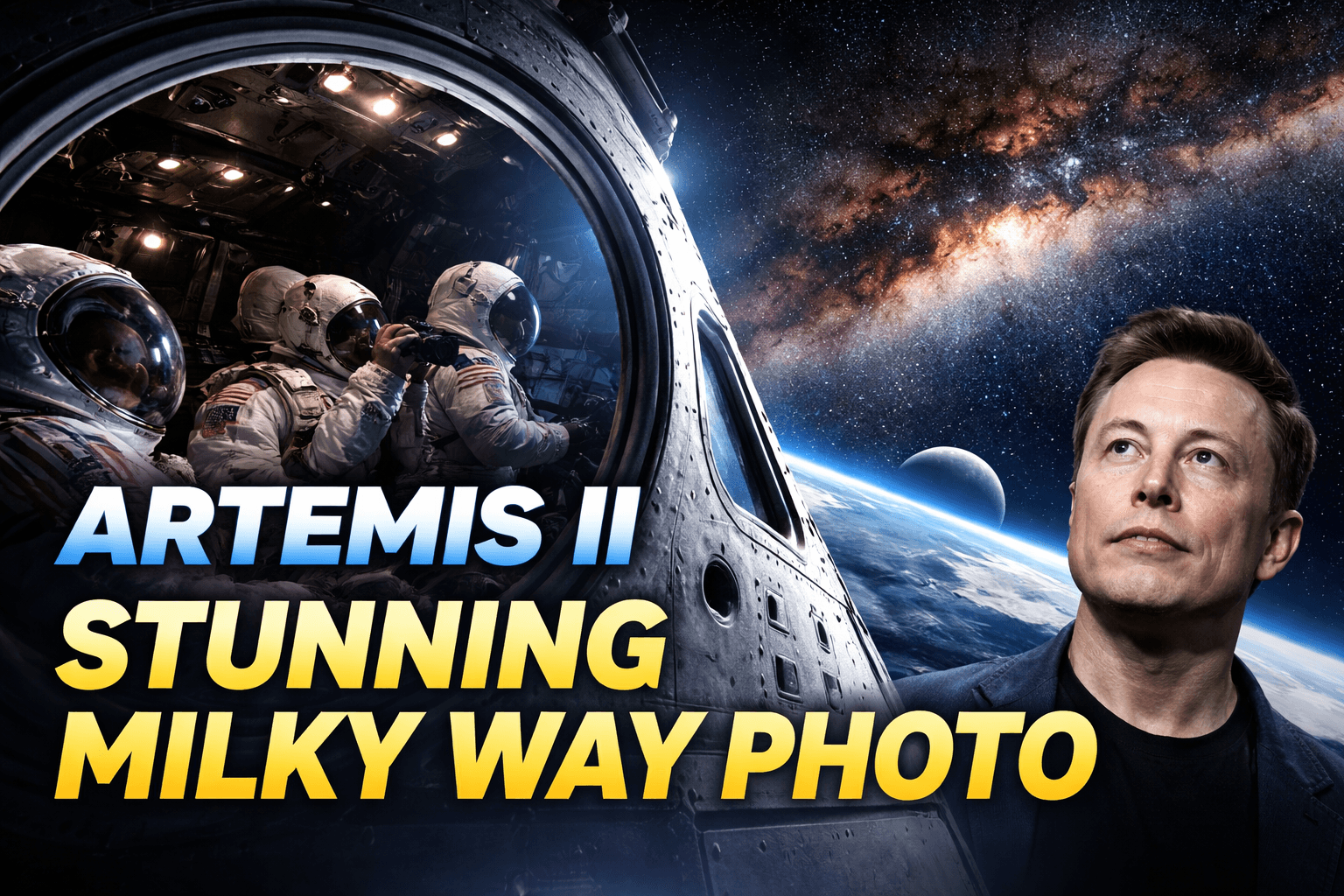
Artemis II Milky Way Image Highlights Humanity’s Return to Deep Space
NASA’s Artemis II mission has delivered one of the most striking images of the year: a photograph of the Milky Way taken by astronauts aboard the Orion spacecraft after their historic trip around the Moon. The image quickly drew worldwide attention not only because of its beauty, but because it came from the first crewed lunar flyby in more than 50 years. Elon Musk also reacted publicly, writing, “One day, we will be out there, among the stars,” adding another layer of public fascination to an already landmark moment.
The photograph matters because it is not just another space image posted online. It was captured during an active deep-space mission that marks NASA’s first crewed Artemis flight, a major step in its broader plan to return astronauts to the Moon and build toward future Mars missions. NASA says Artemis II is the first crewed flight of the Artemis program, launched on April 1, 2026, with a planned mission duration of about 10 days.
What Artemis II Actually Achieved
Artemis II is a crewed lunar flyby mission carrying four astronauts: Reid Wiseman, Victor Glover, Christina Koch, and Canadian Space Agency astronaut Jeremy Hansen. NASA describes it as the first mission with crew aboard both the Space Launch System rocket and Orion spacecraft, designed to prove out the deep-space systems needed for later lunar landing missions.
The mission became historic on April 6, 2026, when the crew surpassed the farthest-distance record for human spaceflight previously set by Apollo 13 in 1970. NASA said Artemis II broke that mark at 248,655 miles from Earth, and at its farthest point the crew would travel about 252,756 miles from Earth before turning back home.
That record is important because it underlines the true scale of this mission. Artemis II is not a symbolic loop around Earth. It is a real deep-space test flight that sends astronauts farther than any humans have gone before, while also generating scientific observations and operational data for future missions.
The Milky Way Photo NASA Actually Released
NASA officially published the Milky Way image in an image article titled Starstruck on April 9, 2026. In that post, NASA states that the Artemis II crew captured the photo of the Milky Way on April 7, 2026. NASA also notes that the Milky Way spans more than 100,000 light-years and that Earth sits along one of the galaxy’s spiral arms, about halfway from the center.
That means the central fact is confirmed: this was indeed a real Artemis II crew image, taken from Orion during the mission, and it was not a simulation, archive file, or telescope composite presented out of context. The image stands as an authentic crew-captured view from humanity’s return to deep space.
At the same time, some colorful descriptions circulating online should be treated carefully. NASA’s official image note confirms the photograph is of the Milky Way, but it does not identify specific nebulae, satellite galaxies, or exposure settings in the image article itself. Those extra astronomy details may appear in secondary coverage, but for a publish-ready fact-checked article, it is safer to stick to what NASA explicitly confirmed.
Why This Image Resonated So Strongly
Part of the reason the Artemis II Milky Way image has resonated so widely is timing. NASA had already been releasing dramatic mission visuals from the lunar flyby, including Earthset, Earthrise, close-ups of lunar terrain, and a rare solar-eclipse view from Orion. NASA said the crew used a fleet of cameras to capture thousands of photos during the mission, with the agency releasing selected images as the astronauts began their return to Earth.
NASA’s April 7 release on the lunar flyby states that the astronauts photographed regions of the Moon, documented ancient lava flows and fractures, observed Earthset and Earthrise, captured views of the Sun’s corona during an eclipse, and reported six meteoroid impact flashes on the darkened lunar surface. That broader visual context helps explain why the Milky Way image landed with such force: it arrived as part of a stream of extraordinary deep-space imagery from a crewed mission.
One of the most memorable officially released frames was “Earthset,” captured through Orion’s window at 6:41 p.m. EDT on April 6 during the lunar flyby. NASA described it as a muted blue Earth setting behind the cratered lunar surface, with Australia and Oceania visible on Earth’s day side and Ohm crater visible in the foreground.
Another major moment came with “Artemis Era Earthrise,” captured at 7:22 p.m. EDT on April 6 from the Moon’s far side. NASA said the image showed Earth as a delicate crescent aligned with the Moon’s rugged horizon.
Read more on the Adam Back denies claims of being Satoshi Nakamoto
Elon Musk’s Reaction and Why It Matters
Elon Musk’s response helped push the image even further into public discussion. His post read, “One day, we will be out there, among the stars,” directly referencing the Artemis II Milky Way image. The wording matters because it frames the photo not simply as a scientific image, but as a symbol of a future where human space travel extends beyond short visits and becomes something more permanent and expansive.
Even so, it is important not to overstate Musk’s role in the event. The image was captured by NASA’s Artemis II crew and released through NASA’s official channels. Musk’s reaction was influential as commentary, not as part of the mission itself. A fact-checked article should keep that distinction clear.
What the Mission Says About NASA’s Artemis Program
NASA describes Artemis II as a key step toward long-term human return to the Moon and future missions to Mars. The agency says the test flight builds on the uncrewed Artemis I mission from 2022 and is meant to demonstrate the capabilities needed for deep-space human missions.
That is why the Milky Way image is bigger than a viral space photo. It comes from a mission whose purpose is to test spacecraft systems, crew operations, imaging, communications, and mission procedures in real deep-space conditions. The image therefore doubles as both inspiration and proof of operational progress.
NASA’s lunar flyby release also makes clear that the mission is scientific as well as symbolic. The crew’s observations were not limited to sightseeing. They monitored differences in lunar color, brightness, and texture, documented surface features tied to geologic evolution, and recorded eclipse phenomena and impact flashes.
A Corrected View of the “Historic Lunar Flyby”
One detail often blurred in quick retellings is what exactly happened during the Moon pass. Artemis II was a lunar flyby, not a lunar landing and not a crewed lunar orbit mission in the Apollo sense of entering and remaining in orbit for extended operations. NASA calls it a crewed lunar flyby and says the mission involved a journey around the Moon before turning back toward Earth.
NASA further said the closest approach to the lunar surface was updated to about 4,067 miles. That figure helps define how near Orion came during the mission and underlines how substantial the flyby was, even without a landing.
Another point worth correcting is the timeframe. The Milky Way image was taken on April 7, 2026, after the most dramatic phase of the lunar flyby imagery captured on April 6. That sequencing matters because it shows the photo was made as the mission progressed beyond the flyby itself, not necessarily at the exact closest-approach moment.
Why the Image Feels Different From Earth-Based Astronomy
The Artemis II Milky Way photo has had a powerful effect because it combines two forms of awe at once: space photography and human exploration. Countless images of the Milky Way exist from telescopes and astrophotographers, but this one came from astronauts physically traveling through deep space aboard a crewed spacecraft. That gives the image a different emotional weight. NASA’s presentation of the image emphasizes exactly that sense of wonder, calling it “a stunning snapshot in time.”
In practical terms, the image also reinforces how valuable crewed missions can be for public engagement. NASA’s release of thousands of mission photos, including lunar terrain, Earth views, eclipse imagery, and the Milky Way shot, creates a visual narrative that makes the Artemis program more tangible to the public.
The Bigger Meaning of the Artemis II Milky Way Image
The reason this photograph matters goes beyond aesthetics. Artemis II is the first crewed Artemis mission, the first human journey around the Moon in more than half a century, and the mission that set a new human-distance record from Earth. The Milky Way image therefore becomes a visual shorthand for all of that progress.
It also arrives at a moment when global interest in lunar exploration is rising again. NASA is positioning Artemis as the foundation for sustainable lunar exploration and future Mars preparation. Seen in that context, the image is not just a beautiful reward from one mission; it is part of the branding and public meaning of a larger program meant to reshape the next era of spaceflight.
Conclusion
The corrected takeaway is clear. NASA’s Artemis II crew really did capture an image of the Milky Way during the mission, and NASA officially published it on April 9, stating the photo was taken on April 7, 2026. Artemis II is also genuinely historic: it launched on April 1, became the first crewed Artemis flight, flew astronauts around the Moon, and set a new record for the farthest humans have traveled from Earth. Elon Musk’s widely shared reaction added cultural momentum, but the achievement itself belongs to the Artemis II crew and NASA’s deep-space program.
In that sense, the Artemis II Milky Way image is more than a trending visual. It is one of the clearest public symbols yet that human deep-space exploration is no longer a memory from the Apollo era. It is happening again, now.