







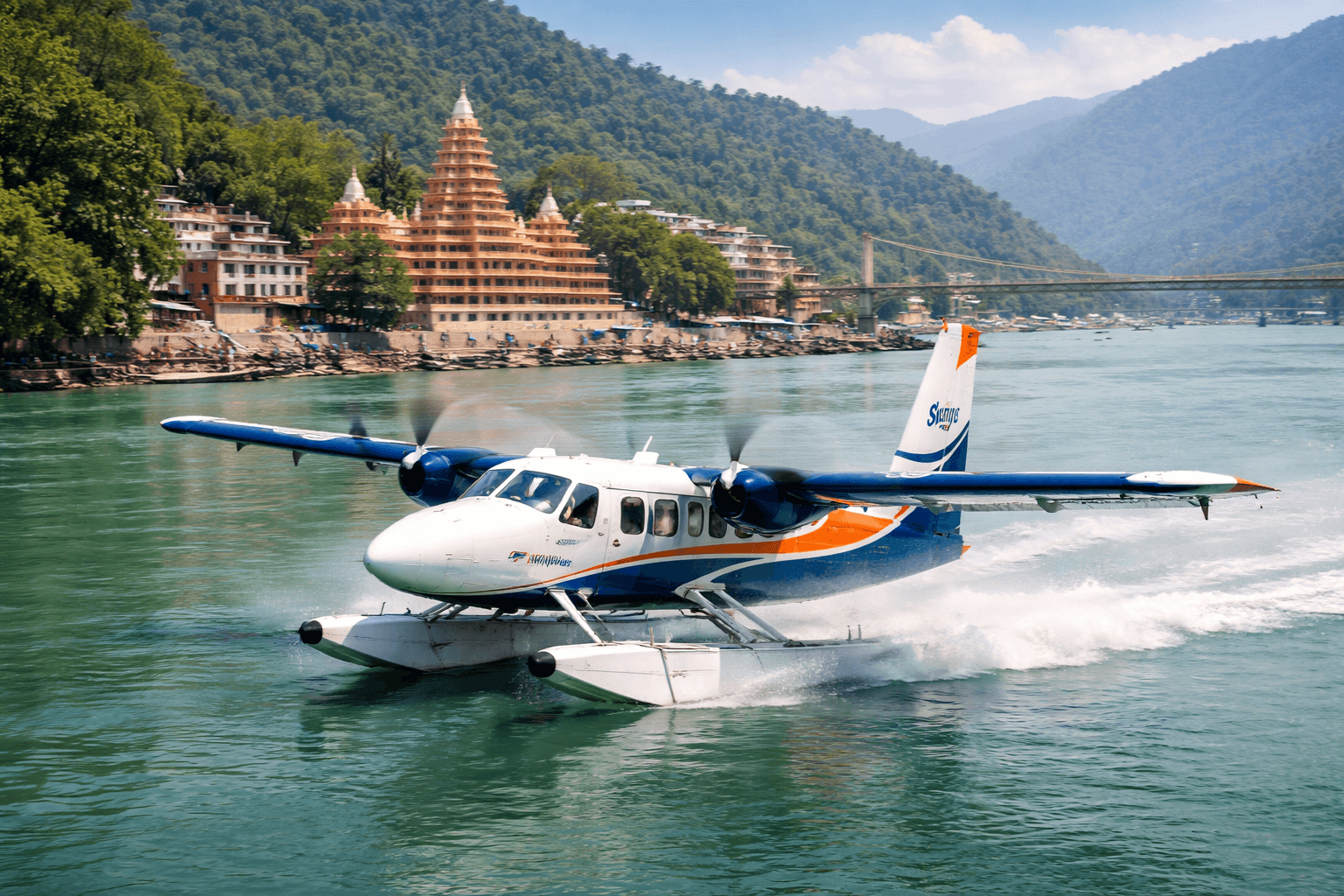
SkyHop’s Seaplane Test in Rishikesh Marks a New Push for Water-Based Aviation in India – A successful trial in Uttarakhand, not India’s first seaplane chapter
India’s seaplane story has entered a new phase with SkyHop Aviation successfully conducting a seaplane test flight at the Ganga Barrage in Rishikesh, Uttarakhand, on April 6, 2026. The trial involved both take-off and landing on water and is being seen as a significant milestone for regional air connectivity, tourism, and water-based aviation infrastructure in India. But the event should be understood accurately: it was not India’s first-ever seaplane operation. India had already launched its first seaplane service in Gujarat in 2020 between Sabarmati Riverfront and Kevadia. What makes this development important is that it marks a fresh commercial push, and a first-of-its-kind moment for Uttarakhand’s aviation ambitions.
The successful trial was carried out by SkyHop Aviation, which is positioning itself as India’s first dedicated commercial seaplane operator. Company statements carried by multiple outlets said the aircraft completed a landing and take-off from the Ganga Barrage, underscoring the feasibility of operating amphibious aircraft in Indian conditions. Reports identified the aircraft as a modified De Havilland Canada DHC-6 Twin Otter, a platform widely known for short take-off and landing performance and suitability for remote sectors.
Why the Rishikesh test matters
The Rishikesh seaplane test matters because it signals that India’s next attempt at building a seaplane network may be broader and more targeted toward remote regions than earlier efforts. Seaplanes can connect destinations where conventional runway infrastructure is difficult, expensive, or environmentally complicated to build. In a country with long coastlines, island territories, river systems, and tourism-heavy remote destinations, that makes the concept strategically attractive.
For Uttarakhand, the trial also has symbolic and economic significance. It is being described as the first seaplane trial landing in the state, opening the door to future connectivity possibilities linked to tourism and hard-to-reach areas. Rishikesh, already one of India’s most prominent destinations for spiritual travel, wellness tourism, and gateway movement toward the Garhwal Himalayas, gives the experiment both visibility and practical relevance.
The barrage used for the trial is associated with the Rishikesh area in Dehradun district, which helps explain why some reports referred to it as Rishikesh while another report described the same Ganga Barrage in Haridwar-linked terms. The broader geography is the Rishikesh-Haridwar corridor, but the event itself has been consistently reported as a Rishikesh trial by most coverage.
What exactly was tested
According to recent reports, the test validated water landing and take-off capability using a converted Twin Otter fitted with floats. One Times of India report specifically described it as the first plane converted to a seaplane in India to complete such a test, which is a more precise and defensible claim than saying it was India’s first seaplane test overall. That distinction matters because India’s first scheduled seaplane service had already begun in Gujarat in 2020 under SpiceJet’s operations before later being suspended.
This makes the current moment less about a “first-ever” event and more about a revival and reset. India has seen enthusiasm around seaplanes before, but sustaining services has been the real challenge. Commercial viability, route planning, infrastructure support, weather conditions, environmental approvals, and passenger demand have all played a role in earlier setbacks. The Rishikesh test shows that operators and policymakers are still interested in making the model work.
The larger policy and connectivity angle
SkyHop’s trial fits into a broader government interest in reviving seaplane services as part of regional connectivity planning. In August 2025, Civil Aviation Minister Ram Mohan Naidu said the Centre planned to restart seaplane services with simplified guidelines and initial routes. That policy backdrop gives the Rishikesh trial added weight because it is not happening in isolation; it sits within a broader effort to make water aerodrome operations more practical in India.
The company has said it is working with the Ministry of Civil Aviation and the Directorate General of Civil Aviation to secure its Air Operator Certificate, a key step before any scheduled passenger services can begin. Reports also say SkyHop sees seaplanes as a way to improve access to places where conventional airports are difficult to develop.
Multiple reports say the company’s first-phase ambition includes connecting remote island or hard-to-access regions, with Lakshadweep frequently mentioned as an early focus area. One report also said the aircraft could be deployed in the Andaman and Nicobar Islands after licensing approval. The common thread across reports is clear even where route specifics vary: the focus is on remote and high-value connectivity markets rather than mainstream metro sectors.
Tourism could be the biggest winner
If commercial services follow, tourism may be the biggest beneficiary. Seaplanes are especially well-suited to destinations where the journey itself becomes part of the appeal. They can create premium travel experiences while also cutting travel time to locations that otherwise require long road or ferry transfers. That can be valuable for pilgrimage routes, island tourism, eco-tourism, and high-end hospitality corridors.
In Uttarakhand specifically, the tourism potential is obvious. Rishikesh already draws domestic and international travelers for yoga, spirituality, rafting, and gateway access to mountain destinations. A viable seaplane ecosystem could eventually support niche circuits, premium mobility, and faster access to tourism clusters if regulatory and environmental conditions allow. The same logic applies to island regions and remote coastal sectors elsewhere in India.
Read more on India’s Draft IT Rules 2026
The big challenge: moving from a test to a business
The real test starts now. A successful trial flight is important, but commercial aviation depends on repeatability, economics, certification, safety systems, infrastructure, and route design. Water-based operations need more than an aircraft. They require suitable water aerodromes, passenger handling processes, rescue and safety planning, environmental clearances, and operational predictability across seasons.
India’s earlier seaplane experiment in Gujarat showed that launch buzz alone is not enough. The first scheduled seaplane service between Ahmedabad and Kevadia was inaugurated in October 2020, but it was later suspended. That history makes the current SkyHop effort important, but it also demands caution. Success will depend on whether operators can build stable routes with real demand rather than one-off publicity value.
What this means for Indian aviation
The Rishikesh test should be read as a sign that India is serious about giving seaplanes another chance. It reflects a growing interest in multimodal aviation solutions, especially for places where roads are long, runways are difficult, and tourism demand justifies premium regional travel. If the regulatory process moves smoothly and route planning is realistic, SkyHop’s experiment could become a template for future operations in island territories, pilgrimage regions, and other remote circuits.
At the same time, accuracy matters. This was not the start of India’s seaplane history. That chapter began earlier. What happened in Rishikesh is better understood as a fresh milestone in India’s seaplane revival: the successful test of a converted amphibious aircraft by a company seeking to launch commercial seaplane operations, and the first such high-profile trial in Uttarakhand.
Conclusion
SkyHop Aviation’s successful seaplane test at the Ganga Barrage in Rishikesh is an important and credible development in India’s aviation story. It demonstrates technical feasibility, revives policy interest in water-based air connectivity, and highlights the commercial potential of linking remote and tourism-heavy regions through amphibious aircraft. But the most accurate way to frame it is this: not India’s first-ever seaplane event, but a meaningful new step in India’s renewed seaplane push. If commercial approvals and route planning follow, the Rishikesh trial may eventually be remembered as the moment India’s seaplane ambitions truly restarted.