







Kashmir saffron at a crossroads
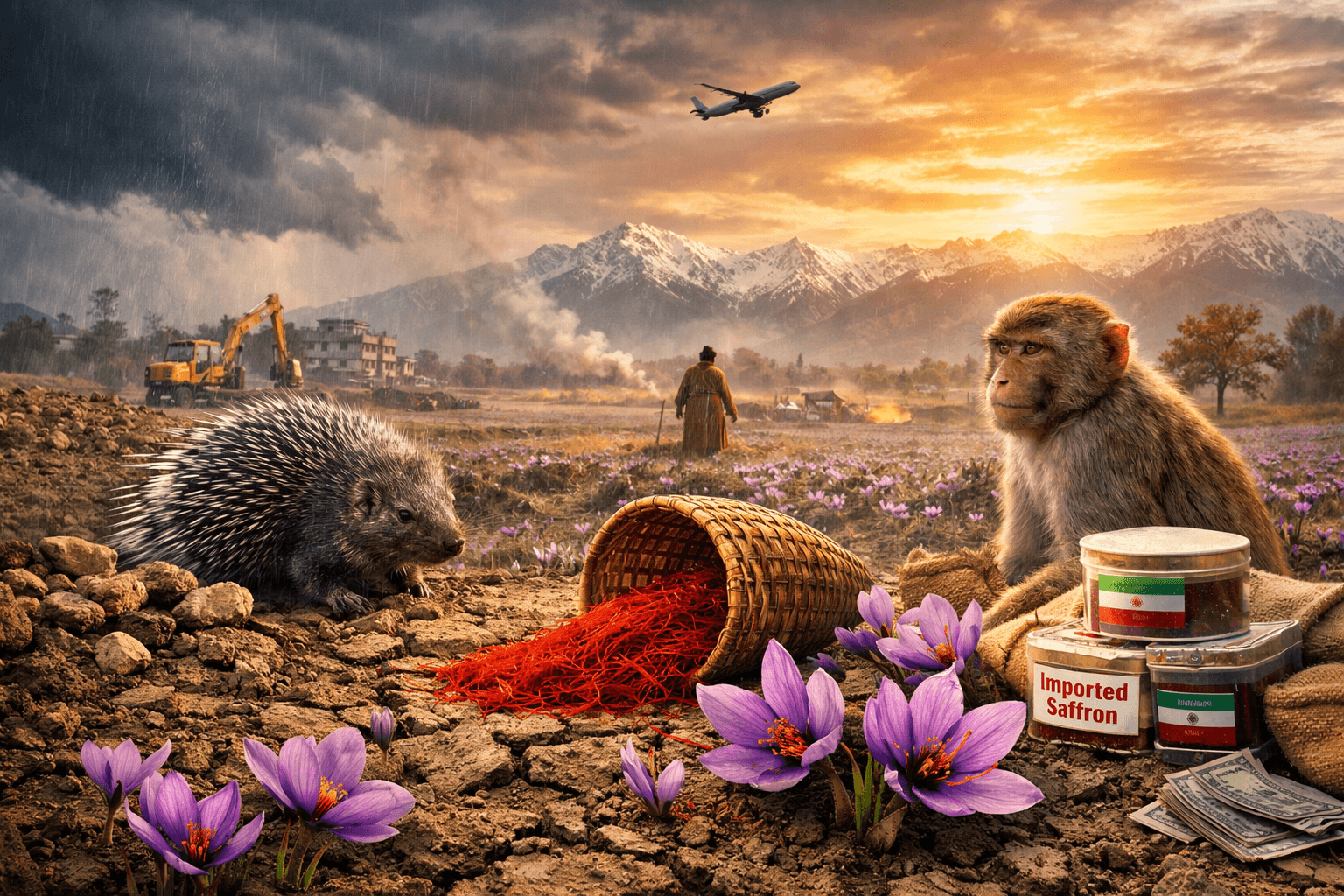
Kashmir saffron, often called the Valley’s “red gold,” remains one of India’s most distinctive agricultural products. It carries a Geographical Indication tag awarded in May 2020, and officials continue to promote it as a premium, globally recognizable brand. Yet behind that image, growers in Pampore and other saffron belts say the crop is under mounting pressure from erratic weather, weakened corms, wildlife damage, market adulteration, and rising cultivation costs.
The most accurate way to describe the situation in 2026 is this: Kashmir’s saffron industry is not disappearing overnight, but it is facing a serious structural strain. Official data shows that production and exports have improved in recent years compared with some earlier lows. At the same time, farmer testimonies and field reporting show that the recovery is uneven, fragile, and far from universally felt on the ground.
That tension between official optimism and farmer anxiety now defines the debate around Kashmir saffron.
What the latest official data actually says
One of the biggest corrections to the earlier draft concerns output. It is misleading to cite only the sharp decline from 8 metric tons in 2010-11 to 2.6 metric tons in 2023-24 from a Reuters feature without noting that more recent 2026 official figures show a rebound and a much stronger production trend. Reuters did report that federal data showed output falling to 2.6 metric tons in 2023-24, but the J&K government later told the Assembly that saffron production stood at 23.53 MT in 2023-24 and 19.58 MT in 2024-25, while total production from 2021 to 2025 reached 90.28 MT.
Similarly, describing saffron acreage as continuously shrinking in the present tense overstates the case. According to the government’s 2026 position, the major decline happened earlier, before the National Mission on Saffron and related revival efforts. Since 2010-11, the total area under saffron cultivation has been reported as broadly stable at 3,715 hectares, including around 3,665 hectares in Kashmir division and 50 hectares in Kishtwar.
That does not mean the crisis is imaginary. It means the story is more complex than simple decline. The cultivated footprint may have stabilized on paper, while productivity, farmer confidence, and field conditions remain inconsistent.
Read more on SkyHop’s Seaplane Test in Rishikesh
Why farmers still say the crisis is real
The Kashmir Life report captures the lived reality behind the numbers. Farmers and local experts interviewed for that report repeatedly describe a sector under pressure from erratic rainfall, weakening corms, wildlife attacks, land-use change, and market distortions linked to Iranian imports and alleged adulteration. The article also cites an estimate of around 150,000 saffron farmers in Kashmir and notes that many growers feel the official narrative does not fully reflect what is happening in their fields.
One recurring issue is climate instability. Saffron is highly sensitive to moisture timing and seasonal shifts. Reuters reported that growers and researchers in Kashmir have been experimenting with indoor cultivation because rising temperatures and erratic rainfall are threatening traditional cultivation patterns. Scientists and growers interviewed there described controlled-environment methods as a possible buffer against crop failure.
Another major pressure point is biological damage. Kashmir Life’s reporting says porcupines, rodents, monkeys, and corm rot are hurting fields in several saffron-growing areas. A senior scientist quoted in the piece described porcupine attacks and rodent damage as an underappreciated contributor to crop losses. Recent media reporting also shows porcupines have become a serious concern for growers in Pampore.
The market problem: imports, imitation, and price pressure
Kashmir saffron’s premium image should, in theory, help farmers command stronger prices. The GI tag was expected to improve authentication and market access, and official communications presented it as a way to make Kashmiri saffron a globally popular brand.
But the market remains messy. Kashmir Life reports that local growers believe cheaper Iranian saffron and imitation products continue to distort the market. Farmers interviewed there said many consumers cannot easily tell the difference, allowing some traders to benefit from lower-cost imports while genuine Kashmiri producers struggle to maintain premium pricing. The same report notes that India’s saffron demand far exceeds domestic production, creating room for imports. Older technical and policy sources have similarly put India’s annual saffron demand at roughly 100 tonnes, much above domestic output.
This is another point where precision matters. It is fair to say that imports and adulteration are major farmer concerns. It is less safe to state, as fact, that all imported saffron sold in India is illegal or that imported product is routinely mislabeled without qualification. The strongest supported framing is that growers allege undercutting and adulteration, and that the gap between India’s demand and domestic supply makes the market vulnerable to these pressures.
Did the government mission fail?
The earlier article said government schemes had broadly failed. That is too one-sided.
The corrected picture is mixed. The National Mission on Saffron and related revival work appear to have had some measurable results. Government figures say the mission helped arrest the earlier decline in cultivation area, improve productivity in rejuvenated fields, and support stronger exports. Official data cited in 2026 also says productivity in rejuvenated areas reached 6.96 kg/ha in 2023-24 and 5.6 kg/ha in 2024-25.
At the same time, Kashmir Life reports deep dissatisfaction among many farmers, especially over irrigation infrastructure and maintenance. Some growers told the publication that pumps and pipelines installed under the saffron mission were not properly maintained and that parts of the system became non-functional. The report also says awareness and access gaps remain, even where alternatives exist.
So the most defensible conclusion is not that the mission simply failed, but that it produced partial gains on paper while leaving serious implementation and trust deficits at the farm level.
Culture, identity, and the future of red gold
Kashmir saffron is more than a crop. Official district material and government communications describe it as central to the agricultural economy and cultural heritage of Kashmir, including its place in cuisine, trade, and the region’s identity.
That is why the current moment feels so consequential. If official production gains continue and GI-linked branding improves, saffron could still remain a viable flagship crop. But if climate shocks intensify, wildlife damage expands, corm costs keep rising, and farmers continue to shift to apples, almonds, construction, or other uses, the sector could weaken despite encouraging aggregate statistics. Kashmir Life quotes growers describing exactly that kind of gradual retreat in some areas.
Indoor cultivation experiments may eventually become part of the answer. Reuters reported that local researchers and growers see controlled-environment farming as a promising way to reduce weather risk, though it will need scale, support, and affordability before it can become a mainstream solution.
Conclusion
Kashmir saffron in 2026 is best understood through a double reality.
The first reality is official: cultivation area has stabilized at around 3,715 hectares, production recovered strongly in 2023-24, and exports remain substantial. The second reality is local: many farmers still face erratic rainfall, corm disease, wildlife losses, weak infrastructure, and market pressure from cheaper imports and imitation. Both realities are true at the same time.
So the corrected story is not that Kashmir’s saffron economy has already collapsed. It is that Kashmir’s most iconic spice remains valuable and resilient, but the industry is under enough pressure that without stronger implementation, better market protection, and climate adaptation, the long-term future of this red gold will remain uncertain.