







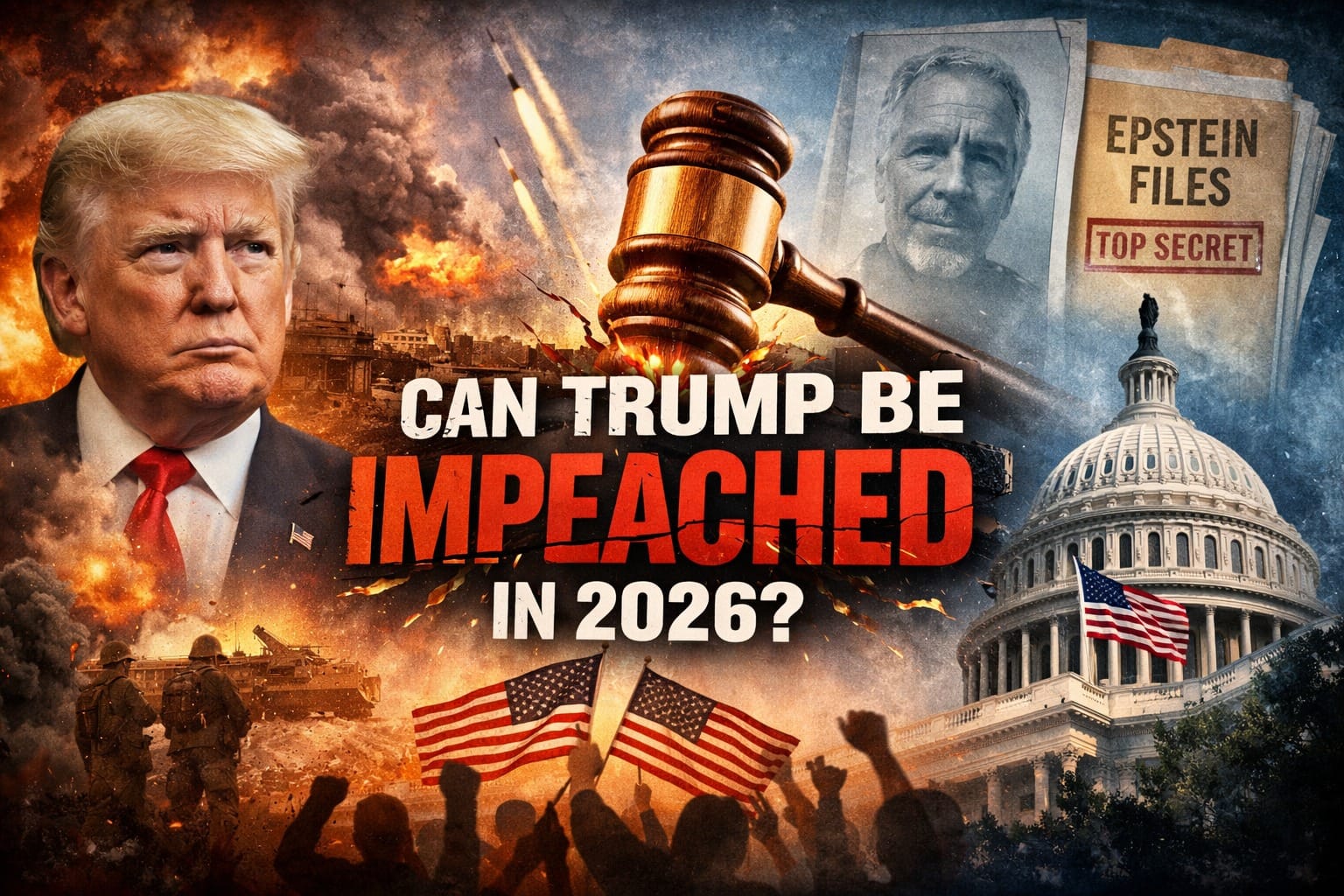
Introduction: Why Impeachment Is Being Discussed Again
In 2026, the question “Can Donald Trump be impeached again?” is no longer hypothetical—it is actively being debated in political, media, and public circles.
From the Iran war escalation, to renewed scrutiny around the Epstein files, to growing domestic and global unrest, multiple developments have triggered fresh calls for accountability.
But for a reader who values peace over politics, the real question is not just whether Trump can be impeached—but:
- Will impeachment reduce conflict or increase instability?
- Is it legally possible in today’s political environment?
- And what does it actually take to remove a U.S. President?
Let’s break this down in a clear, factual, and grounded way.
What Is Impeachment (And What It Is Not)?
Impeachment in the United States is often misunderstood.
Step-by-step process:
- House of Representatives votes to impeach (simple majority needed)
- Senate conducts trial
- 2/3rd Senate vote required to remove the President
Important:
- Impeachment ≠ removal
- It is more like a formal accusation, not a conviction
This means:
Even if Trump is impeached, removal is extremely difficult without bipartisan support.
Also read – Melania Leaving Donald Trump: The Whole Truth
Why Trump Is Facing Impeachment Calls in 2026
1. Iran War Escalation and “War Crimes” Debate
The biggest trigger for impeachment discussions in 2026 is the U.S. military escalation with Iran.
- Trump made extreme public threats, including statements about destroying entire infrastructure
- Over 85 House Democrats supported impeachment or removal discussions
- Critics have raised concerns about potential war crimes and unconstitutional military action
Public sentiment is also shifting:
- Only 7% supported a large-scale ground war
Peace Perspective
For a peace-focused reader, this is the most critical issue.
War—not politics—is the real risk.
Impeachment here becomes:
- A tool to prevent escalation
- Or a political weapon that could worsen instability
2. Epstein Files Controversy and Transparency Issues
The Epstein case continues to haunt U.S. politics.
Key concerns:
- Delays and partial release of Epstein-related documents triggered bipartisan frustration
- Allegations of obstruction or lack of transparency have been raised by critics
- Millions of pages were released, but no prosecutable evidence against Trump was confirmed
Peace Perspective
This issue is less about immediate conflict and more about:
- Trust in institutions
- Justice for victims
- Transparency in governance
Impeachment here would be based on:
- Obstruction
- Abuse of power
- Failure of accountability
3. Political Polarization and Public Pressure
Impeachment is also being driven by political and public momentum:
- Grassroots movements and activists are pushing for removal
- Polls suggest significant public support for impeachment in some segments
- Internal divisions exist within Democrats themselves
But the reality:
Political support alone is not enough. Numbers in Congress matter more.
Legal Grounds: Can These Issues Actually Lead to Impeachment?
Under the U.S. Constitution, impeachment is based on:
- Treason
- Bribery
- High crimes and misdemeanors
Let’s map current issues to these:
| Issue | Possible Legal Ground |
|---|---|
| Iran war actions | Abuse of power / unconstitutional war |
| Epstein files handling | Obstruction of justice |
| Public threats / rhetoric | Abuse of office |
However:
- These must be proven and framed legally
- Political interpretation plays a huge role
Big Reality Check: Why Impeachment Is Still Unlikely
Even with strong accusations, removal is extremely difficult.
1. Congress Numbers Problem
- Requires majority in House
- Requires 2/3 Senate vote
Without Republican support:
Removal is almost impossible
2. Party Loyalty
- Strong party polarization protects sitting presidents
- Even controversial actions often get framed as “policy decisions”
3. Timing and Strategy
- Some leaders prefer:
- Elections over impeachment
- Policy resistance over constitutional confrontation
Alternative to Impeachment: The 25th Amendment
Interestingly, some lawmakers have also discussed:
25th Amendment
- Used if a President is unfit to govern
- Requires:
- Vice President + Cabinet majority
But:
- This is even less likely due to political loyalty within administration
If Impeachment Happens, What Comes Next?
Scenario 1: Impeached but Not Removed
- Most likely outcome
- Political damage, but continues presidency
Scenario 2: Removed from Office
- Extremely rare
- Would trigger massive global political shift
Scenario 3: No Impeachment
- Issue moves to elections
- Public decides future
The Bigger Question: Does Impeachment Lead to Peace?
From a peace-first perspective, impeachment is not automatically a solution.
It could:
- Stop escalation (if leadership changes)
- Send a message of accountability
But it could also:
- Deepen political instability
- Increase global uncertainty
- Polarize society further
Conclusion: Possibility vs Reality
Is impeachment possible?
Yes—legally and procedurally.
Is it likely?
Not easily.
Because:
- Political math is against it
- Senate conviction is extremely difficult
- Party divisions block consensus
Final Thought for a Peace-Oriented Reader
The real issue is not just Trump or impeachment.
It is this:
How can leadership decisions avoid war, protect human lives, and maintain global stability?
Impeachment is one path—but peace requires something deeper:
- Accountability
- Diplomacy
- Responsible governance
Subscribe to our YouTube Channel The Logic Stick for more video insights