






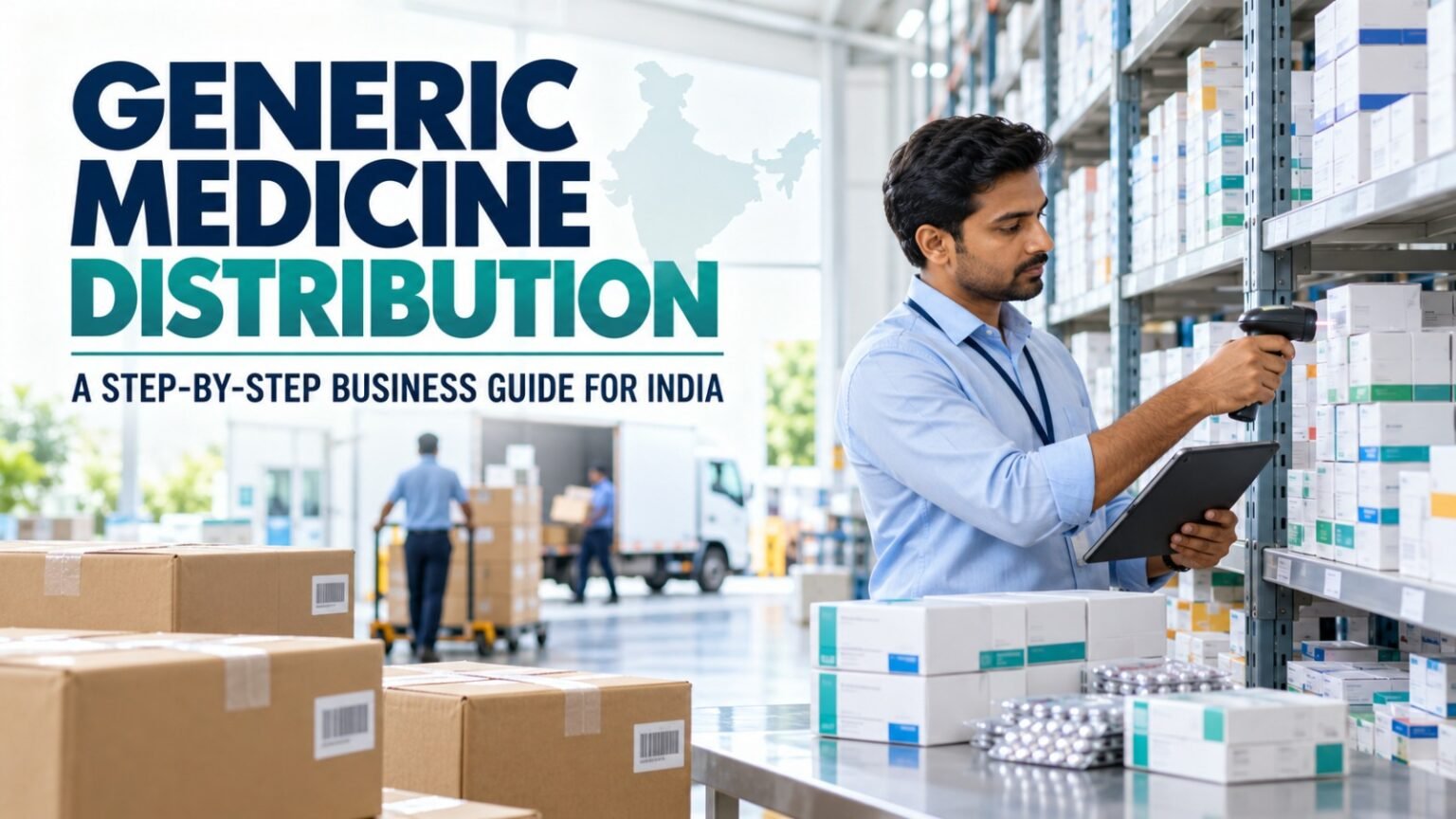
Generic Medicine Distribution Business in India: Step-by-Step Guide
A medicine distributor’s business depends on getting several things right simultaneously: buying genuine products, storing them correctly, supplying eligible customers, collecting payments and preventing stock from expiring.
Demand alone does not guarantee success. A distributor can generate substantial sales while struggling to pay suppliers because money remains tied up in unsold inventory and overdue customer invoices.
For entrepreneurs willing to understand pharmaceutical operations, a generic medicine distribution business in India offers a way to participate in the healthcare supply chain without manufacturing medicines.
However, this is a regulated business with patient-safety responsibilities. A wholesale drug licence, suitable premises, an approved competent person and reliable records form the foundation.
This guide explains how to evaluate the opportunity, establish the business and manage its daily operations. Regulatory points draw on official Indian sources; financial examples are explicitly illustrative.
1. Understand the Opportunity Without Overstating It
India is a major supplier of generic medicines. Government publications describe its contribution as approximately 20% of global generic medicine supply by volume, with around 60,000 generic brands across 60 therapeutic categories. These figures describe India’s pharmaceutical manufacturing and supply footprint; they do not establish the size or profitability of a particular local distribution territory. niti.gov.in
The reference to 60,000 brands also does not mean 60,000 different active ingredients. Multiple brands can contain the same medicine, with differences in strength, dosage form, pack size and manufacturer.
For a new distributor, the more useful questions are local:
- Which medicines do nearby licensed pharmacies regularly purchase?
- Which suppliers already serve them?
- Where do stock shortages or delivery delays occur?
- What payment terms do customers expect?
- Can the proposed business serve that demand profitably?
National scale provides context. Local purchasing behaviour determines your opening inventory.
2. Know Exactly Which Business You Are Starting
Generic medicine distribution usually involves purchasing finished pharmaceutical products from legitimate manufacturers or licensed suppliers and supplying eligible business customers.
It differs from manufacturing, importing, operating a retail pharmacy and marketing your own pharmaceutical brand.
Choose your model before spending money:
| Model | Main activity | Important consideration |
|---|---|---|
| Independent wholesaler | Sources from multiple legitimate suppliers | Must build its own product range and customer base |
| Appointed distributor or stockist | Supplies products under a company arrangement | Commercial terms and territory depend on the agreement |
| Institutional supplier | Supplies hospitals and other eligible institutions | Procurement conditions and payment cycles need careful assessment |
| Retail pharmacy | Dispenses or sells to consumers | Requires the appropriate retail permissions |
| Own-brand pharmaceutical marketing | Markets products under its own brand | Adds contractual, quality and regulatory responsibilities |
A company appointment does not replace the required drug licence.
Similarly, a Pradhan Mantri Bhartiya Janaushadhi Kendra operates within a separate scheme framework. PMBI coordinates the scheme’s procurement and supply arrangements; opening a private generic wholesaling business does not automatically make you a Jan Aushadhi supplier. janaushadhi.gov.in
For this guide, the starting model is a domestic wholesaler distributing finished allopathic medicines.
3. Research One Territory Before Selecting Products
Begin with a geographically manageable area.
Visit prospective customers and understand their purchasing process. A practical initial research target might be 20–30 establishments, but that is a suggested exercise rather than a business requirement.
Speak with pharmacy owners, purchasing managers and authorised institutional buyers.
Ask about:
- Frequently ordered products and pack sizes.
- Brands or manufacturers customers specifically request.
- Current supplier delivery frequency.
- Unfulfilled orders and recurring shortages.
- Minimum remaining shelf life accepted.
- Expected credit periods.
- Returns and expiry-claim arrangements.
- The reasons they would consider another distributor.
Request purchasing patterns or anonymised order information rather than patient records.
Distinguish a polite expression of interest from likely demand. “Send your catalogue” is weaker evidence than a buyer identifying specific products, quantities and acceptable terms.
Build a territory worksheet showing customers, likely order frequency, delivery distance and collection risk. This becomes the basis for the stock plan and financial model.
4. Identify the Correct Wholesale Drug Licences
There is no separate allopathic “generic medicine licence” that removes normal drug-sale requirements.
The licence category depends on the products and activity.
For common wholesale categories:
| Licence form | Broad coverage |
|---|---|
| Form 20B | Wholesale drugs other than those specified in Schedules C, C(1) and X |
| Form 21B | Wholesale drugs specified in Schedules C and C(1), excluding Schedule X |
| Form 20G | Wholesale drugs specified in Schedule X |
Form 19 is the application associated with the usual 20B/21B categories; Schedule X uses a separate application route. Official state guidance lists these distinctions. Department of Drugs Control
Wholesale sale licences are handled through the relevant State or Union Territory licensing authority. CDSCO’s national role does not mean every local wholesaler applies directly to CDSCO headquarters.
Before committing to premises, discuss your proposed product categories with the state authority.
A wholesale licence also does not authorise unrestricted consumer sales. Retail activity requires its own applicable permissions.
Products governed by additional controls need separate assessment. Do not include narcotic or psychotropic substances merely because a supplier offers them.
5. Arrange an Eligible Competent Person
The owner does not necessarily need to hold a pharmacy degree to establish a wholesale business. However, the premises must be under the charge of a competent person acceptable to the licensing authority.
Rule 64 provides recognised routes including:
- A registered pharmacist.
- A person who has passed matriculation or equivalent and has four years’ experience dealing with the sale of drugs.
- A recognised university graduate with one year’s experience dealing with drugs.
Eligibility and supporting evidence must satisfy the licensing authority. cdsco.gov.in
Verify this before employing someone on the assumption that any graduate qualifies.
Request qualification documents, relevant experience certificates and professional registration where applicable. Establish genuine supervision arrangements and clear responsibilities.
The person should understand stock handling, storage requirements, authorised sales and transaction records.
Their appointment should be operationally meaningful. Borrowing someone’s credentials while running the business without proper supervision creates a serious compliance problem.
6. Select Premises That Can Preserve Medicines Properly
The central framework provides a minimum area of 10 square metres for the usual wholesale premises. Combined retail and wholesale operations generally require 15 square metres. Suitable storage and competent supervision remain necessary; meeting the area minimum alone is insufficient. cdsco.gov.in
Before signing a long lease, assess:
- Whether the property can lawfully accommodate the activity.
- Whether the ownership and tenancy documents are acceptable.
- Heat exposure, ventilation and power reliability.
- Water leakage, flooding and pest risks.
- Access for deliveries and secure storage.
- Space for segregating stock that cannot be sold.
For Mumbai and Navi Mumbai, evaluate the actual premises during hot and humid conditions. A room that feels acceptable during a brief visit may behave differently during a power failure or monsoon leakage.
Create separate receiving, saleable-stock and hold areas.
Do not assume a domestic refrigerator or an air conditioner automatically demonstrates suitable pharmaceutical storage. Select equipment and monitoring arrangements around the products and regulatory expectations.
Also read – How to start AI Consultation Business: Step by Step Guide
7. Prepare Documents and Complete the Application
The exact checklist, portal, fees and processing steps depend on the state and licence category.
Typical application material includes:
- Applicable application form and fee receipt.
- Business constitution documents.
- Identity details of the proprietor, partners or directors.
- Ownership documents or tenancy evidence.
- Premises layout.
- Competent-person qualifications, experience and appointment documents.
- Required declarations and affidavits.
Official Delhi guidance illustrates these document categories; it should not be copied as a universal state checklist. Department of Drugs Control
For Maharashtra, start with the Maharashtra FDA website and confirm the current drug-sale licensing route. ONDLS is another official licensing platform, but state participation and the relevant application route should be checked. India
Keep originals available and prepare for inspection or clarification requests.
Do not purchase and stock sale inventory before the necessary authorisation is granted.
Maintain a compliance calendar after approval. Check retention-fee obligations, changes requiring notification and approval requirements for additional premises rather than relying on an old application checklist.
8. Establish Business and Tax Systems
Choose a proprietorship, partnership, LLP or company after considering ownership, liability, administration and financing needs.
Set up the appropriate bank account, accounting system and invoicing process.
Have a tax professional assess GST registration, interstate transactions, product classification and current rates. GST treatment depends on the actual supply and applicable notifications; medicines should not all be assigned one assumed rate.
Registration procedures and statutory obligations are separate from drug licensing. Having a GST number does not authorise medicine distribution. cbic-gst.gov.in
Configure the software before the first purchase.
Your product master should distinguish composition, strength, dosage form, brand, manufacturer and pack size. Similar-looking names must not become interchangeable records.
Establish invoice numbering, payment allocation, credit-note procedures and data backups. Ask the accountant to define applicable record-retention periods across tax and drug-law requirements.
9. Calculate Investment From Working Capital
There is no defensible single investment figure for every generic medicine distributor.
Costs depend on location, inventory breadth, staffing, storage, supplier terms and customer credit.
Use actual quotations for setup expenses. Then calculate working capital separately.
Illustrative example only — not a market benchmark:
| Requirement | Assumed amount |
|---|---|
| Opening inventory at purchase cost | ₹6 lakh |
| Customer receivables | ₹4 lakh |
| Operating cash reserve | ₹2 lakh |
| Less supplier credit available | ₹2 lakh |
| Indicative working capital | ₹10 lakh |
Premises deposits, equipment, software and other setup expenses would be additional.
Avoid double-counting opening stock and normal inventory requirements when building a full financial model.
Stress-test the assumptions. What if customers take 60 days rather than 30 to pay? What if the supplier withdraws credit? What if part of the opening inventory sells slowly?
A smaller catalogue with reliable replenishment may require less capital than a broad catalogue bought in bulk.
Preserving cash for collections delays is often more useful than negotiating an attractive discount on stock that has no confirmed demand.
10. Verify Suppliers Before Negotiating Discounts
Source through manufacturers or licensed suppliers whose authority and identity you can verify.
For each proposed supplier, obtain and check:
- Legal name and operating address.
- Relevant drug licences.
- Bank and tax details.
- Manufacturer and product information.
- Authorisation or appointment evidence where relevant.
- Written commercial and return terms.
Confirm documents through the issuing authority or available official systems where possible. Contact the manufacturer using independently verified contact information when validating an appointment.
A marketplace listing, certificate image or “WHO-GMP” claim is insufficient by itself.
Ask for the actual manufacturing-site details and relevant product permissions. Certificates have a defined scope; they do not prove every offered pack is genuine.
Start with a controlled purchase and inspect the delivery carefully.
CDSCO’s distribution guidance addresses procurement, documentation and product integrity across the distribution chain. Use it as an operating reference while distinguishing guidance from specific binding licence conditions. 10-Final GDP
Reject invoice-free purchasing and unexplained payment requests to unrelated accounts.
11. Select Opening Stock From Observed Demand
Begin with a focused product range supported by territory research.
Do not build the catalogue around a supplier’s largest promotional scheme.
Evaluate each proposed stock-keeping unit using:
- Expected monthly demand.
- Number of likely buyers.
- Purchase cost and contribution.
- Minimum order quantity.
- Replenishment lead time.
- Remaining shelf life.
- Storage requirements.
- Return arrangements.
Composition alone does not define an interchangeable product. Strength, dosage form and release characteristics matter.
For example, immediate-release and modified-release products must not be treated as equivalent stock entries simply because the active ingredient is the same.
The distributor should fulfil valid orders accurately. Decisions about prescribing or permissible substitution belong with appropriately authorised healthcare professionals under applicable rules.
Initially exclude categories that exceed your storage or handling capability. Add complexity only after demonstrating control over the opening range.
12. Negotiate Commercial Terms in Writing
Before paying a deposit or accepting a distributorship, obtain a clear agreement.
Resolve:
- Territory and exclusivity.
- Opening-order commitments.
- Sales targets.
- Purchase rates and promotional schemes.
- Freight and transit risk.
- Payment periods.
- Short-supply and damage claims.
- Near-expiry returns.
- Expired-stock claims.
- Recall cooperation.
- Deposit refund and termination conditions.
Do not assume manufacturers will accept every unsold or expired product.
A return arrangement may require notice before a particular date, supporting invoices or a specified claim process. It may provide credit rather than cash.
Model scheme economics using the actual stock received and likely saleability. “Buy ten, get two” improves the effective purchase cost only if the additional units can be sold legitimately within their useful shelf life.
Avoid large non-refundable payments based on verbal promises of an exclusive territory.
13. Understand Margins and Break-Even Sales
Generic distribution has no universal guaranteed margin.
Commercial returns depend on the product, channel, purchase agreement, discounts, collections, returns and operating expenses.
Do not mistake the gap between purchase price and printed MRP for your wholesale profit. Your customer needs its own commercial terms, and applicable price controls still matter.
NPPA regulates medicine pricing under the DPCO framework, covering scheduled formulations and monitoring non-scheduled medicines. Check current notifications for the exact products handled. pib.gov.in
Consider this hypothetical monthly calculation, excluding GST:
| Item | Amount |
|---|---|
| Net sales | ₹10,00,000 |
| Cost of goods sold | ₹8,80,000 |
| Gross profit | ₹1,20,000 |
| Operating expenses | ₹70,000 |
| Finance costs and expected losses | ₹20,000 |
| Illustrative surplus before tax | ₹30,000 |
These numbers are assumptions, not expected industry performance.
If contribution after variable expenses is 8% and fixed costs are ₹80,000 monthly, break-even sales would be ₹10 lakh.
Recalculate using your own quotations and customer terms before investing.
14. Control Storage and Transport Conditions
Follow each product’s labelled storage conditions throughout storage and delivery.
“All medicines go in a refrigerator” is incorrect. Equally, “room temperature” does not justify uncontrolled exposure to heat.
Some products require refrigeration, often within a specified range such as 2–8°C. Others have different requirements. Use the actual label and manufacturer information.
WHO storage guidance supports appropriate environmental monitoring, stock controls, handling procedures and management of temperature-sensitive products. who.int
Build written procedures for:
- Receiving and inspecting deliveries.
- Recording required conditions.
- Responding to power failures.
- Handling temperature excursions.
- Packing and transporting products.
- Assessing returned goods.
- Cleaning and pest control.
Do not release temperature-exposed stock simply because it looks normal. Hold it and obtain an appropriately documented disposition.
Qualify delivery arrangements before promising cold-chain supply. An insulated box alone does not demonstrate temperature control for every product, route and journey duration.
15. Build Batch-Level Inventory and Recall Capability
Your system should identify exactly which batch entered the business and which customer received it.
Record product identity, manufacturer, batch, expiry, quantity, supplier and transaction references.
Rule 65 includes wholesale cash-or-credit-memo requirements and associated recordkeeping. Configure the system against the applicable rules rather than relying on a generic trading invoice template. cdsco.gov.in
Use first-expiry, first-out, subject to customer shelf-life requirements and product suitability. The earliest-expiring acceptable batch should normally move first.
Review expiry exposure regularly. Internal alerts at six, three and one month can be useful, but these are management settings—not universal statutory thresholds.
Keep expired, damaged, returned and recalled stock segregated from saleable inventory. CDSCO’s distribution guidance addresses segregation during storage and transport. cdsco.gov.in
Test a mock recall: select one batch and identify its purchase, current balance and every recipient.
If that takes hours of manual searching, improve the system before increasing volume.
16. Verify Customers and Establish Credit Limits
Do not assume anyone calling themselves a clinic, hospital or pharmacy can purchase every category for every purpose.
Rule 65 and licence conditions restrict wholesale supply, including resale to persons without the requisite licence, subject to specified permitted categories and exceptions. cdsco.gov.in
Verify each customer’s identity, premises, relevant authorisation and intended purchasing capacity.
Create an onboarding file containing the appropriate licence or supporting documents, billing details, authorised contacts and agreed terms.
Then assess credit separately.
For a new customer, consider advance payment or a small initial limit. Increase exposure only after observing payment behaviour.
Review ageing weekly:
- Current invoices.
- Recently overdue invoices.
- Materially overdue balances.
- Disputed invoices.
- Accounts requiring a supply hold.
A customer’s large order is not proof of creditworthiness.
Agree how returns, claims and credit notes affect payments. Otherwise, disputed adjustments can accumulate while the distributor continues financing fresh supplies.
17. Acquire Customers Through Dependable Service
A new distributor needs a specific reason for buyers to change their purchasing habits.
Possible advantages include reliable availability, accurate picking, realistic delivery commitments and prompt claim handling.
Begin with a route that can be served consistently.
Provide a professional product list showing manufacturer, strength, dosage form, pack size and commercial terms. Share licence and business details through an appropriate onboarding process.
Track repeat orders rather than only opening orders.
A useful account review asks:
- Did the customer reorder?
- Were requested products supplied correctly?
- Was delivery completed as promised?
- Were payments collected within terms?
- Did claims consume the contribution earned?
Avoid customer acquisition through uncontrolled credit or misleading product claims.
Hospitals and other institutions may have vendor-registration, procurement and documentation requirements beyond ordinary retail-account onboarding. Understand these before assuming an institutional order will be straightforward or quickly paid.
18. Prepare for Complaints, Suspect Stock and Disposal
Create a clear process before a quality incident occurs.
When stock is suspected to be defective, spurious, damaged or affected by an alert:
- Stop further supply of the affected stock.
- Segregate and identify it.
- Preserve invoices, packaging and relevant records.
- Contact the supplier and manufacturer.
- Involve the licensing authority as appropriate.
- Trace previous recipients and follow recall instructions.
- Document the final disposition.
A batch-specific quality finding should be interpreted accurately. Do not label every product from a company defective without evidence.
Returned goods require assessment before any decision to restore them to saleable stock.
Expired or rejected medicines also need a documented lawful disposal or return route. WHO guidance addresses returned goods and disposal controls; local legal requirements remain applicable. cdn.who.int
Do not discard medicine stock into ordinary rubbish, drains or informal resale channels.
19. Launch in Stages and Review the Right Numbers
Use a phased launch instead of purchasing broadly on the first day.
| Phase | Main work | Decision before proceeding |
|---|---|---|
| Market validation | Buyer interviews and territory research | Is there specific, serviceable demand? |
| Setup planning | Premises, competent person and finances | Can the model meet requirements and fund credit? |
| Licensing | Application, inspection and corrections | Have the required permissions been granted? |
| Supplier onboarding | Verification and written agreements | Are supply and claim terms acceptable? |
| Controlled launch | Limited stock and initial accounts | Can orders and collections be handled reliably? |
| Expansion | Add products, routes or customers | Does evidence support the additional capital? |
These phases are not a promised approval timeline.
Review sales alongside gross contribution, receivable ageing, stock days, expiry exposure, supplier claims and cash availability.
A rising turnover figure can conceal weakening collections. Expansion should follow evidence that the original route works.
Frequently Asked Questions
Can a non-pharmacist start a medicine wholesale business?
The owner need not necessarily be a pharmacist. The business must meet the applicable licensing conditions, including an eligible competent person accepted by the authority.
Can I operate entirely online?
Online ordering does not remove premises, storage, licensing or transaction obligations. Obtain advice on the exact model before launch.
Is a retail pharmacy licence enough for wholesale distribution?
Do not assume so. Obtain the appropriate wholesale permissions for the proposed products and activity.
How much investment is required?
There is no universal amount. Calculate premises and setup costs separately from inventory, receivables and operating reserves, then deduct realistic supplier credit.
Are generic medicines automatically interchangeable?
No blanket assumption is appropriate. Product characteristics and applicable prescribing and dispensing requirements matter. A wholesaler should not independently make therapeutic-substitution decisions.
What should an entrepreneur do first?
Research one territory, consult the state licensing authority and build a working-capital model. Commit to premises and suppliers after confirming that the proposed business can operate legally, preserve product quality and collect payments sustainably.
For new-generation business ideas, follow JC Based on Instagram