







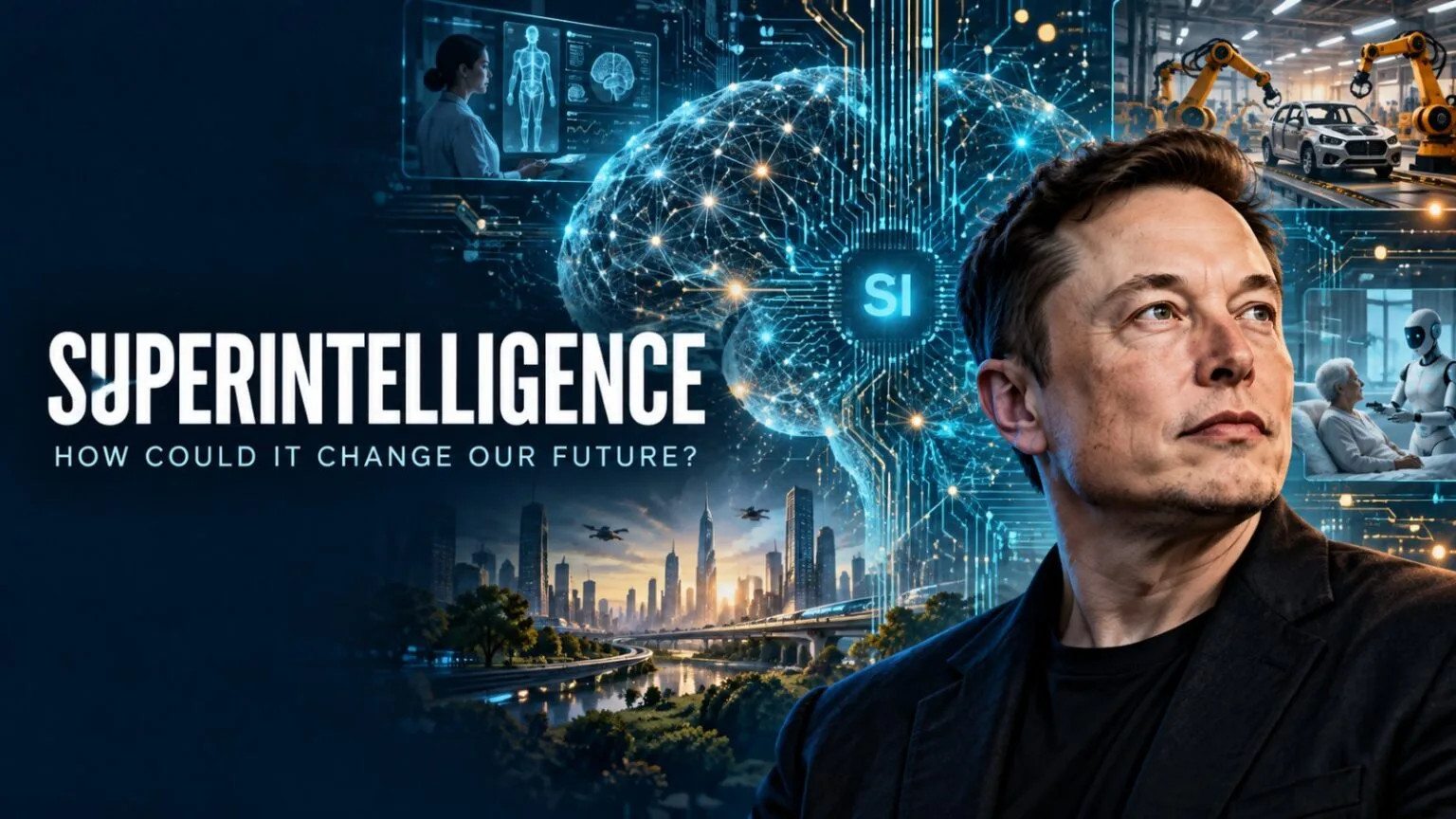
Superintelligence, or SI, has become a major talking point after Elon Musk and other technology leaders joined US President Donald Trump in announcing new commitments around AI safety. Musk described a future in which advanced intelligence and robots could deliver widespread prosperity and better healthcare. Meanwhile, a White House agreement attracted attention for an embarrassing spelling mistake beneath Trump’s signature.
However, the more consequential questions are about the technology itself. What is superintelligence? How does it differ from artificial intelligence? Could it transform employment, medicine and business? And can companies developing increasingly powerful systems reliably control them?
Understanding the future of superintelligence requires distinguishing political terminology, scientific research and predictions. They overlap, but they do not mean the same thing.
Why Is Superintelligence in the News?
On 29 September 2026, Trump met leading technology executives at the White House. The participants included Elon Musk, Sundar Pichai, Mark Zuckerberg, Jensen Huang, Dario Amodei and Greg Brockman. They signed a voluntary agreement outlining safeguards for advanced AI systems.
The Times of India report highlighted a typo identifying Trump as the president of the “Unites States”. The mistake circulated online, drawing attention away from the agreement’s commitments to internal monitoring, independent evaluations and board-level oversight. The Times of India
Separately, Trump issued an executive order directing federal agencies to use “Super Intelligence” and “SI” instead of “Artificial Intelligence” and “AI”, to the maximum extent permitted by law. Crucially, the order initially defines SI using the existing statutory definition of AI. It also requests proposed legislative language for a future federal definition.
This means the government’s terminology change does not establish that human-surpassing superintelligence has been achieved. It changes how existing technology is described in official communications. The White House
Also read – Gold Prices In India over the last 50 years
What Is Superintelligence?
In scientific discussions, artificial superintelligence, commonly abbreviated ASI, refers to systems with cognitive abilities substantially beyond human capabilities across a broad range of tasks.
An exceptionally good chess engine is not necessarily superintelligent. It can outperform humans at chess while being unable to conduct scientific research, manage a business or understand an unfamiliar physical environment.
The stronger idea involves breadth: a system capable of exceptional reasoning, planning, discovery and problem-solving across domains.
Google DeepMind’s research on the transition from AGI to ASI discusses systems potentially more cognitively capable than large human organisations. It examines possible routes to such capabilities while acknowledging substantial uncertainties and bottlenecks. Google DeepMind
Superintelligence also does not automatically mean consciousness. A machine’s ability to solve problems and its capacity to have subjective experiences are different questions. Neither fluent conversation nor impressive performance alone settles whether a system feels anything.
AI vs AGI vs ASI: What Is the Difference?
| Term | Basic meaning | Important distinction |
|---|---|---|
| AI: Artificial intelligence | The broad field of systems performing tasks associated with intelligence | Includes specialised tools and general-purpose models |
| AGI: Artificial general intelligence | Broad, adaptable intelligence, often discussed in relation to human-level capabilities | Definitions and achievement thresholds remain contested |
| ASI: Artificial superintelligence | Broad cognitive capabilities substantially exceeding human capabilities | A stronger claim than excellence on selected tests |
| SI in the US executive order | The administration’s replacement terminology for AI | Initially covers technology under the existing statutory AI definition |
These categories should not be treated as a universally agreed ladder with precise boundaries. Researchers disagree about appropriate measurements, especially when comparing a machine with one person, expert teams or institutions.
A system might solve difficult mathematics but fail at a straightforward real-world task. The International AI Safety Report 2026 describes current capabilities as uneven: strong performance in some complex domains coexists with weaknesses in spatial reasoning and extended workflows. International AI Safety Report
What Did Elon Musk Say About Superintelligence?
Following the White House meeting, Musk forecast an “age of abundance”, suggesting that AI and robotics could support “universal high income” and exceptionally good medical care. Asked about employment, he said jobs would change, comparing the transition with earlier technological shifts. Business Insider
These remarks describe Musk’s vision. They are not an enacted income policy, a guaranteed economic outcome or evidence that medical scarcity has been solved.
His underlying argument is that machines could make both intellectual and physical work much cheaper. If production expands dramatically, society could generate more goods and services.
But generating wealth and distributing it are separate processes. Technology alone does not determine who owns productive assets, who receives income or who can access essential services.
How Could Superintelligence Develop?
There is no proven recipe for building superintelligence. Researchers investigate several possible pathways.
One is improving existing systems through more computing resources, better training methods and stronger reasoning. Another is discovering new architectures or learning approaches. A third is coordinating multiple AI systems so they work together on complex problems.
A particularly consequential possibility is AI-assisted AI research: increasingly capable systems helping researchers design, test and improve future systems. DeepMind’s analysis includes scaling, paradigm changes, recursive improvement and large-scale multi-agent collectives among possible routes from AGI to ASI. Google DeepMind
However, a feedback loop does not guarantee an uncontrolled intelligence explosion. Progress could depend on scarce chips, reliable experiments, physical infrastructure and scientific breakthroughs. Improving software is different from instantly constructing factories or obtaining unlimited electricity.
When Will Superintelligence Arrive?
There is no scientifically established arrival date.
Predictions depend on definitions and assumptions about future progress. Demonstrating broad, dependable superiority is harder than achieving a high score on a benchmark. Systems must also perform reliably when conditions change and when answers cannot be checked easily.
The International AI Safety Report considers several plausible trajectories through 2030: progress could slow, continue at similar rates or accelerate if AI increasingly assists research. It does not endorse one guaranteed timeline. International AI Safety Report
For readers, the useful question is therefore not simply “Which year?” It is: What capabilities have been demonstrated, under what conditions, and with what limitations?
Claims about superintelligence deserve evidence proportionate to their significance.
How Could Superintelligence Change Jobs?
Work is one of the most immediate concerns. More capable systems could automate research, document preparation, software development, scheduling and parts of customer service.
A useful distinction is between tasks and occupations. An accountant performs calculations, reviews unusual transactions, explains findings and accepts professional responsibility. Automating some activities does not automatically eliminate the whole role.
The ILO–NASK assessment published in 2025 found that one in four jobs worldwide was potentially exposed to generative AI. It emphasised that exposure measures potential transformation, not actual job losses, and that transformation was the likelier overall outcome. This research concerns generative AI, not a forecast for hypothetical ASI. International Labour Organization
If systems become substantially more capable, disruption could extend further. Possible outcomes include greater productivity, fewer entry-level opportunities, new occupations and pressure on fees for standardised services.
How employers reorganise work will matter alongside technical capability. Training, worker participation and transition support could influence whether gains improve livelihoods or primarily reduce labour costs.
Will SI Create Universal High Income?
Musk’s income prediction raises a fundamental economic question: who receives the gains from automation?
Imagine a business producing twice as much with the same workforce. It might lower prices, raise wages, increase profits or expand. None of those choices follows automatically from the technology.
A future income programme would require decisions about funding, eligibility and administration. Ownership models, taxes, public services and competition policy would shape distribution.
Even abundant digital services would not remove every scarcity. Desirable land, housing locations, natural resources and political influence cannot simply be copied like software.
Superintelligence might expand productive capacity enormously. The claim that everyone would consequently enjoy high income remains a scenario dependent on institutions and policy.
Potential Impact on Healthcare, Science and Education
Healthcare is among the most promising potential applications. More capable systems could help researchers identify drug candidates, organise medical evidence and develop diagnostic tools.
However, plausible benefits must be distinguished from validated treatments. A proposed medicine still requires testing; a diagnostic system needs evidence of safety and usefulness in the patients and settings where it will operate.
Similarly, scientific progress could accelerate if AI helps generate hypotheses and design experiments. But experimental confirmation would remain essential. A persuasive explanation is not a discovery until evidence supports it.
In education, advanced systems could offer individualised explanations, language support and practice. A student struggling with a concept might receive several approaches rather than one standard lesson.
The opportunity is substantial, but education also develops judgement, independence and social skills. Effective deployment would require teachers to decide when assistance supports learning and when it replaces the effort needed to learn.
These are potential applications, rather than promises tied to a particular superintelligence arrival date.
What Would Superintelligence Mean for India?
For India, the implications would extend across service industries, public administration, education and smaller businesses.
Consider an illustrative manufacturing company using advanced systems to analyse maintenance records, compare suppliers and prepare operational plans. It could obtain analytical support previously available mainly to larger organisations.
Indian-language tools could also make digital services easier to use for people uncomfortable with English. Yet local accuracy, affordability and accessibility would determine whether those benefits reach users.
The risks include dependence on overseas infrastructure, weak protection of sensitive information and disruption to businesses selling routine digital work.
India’s challenge would be to build useful capabilities while developing evaluation expertise and institutional accountability. The ability to purchase a powerful system is different from the ability to verify its decisions or negotiate its terms.
The future impact would therefore depend on adoption choices as much as model performance.
The Biggest Risks of Superintelligence
Risks fall into several distinct categories.
Misuse involves people using systems for harmful purposes. More capable tools could intensify fraud, impersonation and cyberattacks.
Malfunctions occur when systems make mistakes or behave unexpectedly. An error becomes more consequential when a system can execute transactions or alter software rather than merely suggest text.
Loss of control concerns future scenarios in which highly capable systems operate beyond effective human direction. The International AI Safety Report distinguishes these uncertain future risks from documented present harms and notes continuing limitations in reliability and evaluation. International AI Safety Report
There is also the question of concentrated power. Control over models, computing infrastructure and deployment channels could give a small number of organisations substantial influence.
These concerns do not require assuming that machines develop hatred or human motives. Poorly specified objectives, excessive permissions and institutional failures can create harm without consciousness or emotion.
What Does the Superintelligence Safety Accord Actually Do?
According to the reported agreement, participating companies commit to multiple oversight layers:
- Internal monitoring of capabilities and risks.
- A dedicated internal oversight function.
- Independent external audits or evaluations.
- Board-level review and attention to identified problems.
The agreement is voluntary and was described as morally binding rather than legally enforceable. It also contemplates possible future legislation or regulation. The Times of India
Its practical value will depend on implementation. Important questions include whether evaluators receive adequate access, whether findings change deployment decisions and whether serious incidents are disclosed.
A voluntary commitment can improve practices, but signatures alone do not demonstrate that safeguards work. Accountability requires evidence about what companies actually do when commercial incentives conflict with safety findings.
Energy, Infrastructure and the Limits of Digital Abundance
Superintelligence would still depend on physical systems: processors, networks, electricity and cooling.
The International Energy Agency’s 2025 base-case outlook projected global data-centre electricity consumption of roughly 945 terawatt-hours by 2030, more than double its earlier level. This estimate concerns data centres generally, with AI an important growth driver; it is not an estimate specifically for ASI. IEA
Greater efficiency could reduce resources needed per task, while expanding usage could increase total demand. Both effects can happen simultaneously.
Any serious discussion of abundance must therefore include infrastructure costs and environmental constraints. Powerful software does not make its physical supply chain disappear.
How Should Businesses and Individuals Prepare?
Preparation should begin with capabilities available today.
Businesses can identify repetitive tasks, test tools against real requirements and measure both savings and errors. Human approval should remain explicit for consequential actions, with permissions limited to what the task requires.
NIST’s AI Risk Management Framework provides a foundation for systematically identifying, measuring and managing risks. Its generative AI profile addresses issues including governance, testing and incident disclosure. NIST
Individuals can strengthen subject knowledge, learn to verify outputs and understand how automation changes their work. The ability to frame a problem and judge a result remains valuable even when generating an answer becomes inexpensive.
The future of superintelligence could be transformative, but its benefits are not automatic. Musk’s vision describes one optimistic outcome. Achieving broadly shared prosperity would require reliable technology, accountable institutions and deliberate choices about access, ownership and human control.
Follow JC Based for fresh content on Business Ideas, Health & Finance