







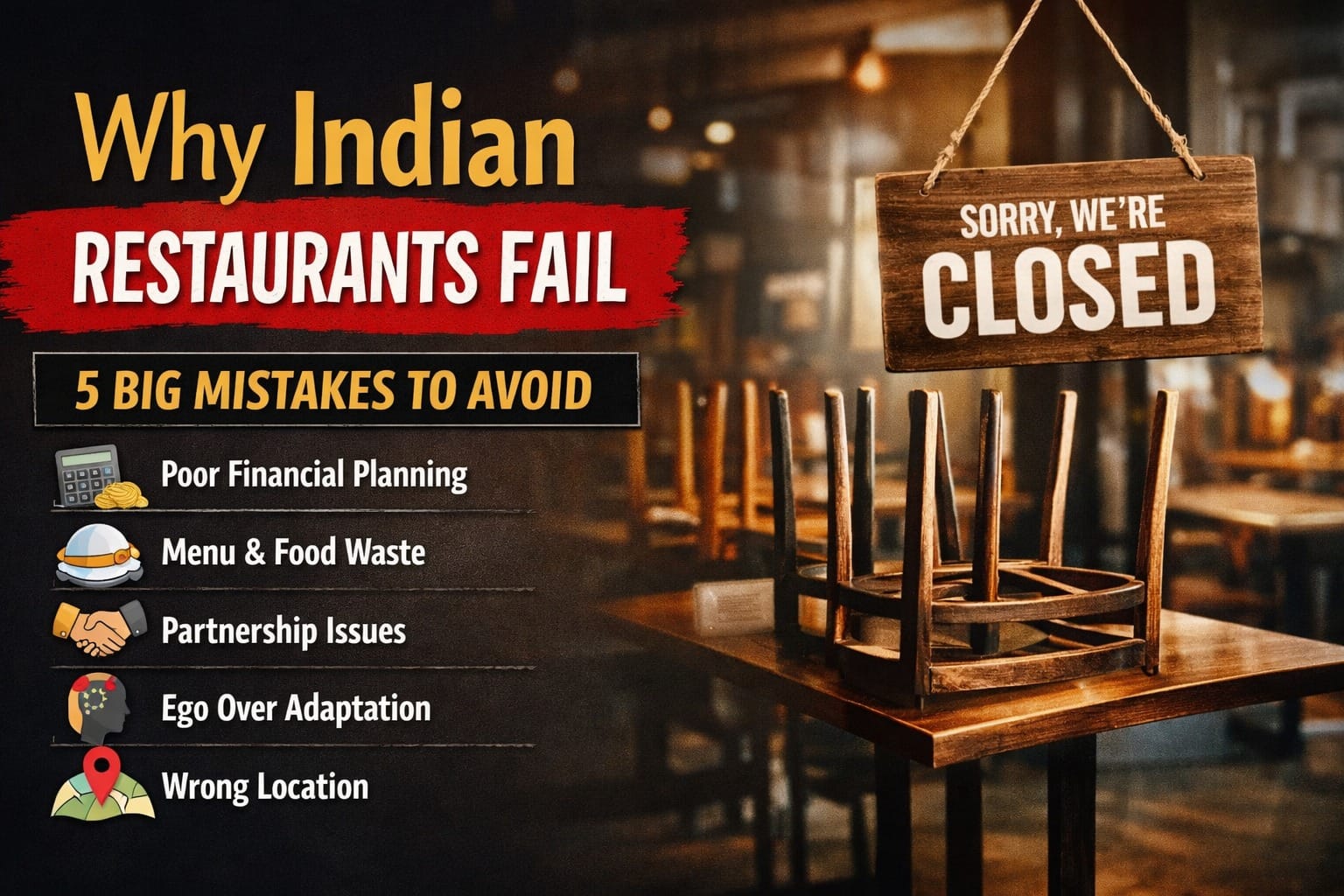
Why Indian Restaurants Fail: 5 Big Mistakes
India’s restaurant industry looks glamorous from the outside.
Great food, packed tables, Instagram reels, and happy customers.
But behind the scenes, the reality is very different.
Every year, thousands of restaurants open across India.
And a large percentage of them shut down within the first 1–2 years.
Why does this happen?
Is it because the food isn’t good enough?
Or is there something deeper that most people fail to understand?
This blog is not written from theory.
It comes from real, first-hand experience of running and failing at a restaurant business.
If you are planning to start a restaurant, café, or cloud kitchen in India, this guide will help you avoid some of the most costly and common mistakes.
1. Ignoring Financial Planning: The Biggest Reason Restaurants Fail
One of the most common reasons why restaurants fail in India is poor financial planning.
Many first-time restaurant owners are passionate about food but lack financial discipline. They invest heavily in interiors, branding, and menu design but fail to understand how long the business will actually take to become profitable.
The Reality of Break-Even
A common myth is that restaurants break even within the first few months.
In reality, most restaurants take 12 to 18 months to stabilize and start generating consistent profits.
If you enter the business expecting quick returns, you are setting yourself up for disappointment.
The Importance of Cash Reserve
Every restaurant should ideally have a minimum of 6 months of operating capital.
This covers:
- Rent
- Salaries
- Inventory
- Utilities
- Marketing
Without this buffer, even a small dip in sales can disrupt operations.
Understanding Prime Cost
One of the most important metrics in the restaurant business is Prime Cost:
Prime Cost = Food Cost + Labour Cost
If your prime cost exceeds 60% of your revenue, your business is under financial stress.
You may have a full restaurant, but you could still be losing money.
Key Takeaway
Restaurant business is not just about taste.
It is about numbers, margins, and financial control.
2. Overloaded Menu and Food Waste: The Silent Profit Killer
Another major reason why restaurants struggle is menu bloat.
New restaurant owners often believe that offering a wide variety of dishes will attract more customers.
In reality, it does the opposite.
The Problem with Large Menus
A large menu requires:
- More ingredients
- More vendors
- More storage
- More complexity in kitchen operations
This leads to inventory mismanagement and spoilage.
In many struggling restaurants, food wastage can go up to 30–40%, which directly eats into profits.
Kitchen Inefficiency
A complicated menu also slows down kitchen operations.
During peak hours:
- Orders take longer
- Staff gets confused
- Customer wait time increases
In today’s digital world, one bad review can impact your reputation significantly.
The Smart Approach: Focused Menu
Successful restaurants follow a different strategy:
- Limited dishes
- Faster execution
- Consistent taste
They focus on repeatable success rather than variety.
Key Takeaway
A smaller, smarter menu will always outperform a large, confusing one.
Also read – Secrets of a Millionaire Mindset
3. Unclear Partnership Terms: The Most Expensive Mistake
Many restaurant businesses begin with partnerships.
Friends, acquaintances, or investors come together to start something exciting.
But this is also where one of the biggest problems begins.
The Illusion of Verbal Understanding
At the beginning, everything feels smooth:
- Roles are “understood”
- Responsibilities are “shared”
- Decisions are “mutual”
But as soon as challenges arise, this structure collapses.
What Happens When Things Go Wrong
When sales slow down or losses begin:
- Blame games start
- Responsibilities become unclear
- Personal relationships get affected
Statements like:
- “This was your responsibility”
- “You didn’t handle this properly”
become common.
The Need for Written Clarity
A successful partnership requires:
- Clearly defined roles
- Written agreements
- Decision-making authority
- Exit clauses
Without this, the business becomes unstable.
Key Takeaway
Partnership without structure is not collaboration.
It is a risk waiting to explode.
4. Ego Over Adaptation: The Silent Killer of Growth
One of the most underestimated reasons why restaurants fail is ego.
Not financial ego.
Not branding ego.
But decision-making ego.
When You Know Something Isn’t Working
Every restaurant owner reaches a point where they realize:
- A dish is not selling
- Pricing is not working
- Customers are not returning
But instead of adapting, they resist change.
Why?
Because they are emotionally attached to their concept.
Common Thoughts That Kill Businesses
- “We’ve worked so hard on this idea”
- “Customers don’t understand our concept”
- “It will work eventually”
But the market does not operate on emotion.
The Reality of the Market
The market responds only to:
- Value
- Experience
- Pricing
- Convenience
If something is not working, it needs to be changed.
Adaptation Is Not Weakness
Successful restaurant owners:
- Test new ideas
- Change menus
- Adjust pricing
- Improve service
They treat their business like a system, not an identity.
Key Takeaway
In business, flexibility is strength.
Ego is expensive.
5. The Location Trap: My Personal Experience from Goa
One of the most important lessons I learned came from my own experience.
I opened a café in Goa at a location that had a high number of foreign tourists.
On paper, it seemed like a perfect opportunity.
The Assumption
Foreign tourists = high spending
High spending = premium menu
Premium menu = higher profit
So I designed the café around a continental menu with premium pricing.
The Reality
The majority of tourists in that area were Russian travelers on a budget.
They were not looking for expensive dining experiences.
They were looking for value-for-money meals.
This completely changed the economics of the business.
The concept that looked perfect on paper did not match the actual customer behavior.
What I Learned
Location is not just about footfall.
It is about:
- Who your customer is
- Why they are there
- How much they are willing to spend
The Importance of Ground Research
Before starting a restaurant:
- Spend 3–4 months observing the location
- Study existing businesses
- Understand customer patterns
- Analyze pricing trends
This research can save you from major losses.
The Strategic Decision
When starting a restaurant, choose one of the two:
- Go completely out-of-the-box and market it aggressively
- Go with a proven, tested model and execute it better
The worst position is being in between.
Key Takeaway
Location understanding is not optional.
It is foundational.
Final Thoughts: What Really Makes or Breaks a Restaurant
Restaurant businesses do not fail because of bad food alone.
They fail because of:
- Poor financial planning
- Inefficient menu design
- Weak partnerships
- Lack of adaptability
- Misunderstanding of location
If you are planning to start a restaurant in India, take these lessons seriously.
Because this business rewards:
- Discipline
- Observation
- Adaptation
- Systems
More than anything else.
A Personal Note
Despite everything, I don’t regret my journey.
Those 18 months of running a restaurant were
one of the most beautiful and learning-filled phases of my life.
Because in the end,
experience is the only thing that truly stays with you.
Watch the Full Video
If you want to understand these mistakes visually and in more detail,
watch the full video here:
Subscribe to our YouTube Channel The Logic Stick for more video insights