







Introduction
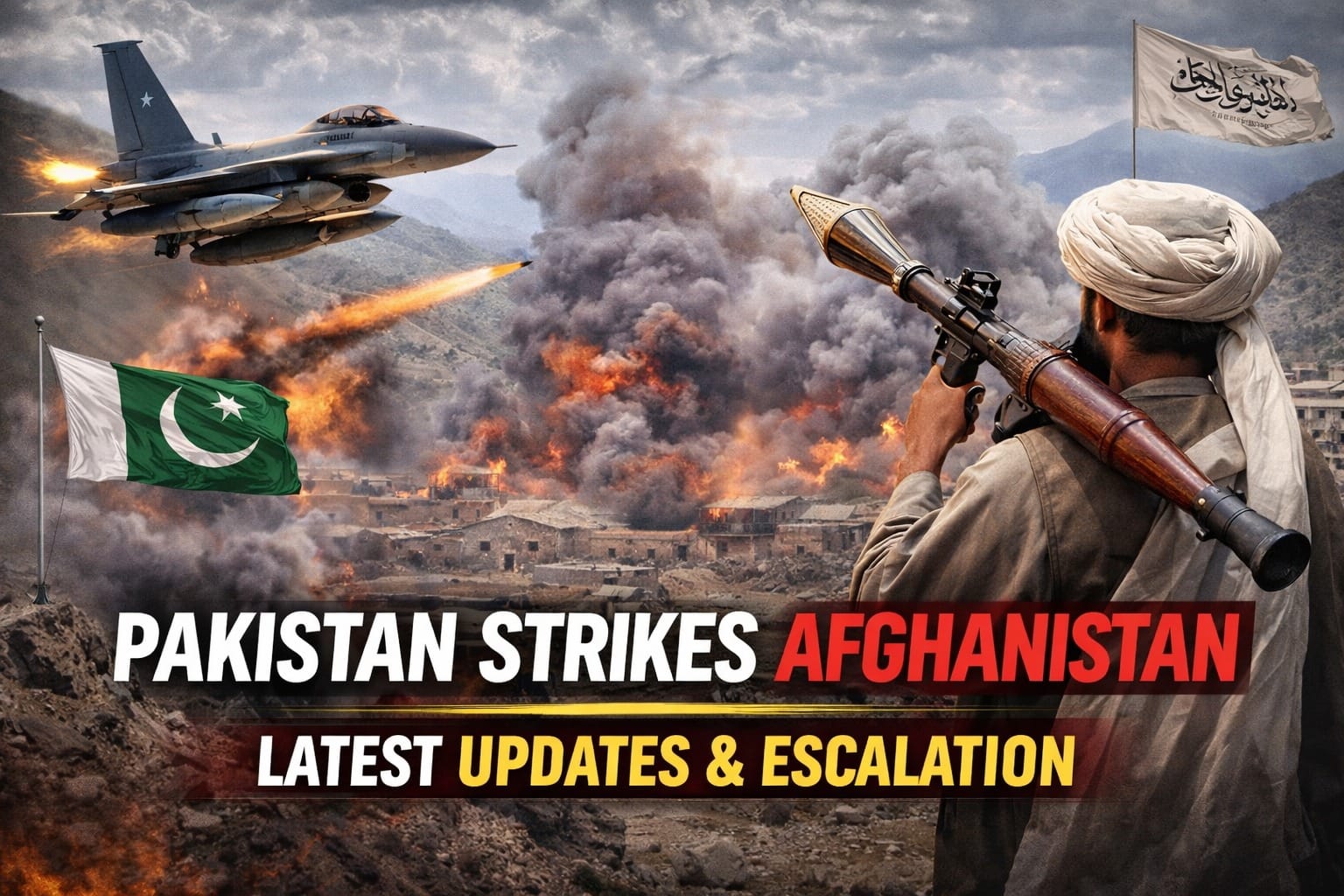
Pakistan Strikes Afghanistan
Tensions between Pakistan and Afghanistan have escalated sharply following recent cross-border airstrikes carried out by Pakistan inside Afghan territory, reportedly targeting militant hideouts along the volatile border region. The strikes, which Afghan authorities say killed dozens of civilians, represent one of the most serious escalations between the two neighbours since the Taliban returned to power in Kabul in 2021.
Pakistan maintains that the strikes were necessary for national security after a wave of deadly militant attacks, while Afghanistan has condemned them as violations of sovereignty and alleged civilian targeting.
This article provides a complete fact-checked analysis including:
- Latest developments
- Reasons behind the strikes
- Afghanistan’s response
- Pakistan’s strategy
- Historical context
- 5W framework (Who, What, When, Where, Why)
Also read – Operation Herof: Inside Story & History of Balochistan
Latest Updates: Pakistan Airstrikes Inside Afghanistan
Pakistan launches cross-border strikes
Pakistan conducted targeted airstrikes along the Afghanistan border, claiming the operations were intelligence-based and aimed at militant camps belonging to the Tehreek-e-Taliban Pakistan (TTP) and other extremist groups.
According to Pakistani officials:
- Strikes targeted multiple militant hideouts
- Operations were retaliation for recent suicide bombings
- Militant infrastructure across the border posed direct threats
Pakistan’s Information Minister confirmed that the action followed several attacks during Ramadan attributed to Afghan-based militants.
Afghan civilian casualties reported
Afghanistan’s Taliban government strongly condemned the strikes, stating that dozens of civilians, including women and children, were killed and injured in Nangarhar and Paktika provinces.
Reports indicate:
- Residential areas were hit
- A madrassa was among targets
- Casualties exceeded 20 in some locations
Afghan authorities accused Pakistan of bombing civilian sites and warned of a response.
Trigger: Surge in militant attacks in Pakistan
The strikes followed a series of deadly attacks inside Pakistan, including:
- Suicide bombing in Bajaur killing 11 soldiers and a child
- Attack in Bannu killing two soldiers
- Rise in insurgent activity linked to TTP
Pakistan accuses militants operating from Afghan territory of orchestrating these attacks.
Why Pakistan Struck Afghanistan
1. Cross-border militant safe havens
Pakistan claims Afghan soil is being used as a sanctuary for:
- Tehreek-e-Taliban Pakistan (TTP)
- Islamic State affiliates
- Other insurgent groups
Islamabad argues Kabul has failed to curb militant activities, prompting unilateral action.
2. Retaliation for recent suicide attacks
The February 2026 Bajaur attack, claimed by TTP, intensified pressure on Pakistan’s military to respond.
3. Domestic political pressure
Pakistan’s government faces rising criticism over deteriorating security conditions and militant resurgence.
4. Strategic deterrence
The strikes signal Pakistan’s willingness to conduct cross-border operations to deter militant threats.
Afghanistan’s Response
Strong condemnation
Afghanistan’s Taliban government condemned the strikes as:
- Violation of sovereignty
- Targeting civilians
- Attempt to deflect Pakistan’s internal security failures
Afghan officials warned of an “appropriate response” at a suitable time.
Denial of militant shelter allegations
Kabul denies harbouring TTP fighters and insists Pakistan must address internal security challenges independently.
Diplomatic tensions
Pakistan summoned Afghan diplomats after attacks, further straining relations.
Pakistan’s Strategy and Objectives
Pakistan’s approach appears multi-layered:
Security objective
Neutralize militant bases threatening Pakistan.
Political objective
Pressure Afghanistan to take action against TTP.
Military objective
Demonstrate cross-border strike capability.
Diplomatic objective
Justify strikes under counter-terrorism framework.
History of Pakistan–Afghanistan Strikes and Border Conflict
1. Long-standing Durand Line dispute
The two countries share a 2,600-km porous border, often contested and poorly controlled.
2. Rise of TTP after Taliban takeover (2021)
Pakistan saw a surge in attacks after the Taliban returned to power, with militants allegedly relocating across the border.
3. Major recent incidents
2025 North Waziristan clashes
71 militants killed during infiltration attempts along the border.
2024–2025 Bannu attacks
Militant attacks linked to Afghan-based groups triggered retaliatory operations.
October 2025 cross-border clashes
Deadly fighting between forces led to temporary ceasefire efforts.
4. Pakistan’s counter-terrorism operations
Pakistan has conducted extensive anti-terror campaigns such as Operation Radd-ul-Fasaad targeting extremist networks linked to Afghanistan.
5W Analysis of the Strikes
Who
Pakistan Air Force targeting suspected militant groups operating near the Afghanistan border.
What
Cross-border airstrikes on alleged terrorist camps, resulting in militant and civilian casualties.
When
February 2026, following a surge in militant attacks inside Pakistan.
Where
Eastern Afghan provinces including Nangarhar and Paktika.
Why
Retaliation against cross-border militant attacks and pressure on Afghanistan to curb insurgent safe havens.
Regional and Global Implications
1. Escalation risk
The strikes increase the possibility of retaliatory action by Afghanistan.
2. Humanitarian concerns
Civilian casualties raise human rights and international law questions.
3. Trade and refugee impact
Border closures disrupt trade and migration flows.
4. Geopolitical implications
The conflict affects regional security dynamics involving China, Iran, and Central Asia.
Security Landscape: Militancy in Pakistan
Pakistan experienced its deadliest year in a decade in 2025 due to rising militant activity.
The resurgence includes:
- TTP insurgency
- ISIS-K presence
- Sectarian violence
Diplomatic Outlook
Possible scenarios
1. Escalation
Retaliatory strikes or border clashes.
2. Negotiations
Qatar- or Saudi-mediated talks.
3. Prolonged low-intensity conflict
Continued cross-border strikes without full war.
Expert Analysis
Analysts view the strikes as part of Pakistan’s broader doctrine of cross-border counter-terror operations similar to India’s surgical strike strategy.
However, critics warn that civilian casualties may fuel anti-Pakistan sentiment and destabilize the region.
Conclusion
Pakistan’s recent strikes inside Afghanistan mark a dangerous escalation in an already fragile relationship shaped by militant insurgency, border disputes, and geopolitical tensions.
While Pakistan frames the strikes as necessary counter-terrorism measures, Afghanistan’s condemnation and allegations of civilian casualties highlight the complexity of the conflict.
The future trajectory will depend on diplomatic engagement, counter-terror cooperation, and whether both countries can prevent the conflict from escalating into broader regional instability.
Subscribe to our YouTube Channel The Logic Stick for more video insights